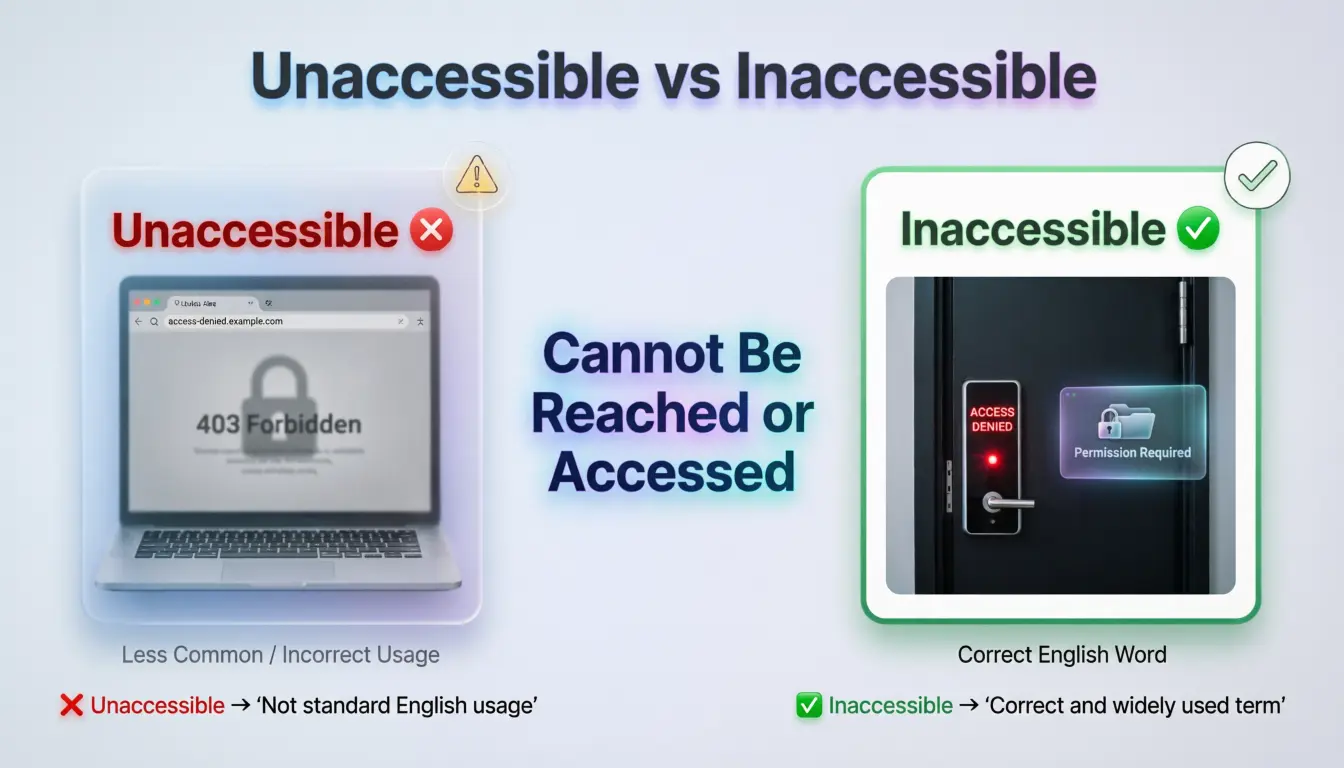
“Inaccessible” is the correct and standard spelling, while “unaccessible” is a nonstandard variant and generally considered incorrect in modern English. “Inaccessible” means not able to be reached, entered, or obtained.
Have you ever written the word unaccessible and wondered if it was correct? You are not alone. Many English learners, students, writers, and professionals search for unaccessible vs inaccessible because both words seem logical. After all, the prefix un- is commonly used to create opposites, so unaccessible appears reasonable at first glance.
However, English spelling and word formation do not always follow simple patterns. Some words become standard through long-term usage, while others remain rare or are considered incorrect by modern style guides.
Understanding the difference between unaccessible vs inaccessible can help you write more clearly and avoid mistakes in academic papers, business documents, emails, and online content. It also improves your credibility because correct spelling shows attention to detail.
In this guide, you’ll learn which spelling is correct, where these words come from, how British and American English treat them, and which version you should use in different situations. You’ll also find examples, comparison tables, exercises, quizzes, and FAQs to help you master the topic.
Unaccessible vs Inaccessible – Quick Answer
Inaccessible is the correct and widely accepted spelling.
Unaccessible exists in some dictionaries as a rare variant, but it is uncommon and generally avoided in modern English.
Examples
✅ The mountain village was inaccessible during winter.
✅ The website became inaccessible after the server failed.
❌ The mountain village was unaccessible during winter.
❌ The website became unaccessible after the server failed.
For almost all writing situations, choose inaccessible.
The Origin of Unaccessible vs Inaccessible
The word accessible comes from the Latin word accessibilis, meaning “able to be approached” or “easy to reach.”
English often forms negatives using prefixes such as:
- in-
- un-
- im-
- ir-
- il-
The prefix in- became attached to accessible, creating inaccessible. Over time, this form became the accepted standard.
Although unaccessible occasionally appeared in historical texts, it never gained the same level of acceptance. Modern dictionaries, style guides, publishers, and educational institutions overwhelmingly prefer inaccessible.
This is why inaccessible remains the dominant spelling today.
British English vs American English Spelling
Unlike many spelling differences between British and American English, there is no significant regional disagreement here.
Both British and American English prefer inaccessible.
Comparison Table
| Meaning | British English | American English | Preferred? |
| Not reachable | inaccessible | inaccessible | ✅ Yes |
| Not obtainable | inaccessible | inaccessible | ✅ Yes |
| Rare variant | unaccessible | unaccessible | ❌ Rare |
Examples
British English
- The remote island remained inaccessible after the storm.
American English
- The road became inaccessible because of flooding.
In both varieties of English, inaccessible is the recommended spelling.
Which Spelling Should You Use?
Your audience determines many language choices, but not this one.
For US Audiences
Use inaccessible.
For UK Audiences
Use inaccessible.
For Australia, Canada, New Zealand, and Other Commonwealth Countries
Use inaccessible.
For International Audiences
Use inaccessible because it is universally recognized.
Quick Recommendation
| Audience | Recommended Spelling |
| United States | inaccessible |
| United Kingdom | inaccessible |
| Canada | inaccessible |
| Australia | inaccessible |
| Global Audience | inaccessible |
Common Mistakes with Unaccessible vs Inaccessible
Many writers make these errors:
Mistake 1: Assuming “un-” Works Everywhere
❌ unaccessible
✅ inaccessible
Not every adjective takes the prefix un-.
Mistake 2: Trusting Spellcheck Too Much
Some tools may not flag unaccessible because it exists as a rare variant.
However, professional editors still prefer inaccessible.
Mistake 3: Mixing Forms
❌ The file was unaccessible and inaccessible.
✅ The file was inaccessible.
Choose one form consistently.
Mistake 4: Using Rare Variants in Formal Writing
Academic and professional writing should use the standard form.
✅ inaccessible
Unaccessible vs Inaccessible in Everyday Examples
“The report is currently inaccessible because the server is down.”
News
“Several rural communities became inaccessible after heavy snowfall.”
Social Media
“The website is still inaccessible. Anyone else having this problem?”
Formal Writing
“The archive remained inaccessible to researchers during renovations.”
Academic Writing
“The original source was inaccessible at the time of the study.”
Business Communication
“Customer records became temporarily inaccessible during maintenance.”
Unaccessible vs Inaccessible – Google Trends & Usage Data
Usage data consistently shows that inaccessible is vastly more common than unaccessible.
Popular Regions
- United States
- United Kingdom
- Canada
- Australia
- India
Across these countries, inaccessible dominates books, newspapers, websites, academic journals, and business documents.
Common Contexts
Inaccessible frequently appears in:
- Technology
- Education
- Healthcare
- Government reports
- News articles
- Academic research
Unaccessible appears only occasionally and is considered uncommon.
Comparison Table: Keyword Variations
| Variation | Status | Recommended |
| inaccessible | Standard spelling | ✅ Yes |
| unaccessible | Rare variant | ❌ No |
| inaccessible website | Common phrase | ✅ Yes |
| inaccessible location | Common phrase | ✅ Yes |
| inaccessible data | Common phrase | ✅ Yes |
Unaccessible vs Inaccessible in Academic Writing
Academic institutions strongly prefer inaccessible.
Examples:
“The primary manuscript was inaccessible during the research period.”
Reasons academics choose inaccessible:
- Standardized spelling
- Accepted by journals
- Recognized internationally
- Preferred by editors
Avoid unaccessible in essays, dissertations, and research papers.
Unaccessible vs Inaccessible in Business English
Business communication values clarity and consistency.
Examples
- The database is currently inaccessible.
- Certain documents remain inaccessible to external users.
- The client portal became inaccessible after the update.
Using the standard spelling helps maintain professionalism.
Common Style Guide Recommendations
| Style Guide | Recommendation |
| AP Style | inaccessible |
| Chicago Manual of Style | inaccessible |
| APA Style | inaccessible |
| MLA Style | inaccessible |
| Oxford Style | inaccessible |
Major style guides overwhelmingly favor inaccessible.
Real Examples from Published Sources
News Example
“The area remained inaccessible after severe flooding.”
Government Example
“Certain records are inaccessible to the public.”
Academic Example
“Some historical documents were inaccessible during analysis.”
Technology Example
“The service became inaccessible due to network issues.”
These examples show the standard spelling used in professional publications.
Quick Quiz
Choose the correct answer.
1. Which spelling is standard?
A. Unaccessible
B. Inaccessible
✅ Answer: B
2. Which spelling is preferred in academic writing?
A. Inaccessible
B. Unaccessible
✅ Answer: A
3. Which spelling is more common worldwide?
A. Inaccessible
B. Unaccessible
✅ Answer: A
4. Which form do major style guides recommend?
A. Unaccessible
B. Inaccessible
✅ Answer: B
5. Which version should you use in business communication?
A. Inaccessible
B. Unaccessible
✅ Answer: A
Fill in the Blanks Exercise
Complete each sentence using the correct word.
- The road became __________ after the landslide.
Answer: inaccessible
- The online portal was temporarily __________.
Answer: inaccessible
- Several archives remained __________ to researchers.
Answer: inaccessible
- The mountain village was nearly __________ during winter.
Answer: inaccessible
- The company’s records became __________ after the outage.
Answer: inaccessible
FAQs
1. Is unaccessible a real word?
Yes, it exists as a rare variant, but it is uncommon and rarely recommended.
2. Which is correct: unaccessible or inaccessible?
Inaccessible is the standard and preferred spelling.
3. Do Americans use unaccessible?
Very rarely. American English overwhelmingly prefers inaccessible.
4. Do British people use unaccessible?
Rarely. British English also favors inaccessible.
5. Can I use unaccessible in formal writing?
It is better to avoid it and use inaccessible instead.
6. Why is inaccessible more common?
Historical usage and language standardization made inaccessible the accepted form.
7. Is unaccessible grammatically wrong?
Not entirely, but it is considered nonstandard and uncommon.
8. Which spelling should students use?
Students should always use inaccessible.
9. Which spelling appears in dictionaries?
Most dictionaries list inaccessible as the primary form, while some mention unaccessible as a rare variant.
Conclusion
The debate over unaccessible vs inaccessible is simpler than many spelling questions in English. While both forms have appeared in the language, inaccessible is the clear winner in modern usage. It is the spelling preferred by dictionaries, educators, publishers, style guides, businesses, and academic institutions.
The word comes from the Latin root behind accessible and follows a long-established pattern that English speakers recognize immediately. Although unaccessible is not completely unknown, it is rare enough that many readers may view it as a mistake. For that reason, using inaccessible is the safest and most professional choice.
If you are writing an email, preparing a business report, publishing a blog post, completing a school assignment, or creating academic research, inaccessible will be understood and accepted by your audience. It works consistently across British English, American English, and other varieties of English worldwide.
When in doubt, remember this simple rule: Use inaccessible, not unaccessible. Doing so will make your writing clearer, more professional, and easier for readers to trust.

I hold a degree in English Literature and Linguistics and have worked extensively on educational blogs, comparison websites, and digital learning platforms. My writing focuses on simplifying complex language rules, highlighting British vs American English differences, and providing practical examples for everyday usage.