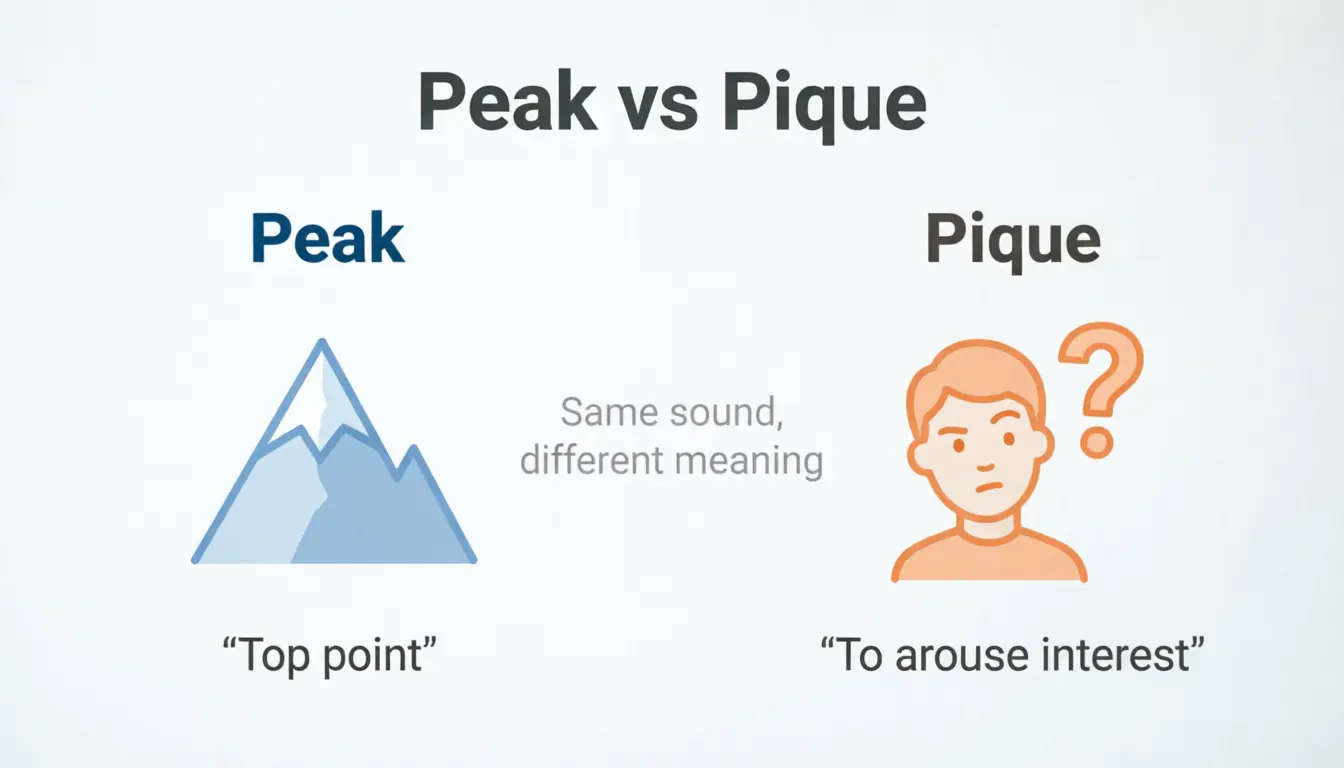
“Peak” is a noun or verb referring to the highest point or maximum level, while “pique” is a verb meaning to arouse interest, curiosity, or irritation.
Many English words sound the same but mean very different things. Peak and pique are perfect examples. They are often confused because they sound alike, but they have different meanings and uses.
People search for “peak or pique” because they want to know which spelling is correct in phrases like peak my interest or pique my interest. This confusion is very common in emails, blogs, social media posts, and even professional writing.
The truth is simple: both words are correct, but they are not interchangeable.
Using the wrong word can change your meaning and make your writing look less polished. That is why understanding the difference matters.
In this guide, you will learn the meaning of peak and pique, where these words came from, how British and American English use them, common mistakes, real-life examples, and how to choose the right one.
By the end, you will never mix up peak or pique again.
Peak or Pique – Quick Answer
The quick answer is:
- Peak = the highest point
- Pique = to arouse interest or irritation
Example:
✅ The athlete reached the peak of his career.
✅ The story piqued my interest.
Wrong example:
❌ The story peaked my interest.
✔ The story piqued my interest.
Easy trick to remember:
- Peak = top of a mountain
- Pique = interest starts
So if you mean “interest,” use pique.
If you mean “highest point,” use peak.
The Origin of Peak or Pique
Understanding word history makes the difference easier.
Origin of Peak
The word peak comes from Middle English and old mountain-related terms. It has always meant a pointed top or highest point.
Examples:
- mountain peak
- peak season
- peak performance
Over time, it also became a verb:
- Sales peaked in July.
This means something reached its highest level.
Origin of Pique
The word pique comes from French piquer, meaning “to prick” or “stimulate.”
That is why pique means:
- to create interest
- to excite curiosity
- to irritate someone
Examples:
- The mystery piqued her curiosity.
- His rude words piqued her anger.
The spelling stayed French, which makes it look unusual in English.
British English vs American English Spelling
Good news: there is no major spelling difference between British and American English for these words.
Both use:
- Peak
- Pique
The confusion is about meaning, not region.
British English Examples
- Holiday travel is at its peak.
- The book piqued my curiosity.
American English Examples
- Demand hit its peak last week.
- The ad piqued consumer interest.
Comparison Table
| Word | Meaning | British English | American English |
| Peak | Highest point | Peak | Peak |
| Peak (verb) | Reach highest level | Peak | Peak |
| Pique | Spark interest | Pique | Pique |
| Pique (verb) | Irritate | Pique | Pique |
So both countries follow the same spelling rules.
Which Spelling Should You Use?
Your choice depends on meaning.
Use Peak if:
You mean:
- highest point
- top level
- maximum amount
Examples:
- This is the peak of summer.
- She is at the peak of success.
Best for:
- business writing
- reports
- sports
- news
Use Pique if:
You mean:
- create interest
- spark curiosity
- annoy someone
Examples:
- The topic piqued my interest.
- His comment piqued her.
Best for:
- storytelling
- marketing
- blogs
- formal writing
Audience-Based Advice
| Audience | Best Choice |
| US readers | Use based on meaning |
| UK readers | Use based on meaning |
| Commonwealth readers | Use based on meaning |
| Global readers | Use the correct meaning |
The rule is universal.
Common Mistakes with Peak or Pique
These mistakes happen often.
Mistake 1: Peak my interest
❌ That article peaked my interest.
✔ That article piqued my interest.
Why? Because interest is being created.
Mistake 2: Pique performance
❌ She is at her pique performance.
✔ She is at her peak performance.
Why? Because it means highest level.
Mistake 3: Sales piqued last month
❌ Sales piqued last month.
✔ Sales peaked last month.
Why? Because sales reached a high point.
Mistake 4: Peaked curiosity
❌ The movie peaked my curiosity.
✔ The movie piqued my curiosity.
Again, curiosity uses pique.
Peak or Pique in Everyday Examples
Here is how people use them daily.
Emails
Correct:
- Your proposal piqued my interest.
- We are in the peak sales season.
News
Correct:
- Oil prices reached their peak.
- The case piqued public interest.
Social Media
Correct:
- This trailer really piqued my curiosity.
- Summer travel is at its peak.
Formal Writing
Correct:
- Productivity reached its peak in Q4.
- The research piqued scientific interest.
Marketing
Correct:
- The campaign piqued customer interest.
- Demand hit its peak during holidays.
Peak or Pique – Google Trends & Usage Data
Search data shows both words are popular, but for different reasons.
Peak is searched more often because it has wider use:
- business
- sports
- weather
- travel
Common countries:
- USA
- UK
- Canada
- Australia
Pique is searched less but often appears in phrases like:
- pique interest
- pique curiosity
Common countries:
- USA
- UK
- India
Why?
Because many people type peak my interest by mistake when they mean pique my interest.
Context matters more than popularity.
Peak vs Pique Comparison Table
| Feature | Peak | Pique |
| Part of speech | Noun/Verb | Verb/Noun |
| Meaning | Highest point | Stimulate interest |
| Common phrase | Peak season | Pique interest |
| Related to height? | Yes | No |
| Related to curiosity? | No | Yes |
| Formal writing | Yes | Yes |
FAQs About Peak or Pique
1. Is it peak my interest or pique my interest?
The correct phrase is pique my interest.
2. What does peak mean?
It means the highest point.
Example: mountain peak.
3. What does pique mean?
It means to spark interest or curiosity.
4. Why do people confuse peak and pique?
Because they sound the same.
5. Is peak my curiosity wrong?
Yes. The correct phrase is pique my curiosity.
6. Can peak be used as a verb?
Yes.
Example: Sales peaked in winter.
7. Can pique mean anger?
Yes.
Example: His words piqued her.
8. Is pique formal?
Yes. It is common in formal and casual writing.
Conclusion
The difference between peak or pique is simple once you know the meaning.
Use peak when talking about the highest point, best level, or maximum amount. Think of a mountain peak or peak performance. It is about reaching the top.
Use pique when talking about creating interest, curiosity, or even mild anger. The common phrase is always pique my interest, not peak my interest.
The confusion happens because both words sound the same. But their meanings are very different.
A simple memory trick helps:
Peak = top
Pique = spark
This small spelling choice can make your writing clearer and stronger. If you write emails, reports, articles, or social media posts, choosing the right word shows skill and attention to detail.
Next time you stop and wonder about peak or pique, remember the meaning first. That will always guide you to the correct spelling.

I am an Emily Carter Brooks U.S.A based linguistics writer known for my clear, reader-friendly explanations of English grammar and vocabulary differences. I have contributed to multiple online language resources and specializes in spelling variations, pronunciation confusion, and British vs American English comparisons. I’m passionate about helping learners improve their English through practical, everyday communication. engaging, and stress-free.