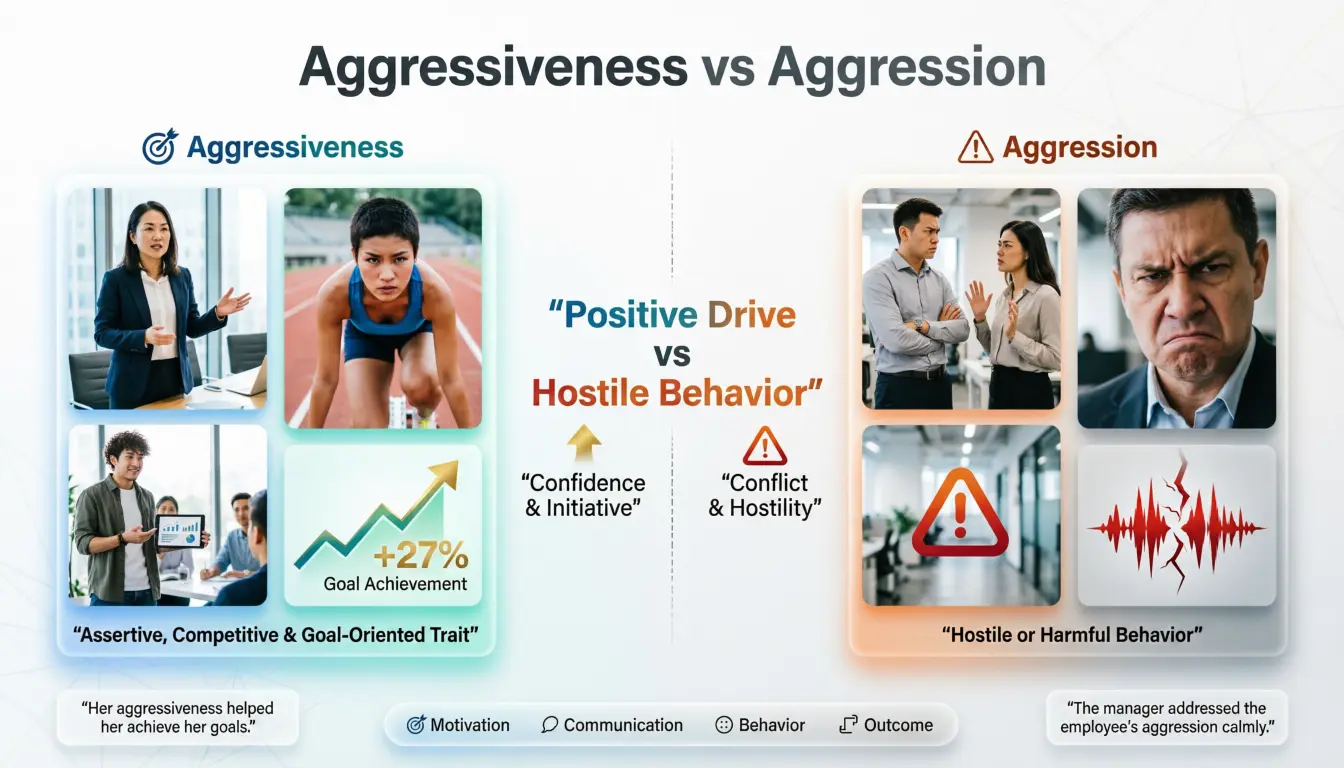
“Aggressiveness” and “aggression” are related words, but they are not interchangeable in every context. Aggressiveness refers to the quality, tendency, or style of being aggressive, while aggression refers to actual hostile, forceful, or attacking behavior or actions.
Have you ever wondered if you should use aggressiveness or aggression? Many English learners and even native speakers confuse these two words because they both come from the same root and relate to forceful behavior. However, they do not always mean the same thing.
Understanding the difference between aggressiveness vs aggression helps you write more clearly, speak more naturally, and avoid common mistakes. While the words are closely related, one usually describes a personality trait, and the other often describes an action or behavior.
Knowing when to use each word makes your communication more accurate in school, business, sports, psychology, and everyday conversations.
In this guide, you’ll learn the meanings, origins, grammar, examples, and practical differences between these two terms. You’ll also find comparison tables, writing tips, real-world examples, quizzes, exercises, FAQs, and style recommendations. By the end, you’ll know exactly which word fits your sentence.
Aggressiveness vs Aggression – Quick Answer
Aggressiveness is the quality or personality trait of being aggressive.
Aggression is the act, behavior, or expression of being aggressive.
Simple Examples
✅ Aggressiveness
- Her aggressiveness helped her win the debate.
- The coach admired the player’s aggressiveness on the field.
Here, the word describes someone’s attitude or character.
✅ Aggression
- The dog showed aggression toward strangers.
- The teacher stopped the aggression between the students.
Here, the word refers to an action or hostile behavior.
Quick Rule
| Word | Meaning | Best Used For |
| Aggressiveness | A personality trait or level of assertiveness | Describing character |
| Aggression | A hostile action or behavior | Describing actions or conflict |
Easy way to remember:
- Aggressiveness = quality
- Aggression = behavior
The Origin of Aggressiveness vs Aggression
Both words come from the Latin word aggredi, which means “to approach,” “to attack,” or “to move toward.”
Over time, English developed different forms of the same root.
Aggression
The noun aggression entered English first. It described attacks, hostile acts, and later emotional or psychological behavior.
Examples include:
- military aggression
- verbal aggression
- physical aggression
Aggressiveness
The word aggressiveness developed later by adding the suffix -ness to the adjective aggressive.
The suffix -ness turns an adjective into a noun that describes a quality.
Examples:
- kindness
- happiness
- politeness
- aggressiveness
This is why aggressiveness usually refers to a person’s level of aggressive behavior rather than one specific act.
Why People Confuse Them
The words:
- have the same root
- sound similar
- relate to aggressive behavior
However, grammar gives each word a different role.
- Aggression = action
- Aggressiveness = characteristic
British English vs American English Spelling
Unlike words such as analysed/analyzed or colour/color, aggressiveness and aggression have exactly the same spelling in both British English and American English.
There are no spelling differences between the two varieties of English.
The only difference is how speakers choose to use the words depending on context.
British English Examples
- The player’s aggressiveness impressed the coach.
- The government condemned military aggression.
American English Examples
- Her aggressiveness helped close the deal.
- The child showed signs of aggression.
Both versions are completely correct.
British vs American Comparison Table
| Feature | British English | American English |
| Aggressiveness | ✅ Same spelling | ✅ Same spelling |
| Aggression | ✅ Same spelling | ✅ Same spelling |
| Meaning | Same | Same |
| Grammar | Same | Same |
| Pronunciation | Nearly identical | Nearly identical |
Conclusion: There is no UK vs US spelling difference for these words.
Which Spelling Should You Use?
Since there is no spelling difference, your choice depends on meaning, not location.
Choose aggressiveness when talking about:
- personality
- attitude
- competitiveness
- confidence
- personal style
Examples:
- Her aggressiveness made her a strong negotiator.
- The team needed more aggressiveness.
Choose aggression when discussing:
- violence
- attacks
- conflict
- hostile actions
- harmful behavior
Examples:
- The police investigated the aggression.
- Verbal aggression hurts relationships.
Audience-Based Advice
| Audience | Recommended Choice |
| US readers | Use the word that matches the meaning. |
| UK readers | Use the word that matches the meaning. |
| Australia | Same usage. |
| Canada | Same usage. |
| International audience | Focus on meaning, not spelling. |
No matter where your audience lives, the distinction is semantic rather than regional.
Aggressiveness vs Aggression Comparison Table
| Feature | Aggressiveness | Aggression |
| Part of speech | Noun | Noun |
| Main meaning | Quality or trait | Action or behavior |
| Refers to | Personality | Hostile act |
| Common in sports | Yes | Sometimes |
| Common in psychology | Yes | Very common |
| Often positive? | Sometimes | Rarely |
| Often negative? | Sometimes | Usually |
| Example | His aggressiveness impressed everyone. | His aggression frightened everyone. |
Common Mistakes with Aggressiveness vs Aggression
Because these words are closely related, many writers use them interchangeably. However, each has a different purpose. Using the correct word makes your writing more precise.
Mistake 1: Using Aggression for a Personality Trait
❌ Incorrect: Her aggression helped her become a successful salesperson.
✅ Correct: Her aggressiveness helped her become a successful salesperson.
Why? The sentence describes a personal quality, not a hostile action.
Mistake 2: Using Aggressiveness for a Violent Act
❌ Incorrect: The police responded to the aggressiveness.
✅ Correct: The police responded to the aggression.
Why? The sentence refers to an actual incident or behavior.
Mistake 3: Assuming One Word Is Always Negative
Many people think aggressiveness is always bad.
In reality, it can have a positive meaning.
Examples:
- Sales aggressiveness
- Competitive aggressiveness
- Marketing aggressiveness
- Athletic aggressiveness
These often describe confidence and determination rather than hostility.
Mistake 4: Forgetting the Context
Always ask yourself:
- Am I describing a person’s character? → Aggressiveness
- Am I describing an action or attack? → Aggression
Aggressiveness vs Aggression in Everyday Examples
Here are examples from different situations.
In Emails
Aggressiveness
We appreciate your aggressiveness in finding new clients.
Aggression
Please avoid aggression during workplace discussions.
In News Reports
Aggressiveness
Analysts praised the company’s aggressiveness in expanding into new markets.
Aggression
International leaders condemned the military aggression.
On Social Media
Aggressiveness
I love her aggressiveness during the match!
Aggression
Online aggression has become a serious problem.
In Formal Writing
Aggressiveness
The research measured competitive aggressiveness among participants.
Aggression
The study examined physical aggression in young adults.
Sports
- The coach wanted more aggressiveness from the defense.
- The referee penalized the player’s aggression.
Business
- Their market aggressiveness increased sales.
- Hostile aggression between competitors damaged negotiations.
In Psychology
- Competitive aggressiveness can motivate success.
- Uncontrolled aggression may require behavioral treatment.
Aggressiveness vs Aggression – Google Trends & Usage Data
Search interest shows that both words are widely used, but in different contexts.
Aggression
The word aggression is searched much more often because it appears in:
- psychology
- education
- law
- medicine
- international relations
- news reports
People often search for:
- verbal aggression
- passive aggression
- physical aggression
- military aggression
Aggressiveness
The word aggressiveness is less common but still important.
It frequently appears in:
- sports
- business
- leadership
- marketing
- personality studies
- management
Common searches include:
- sales aggressiveness
- competitive aggressiveness
- aggressiveness meaning
- aggressiveness in business
Popular Countries
Both words are commonly searched in:
- United States
- United Kingdom
- Canada
- Australia
- India
English learners around the world also search for these terms to understand the difference in meaning.
Comparison Table: Aggressiveness vs Aggression
| Feature | Aggressiveness | Aggression |
| Meaning | Quality or personality trait | Action or hostile behavior |
| Tone | Can be positive or negative | Usually negative |
| Used in Sports | Very common | Common |
| Used in Psychology | Common | Very common |
| Used in Business | Common | Less common |
| Used in News | Less common | Very common |
| Refers to Personality | Yes | No |
| Refers to Actions | Sometimes | Yes |
Aggressiveness vs Aggression in Academic Writing
Academic writing values precision. Choosing the correct word helps readers understand your point.
Use aggressiveness when discussing a measurable trait, personality characteristic, or strategy.
Examples:
- The study measured aggressiveness among professional athletes.
- Competitive aggressiveness was linked to higher performance.
Use aggression when referring to observable behavior or conflict.
Examples:
- Researchers examined verbal aggression in classroom settings.
- The experiment focused on physical aggression in adolescents.
Academic Tip
In research papers, use the word that accurately reflects what was measured:
- Trait → Aggressiveness
- Behavior → Aggression
Aggressiveness vs Aggression in Business English
Both words appear in business writing, but they have different meanings.
Aggressiveness
Usually has a positive meaning.
Examples:
- aggressive marketing
- sales aggressiveness
- competitive aggressiveness
- investment aggressiveness
Example sentence:
The company’s aggressiveness helped it gain market share.
Aggression
Usually describes conflict or unacceptable conduct.
Examples:
- workplace aggression
- customer aggression
- verbal aggression
- aggressive behavior
Example sentence:
The company introduced policies to reduce workplace aggression.
Business Tip: When praising ambition or determination, use aggressiveness. When discussing harmful conduct, use aggression.
Common Style Guide Recommendations
Most major English style guides and dictionaries treat aggressiveness and aggression as separate words with different meanings rather than interchangeable synonyms.
| Style Guide | Recommendation |
| APA Style | Use the word that best matches the psychological concept being discussed. |
| Chicago Manual of Style | Follow standard dictionary meanings and maintain consistency. |
| MLA Style | Choose the term that fits the context and intended meaning. |
| Oxford Dictionary | Defines aggression as hostile behavior and aggressiveness as the quality of being aggressive. |
| Merriam-Webster | Distinguishes between the trait (aggressiveness) and the behavior (aggression). |
General Advice
- Be consistent throughout your document.
- Avoid switching between the two words unless the meaning changes.
- Select the term that accurately reflects the context.
Real Examples from Published Sources
Here are examples similar to how these words are commonly used in published writing.
Psychology
Researchers studied childhood aggression and its long-term effects.
Business
The company’s competitive aggressiveness helped increase market share.
Sports
The coach praised the team’s aggressiveness throughout the game.
International News
Leaders condemned the country’s military aggression.
Education
Schools are developing programs to reduce student aggression while encouraging healthy competitiveness.
Aggressiveness vs Aggression Quiz
Test your understanding by choosing the correct word.
Multiple Choice
1. The coach wanted more ________ from the players.
A. Aggression
B. Aggressiveness ✅
2. The teacher stopped the ________ between the students.
A. Aggression ✅
B. Aggressiveness
3. Her ________ helped her negotiate a better deal.
A. Aggressiveness ✅
B. Aggression
4. The report examined workplace ________.
A. Aggression ✅
B. Aggressiveness
5. Competitive ________ can help businesses grow.
A. Aggressiveness ✅
B. Aggression
Fill in the Blanks Exercise
Choose aggressiveness or aggression to complete each sentence.
- The company admired her __________ in sales.
Answer: aggressiveness - The child showed signs of __________ toward classmates.
Answer: aggression - The athlete’s __________ impressed the coach.
Answer: aggressiveness - Police responded to the reported __________.
Answer: aggression - Healthy __________ can help a business stay competitive.
Answer: aggressiveness - The counselor worked with students to reduce __________.
Answer: aggression - His __________ during negotiations helped close the deal.
Answer: aggressiveness - The study explored the causes of human __________.
Answer: aggression
FAQs
1. What is the difference between aggressiveness and aggression?
Aggressiveness is the quality or personality trait of being aggressive, while aggression refers to hostile actions or behavior. The first describes character, and the second describes conduct.
2. Can aggressiveness be positive?
Yes. In sports, business, leadership, and sales, aggressiveness often means confidence, determination, or a willingness to take initiative. It does not always have a negative meaning.
3. Is aggression always negative?
Most of the time, yes. Aggression usually refers to harmful, hostile, or violent behavior, although some academic contexts use it neutrally to describe a type of behavior.
4. Are aggressiveness and aggression interchangeable?
No. Although they are related, they have different meanings. Use aggressiveness for a trait or quality and aggression for an action or behavior.
5. Which word is more common?
Aggression is more common in everyday English because it appears frequently in psychology, education, healthcare, law, and news reports. Aggressiveness is more common in sports, business, and leadership discussions.
6. Is there a British and American spelling difference?
No. Both aggressiveness and aggression are spelled the same in British English and American English. The difference lies in meaning, not spelling.
7. Which word should I use in academic writing?
Choose the word that matches your subject:
- Use aggressiveness when discussing a measurable personality trait or characteristic.
- Use aggression when discussing observable behavior, conflict, or hostile actions.
8. How can I remember the difference easily?
A simple trick is:
- Aggressiveness = quality or trait
- Aggression = action or behavior
If you’re describing who someone is, use aggressiveness. If you’re describing what someone did, use aggression.
Conclusion
Understanding the difference between aggressiveness vs aggression helps you communicate with greater clarity and confidence. Although both words come from the same root and relate to forceful behavior, they serve different purposes. Aggressiveness refers to a person’s quality, attitude, or level of determination, while aggression describes a specific hostile action or behavior.
The distinction is important in everyday conversations, academic writing, business communication, psychology, sports, and news reporting. Choosing the right word ensures that your message is accurate and avoids confusion. A salesperson may be praised for their aggressiveness, but an employee should never display aggression toward coworkers. This simple difference changes the meaning of an entire sentence.
Remember that there is no spelling difference between British and American English. Your decision should always depend on the context rather than your audience’s location. Whenever you’re unsure, ask yourself one question: Am I describing a personal trait or an action? If it’s a trait, choose aggressiveness. If it’s an action or behavior, choose aggression. Following this rule will help you use both words correctly in every situation.

I am an Emily Carter Brooks U.S.A based linguistics writer known for my clear, reader-friendly explanations of English grammar and vocabulary differences. I have contributed to multiple online language resources and specializes in spelling variations, pronunciation confusion, and British vs American English comparisons. I’m passionate about helping learners improve their English through practical, everyday communication. engaging, and stress-free.