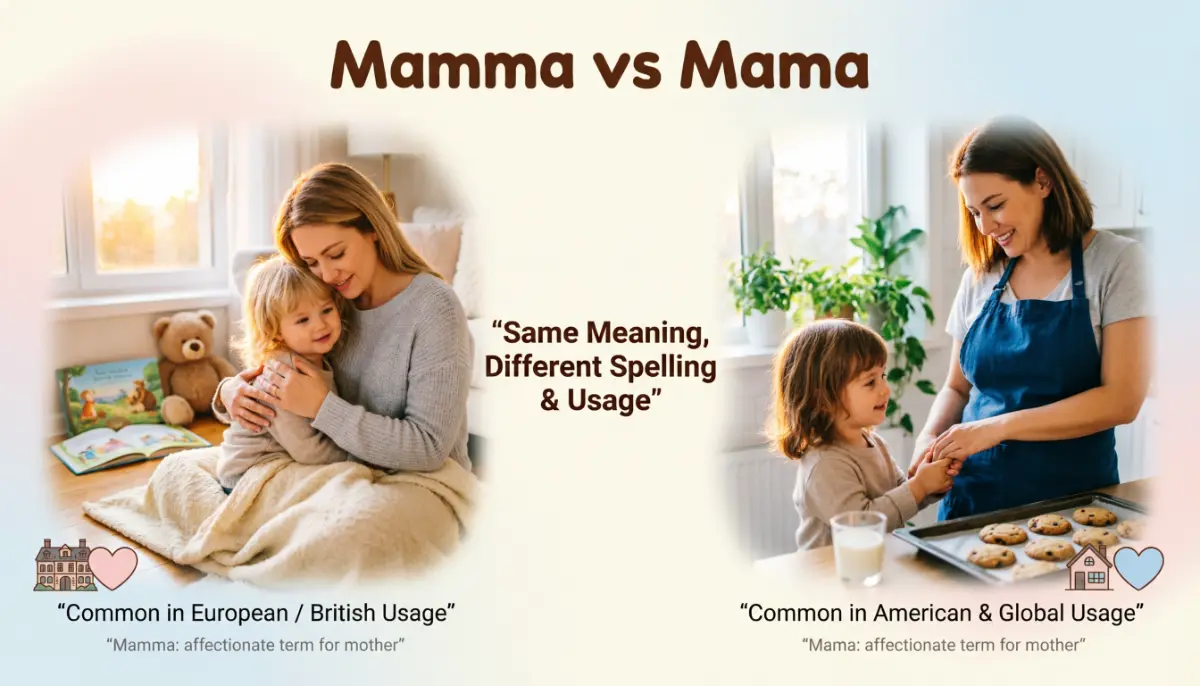
“Mamma” and “mama” are both correct words, but they are used in slightly different contexts and styles. “Mama” is the more common, informal word used in everyday English for mother, while “mamma” is an older or more affectionate variant, often used in British English or literary writing.
The words “mamma” vs “mama” often confuse English learners, writers, and even native speakers. At first glance, they look almost the same, but small spelling changes can lead to different meanings, pronunciations, and cultural usage. Many people search this keyword when they are unsure how to address their mother in writing, when translating informal speech, or when editing text for British or American English standards.
In everyday life, both words are used as affectionate names for “mother,” but their usage depends on region, language influence, and writing style. Some people see “mamma” in older books or British texts, while “mama” appears more often in American English and modern social media. This creates confusion about which one is correct.
This article clears that confusion in a simple way. You will learn the quick meaning, origin, spelling differences, real usage examples, and which form you should use in different situations. By the end, you will clearly understand when to use mamma vs mama without hesitation.
Mamma vs Mama – Quick Answer
Both “mamma” and “mama” mean the same thing: a casual, affectionate word for “mother.”
However, they differ in usage and style:
- Mama → More common in American English and modern informal writing
- Mamma → More common in British English, older texts, and some European influences
Examples:
- “Mama, can you help me?” (US informal speech)
- “Mamma is calling you for dinner.” (UK-style or old-fashioned tone)
Simple rule:
Both are correct, but “mama” is more modern, while “mamma” feels traditional or stylistic.
The Origin of Mamma vs Mama
The words mamma and mama come from early baby speech patterns. Across many languages, babies naturally form “ma” sounds because they are easy to pronounce.
Historical roots:
- Latin: mamma = mother or breast
- Proto-Indo-European languages also used similar “ma” sounds
- Many European languages developed variations like:
- Italian: mamma
- Spanish: mamá
- French: maman
Over time, English adopted both spelling forms:
- Mamma entered older British and literary English
- Mama became more common in simplified modern spelling, especially in the United States
The difference is not about meaning, but about language evolution and regional preference.
British English vs American English Spelling
Even though both words are understood globally, spelling preferences vary.
Key differences:
- British English often preserves traditional or double-letter forms
- American English tends to simplify spelling
Comparison Table:
| Feature | Mama | Mamma |
| Region | USA, modern global use | UK, older texts |
| Style | Simple, modern | Traditional, classic |
| Tone | Casual, friendly | Warm, old-fashioned |
| Usage in books | Very common | Less common today |
| Pronunciation | “mah-mah” | “mam-mah” (slightly stressed) |
Both are correct, but usage depends on tone and audience.
Which Spelling Should You Use?
Choosing between mama vs mamma depends on your audience and writing purpose.
Use “Mama” if:
- You are writing for American readers
- You are posting on social media
- You want a simple, modern tone
- You are writing dialogue or casual text
Use “Mamma” if:
- You are writing in British English style
- You want a traditional or emotional tone
- You are writing literature or poetry
- You are referencing older cultural usage
Global advice:
If you are unsure, “mama” is the safest and most widely accepted option today.
Common Mistakes with Mamma vs Mama
Many users make simple errors when using these words.
Mistake 1: Thinking one is incorrect
❌ “Mamma is wrong”
✔ Both are correct depending on context
Mistake 2: Mixing spelling in one document
❌ “Mama and Mamma are calling me”
✔ “Mama is calling me”
Mistake 3: Using formal tone incorrectly
❌ “Dear Mamma Sir/Madam”
✔ “Dear Mother” or “Dear Mom”
Mistake 4: Overthinking pronunciation
Both words are pronounced almost the same in casual speech.
Mamma vs Mama in Everyday Examples
Let’s see how both words appear in real-life usage:
1. Emails:
- “Hi Mama, I will call you tonight.”
- “Dear Mamma, I hope you are well.”
2. Social Media:
- “Missing my mama today ❤️”
- “Love you always, mamma 💕”
3. Conversations:
- “Mama, where are my keys?”
- “Mamma said dinner is ready.”
4. Story Writing:
- “The child ran to his mamma in tears.”
- “She hugged her mama tightly after school.”
Both versions fit naturally depending on tone.
Mamma vs Mama – Google Trends & Usage Data
Search behavior shows interesting patterns:
- Mama is more searched globally, especially in the United States, Canada, and social media platforms.
- Mamma appears more in literary searches, UK-based content, and historical references.
- Mobile searches often prefer “mama” due to simpler spelling.
- “Mamma” is often used in emotional or nostalgic content.
Key insight:
- “Mama” = modern digital usage
- “Mamma” = traditional and emotional tone
Overall trend shows “mama” is becoming dominant worldwide.
Comparison Table: Mama vs Mamma Variations
| Variation | Meaning | Usage Region | Tone |
| Mama | Mother (informal) | US/global | Modern, simple |
| Mamma | Mother (affectionate) | UK/Europe | Traditional, warm |
| Momma | Slang version | US Southern English | Very casual |
| Mom | Formal-informal blend | US/Canada | Neutral |
| Mum | British English | UK/Commonwealth | Standard |
FAQs About Mamma vs Mama
1. Is “mamma” correct English?
Yes, “mamma” is correct but more traditional and less common today.
2. Is “mama” American or British?
“Mama” is mainly American English but widely used globally now.
3. Do “mamma” and “mama” mean different things?
No, both mean “mother.” Only spelling and tone differ.
4. Which is more modern, mama or mamma?
“Mama” is more modern and widely used in digital communication.
5. Can I use both in writing?
Yes, but avoid mixing both in the same document.
6. Is “mamma” used in formal writing?
Rarely. It is mostly used in poetry, literature, or emotional writing.
7. Why do some languages use “mamma”?
Because many European languages historically adopted similar baby-speech sounds.
8. Is “mama” more popular globally?
Yes, “mama” has higher global usage in modern English.
9. What is the safest choice?
“Mama” is the safest and most universally understood spelling.
Conclusion
The difference between mamma vs mama is simple once you understand it. Both words refer to the same meaning an affectionate name for mother but they differ in style, region, and tone. “Mama” is the modern, widely used version seen in American English and digital communication. It is simple, clean, and globally recognized. On the other hand, “mamma” carries a traditional and emotional tone, often seen in British English, older literature, and poetic writing.
Choosing the right spelling depends on your audience. If you are writing for a global or modern audience, “mama” is the safest choice. If you want a classic or nostalgic feel, “mamma” works well. Neither is wrong, but consistency matters more than preference.
In the end, language is flexible. Both forms reflect love, warmth, and human connection. Understanding their difference helps you write more clearly and naturally in any context without confusion.
Read More Article:
- Present or Gift – Which One Is Correct?
- Hierarchical vs Hierarchal – What’s the Difference and Which Spelling Is Correct?
- Compair vs Compare – Which Spelling Is Correct?
- Remediated vs Remedied – What’s the Difference and Which Word Should You Use?

I am an Emily Carter Brooks U.S.A based linguistics writer known for my clear, reader-friendly explanations of English grammar and vocabulary differences. I have contributed to multiple online language resources and specializes in spelling variations, pronunciation confusion, and British vs American English comparisons. I’m passionate about helping learners improve their English through practical, everyday communication. engaging, and stress-free.