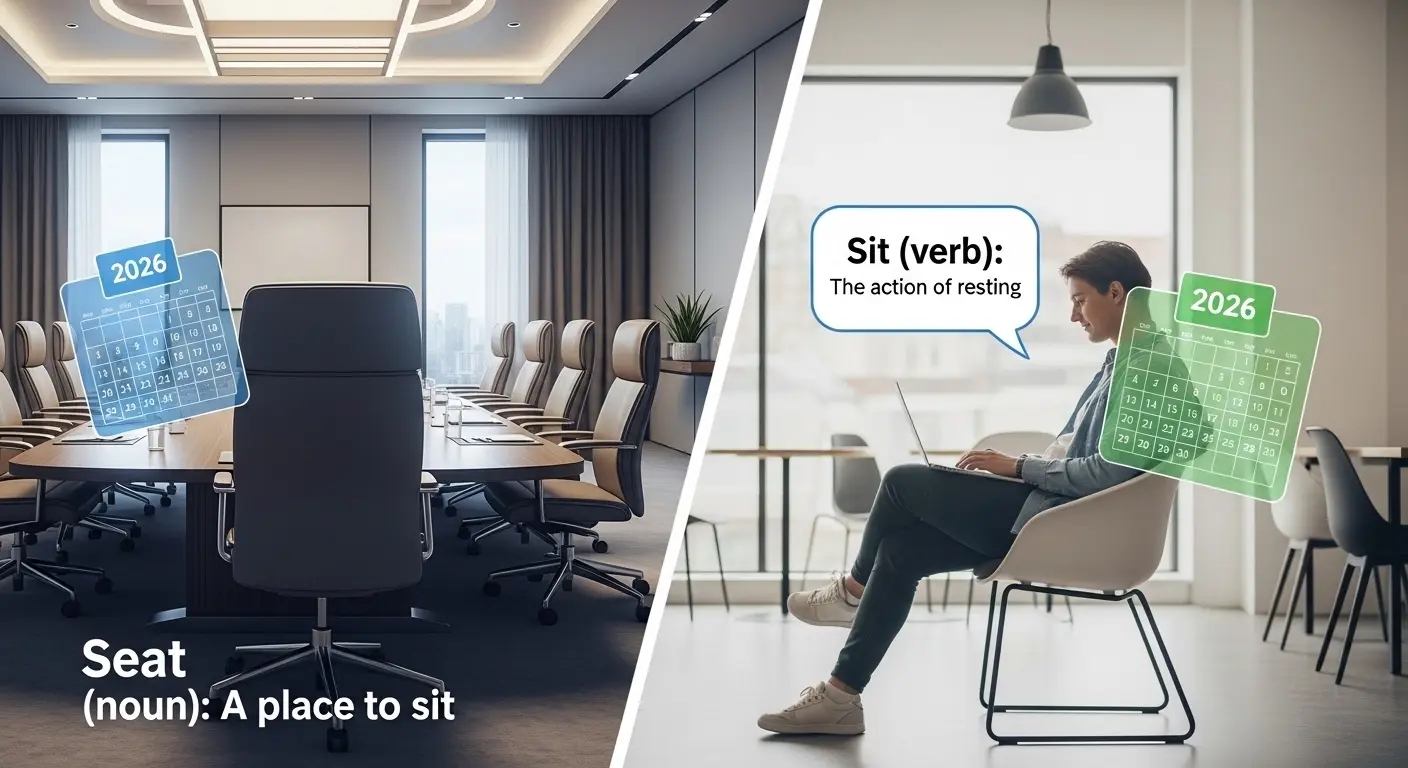
“Seat” is a noun (or verb) referring to a place to sit or to place someone somewhere, while “sit” is a verb meaning to rest your body in a seated position.
Have you ever paused while writing and wondered: Should I use “seat” or “sit”? You’re not alone. Many English learners and even native speakers get confused by these two common words. They look simple, but they serve different roles in a sentence, which causes mistakes in speaking and writing.
People often search for “seat or sit” because both words relate to sitting, but they are not interchangeable. Using the wrong one can make your sentence sound unnatural or incorrect. For example, saying “Please sit yourself” instead of “Please seat yourself” changes the tone and grammar.
This article clears up the confusion in a simple and practical way. You’ll learn the exact difference between “seat” and “sit,” where each word comes from, and how to use them in real-life situations.
We’ll also cover common mistakes, examples, and usage tips so you can feel confident every time you use these words.
Let’s make it easy.
Seat or Sit – Quick Answer
The difference is simple:
- Sit is a verb. It means to rest your body on a chair or surface.
- Seat is usually a noun, but it can also be a verb meaning to place someone somewhere.
Examples:
- Sit (verb):
- Please sit here.
- She likes to sit by the window.
- Seat (noun):
- This seat is taken.
- I found a comfortable seat.
- Seat (verb):
- The host will seat you.
- Please seat yourself.
Quick rule:
Use “sit” for the action you do yourself.
Use “seat” for a place or when someone places you.
The Origin of Seat or Sit
Understanding the origin helps make things clearer.
- Sit comes from Old English “sittan,” which means “to be seated” or “to rest.”
- Seat comes from Old Norse “sæti,” meaning “a place to sit.”
So from the start:
- Sit = action
- Seat = place
Over time, English speakers also began using “seat” as a verb, especially in formal situations like restaurants or events.
That’s why today:
- “Sit” stays an action word
- “Seat” is mostly a thing, but sometimes an action done by others
British English vs American English Spelling
Good news: there is no spelling difference between British and American English for “seat” and “sit.”
Both forms use:
- Sit
- Seat
However, there is a small difference in usage style.
- In American English, people often say:
- “Please have a seat.”
- In British English, people may say:
- “Please sit down.”
Comparison Table
| Aspect | British English | American English |
| Common phrase | Sit down | Have a seat |
| Formal tone | Less use of “seat” | More use of “seat” |
| Verb usage | Sit (more common) | Sit + Seat (both common) |
Both are correct. The difference is mostly style, not rules.
Which Spelling Should You Use?
Since both words are correct, your choice depends on your audience and sentence.
Use “Sit” when:
- You talk about your own action
- You write casually
- You want simple, direct language
Example:
- Sit here.
- I will sit next to you.
Use “Seat” when:
- You talk about a place (noun)
- You write formally
- Someone else places a person
Example:
- Take your seat.
- The waiter will seat you.
Audience Tips:
- US audience: “Have a seat” sounds natural
- UK/Commonwealth: “Sit down” is more common
- Global audience: Use “sit” for clarity
Simple advice: When unsure, use “sit.” It is safer and more natural in most cases.
Common Mistakes with Seat or Sit
Many learners mix these two words. Here are the most common mistakes:
❌ Wrong: Please seat here
✔️ Correct: Please sit here
👉 “Seat” is not used this way.
❌ Wrong: I will seat on the chair
✔️ Correct: I will sit on the chair
“Sit” is the correct action verb.
❌ Wrong: He sit me near the door
✔️ Correct: He seated me near the door
If someone places you, use “seated.”
❌ Wrong: Sit yourself
✔️ Correct: Seat yourself OR Sit down
Both are correct, but used differently.
❌ Wrong: This sit is broken
✔️ Correct: This seat is broken
“Seat” is the object, not “sit.”
Seat or Sit in Everyday Examples
Let’s see how these words work in real life.
1. Emails
- Please sit in the waiting area.
- Kindly take your seat before the meeting starts.
2. News
- Passengers must remain seated during the flight.
- There are not enough seats in the hall.
3. Social Media
- Just want to sit and relax today.
- Got the best seat in the stadium!
4. Formal Writing
- Guests were seated according to their names.
- Each guest was assigned a seat.
Notice:
Formal writing uses “seat” more often.
Seat or Sit – Google Trends & Usage Data
Search trends show that both “seat” and “sit” are widely used, but in different contexts.
Popularity:
- Sit is searched more often because it is a basic verb.
- Seat appears more in formal or service-related searches (like booking seats).
By Country:
- United States: “Have a seat” is very common
- United Kingdom: “Sit down” is more common
- Global (ESL learners): “Sit” is preferred for learning
Context:
- Sit → daily speech, simple writing
- Seat → travel, events, formal tone
Key insight:
“Sit” dominates everyday language, while “seat” is more situational.
Comparison Table: Seat vs Sit
| Feature | Sit | Seat |
| Part of speech | Verb | Noun + Verb |
| Meaning | To rest your body | A place to sit / to place |
| Usage | Informal + common | Formal + specific |
| Example | Sit here | Take a seat |
| Action type | You do it yourself | Someone places you |
FAQs About Seat or Sit
1. Is “seat” or “sit” correct?
Both are correct, but used differently. “Sit” is an action, “seat” is a place or formal action.
2. Can I say “please seat here”?
No. Say “please sit here.”
3. What is the difference between “sit down” and “take a seat”?
They mean the same, but “take a seat” is more polite and formal.
4. Is “seat yourself” correct?
Yes, it is correct and often used in restaurants.
5. Which is more common in daily use?
“Sit” is more common in everyday speech.
6. Can “seat” be a verb?
Yes. Example: “The host will seat you.”
7. Is there a spelling difference in UK and US English?
No. Both use the same spelling.
8. Which word should beginners use?
Use “sit.” It is easier and safer.
Conclusion:
The difference between “seat” and “sit” is simple once you understand their roles. “Sit” is a basic verb that describes the action of resting your body. It is easy, direct, and used in everyday speech. On the other hand, “seat” is mainly a noun that refers to a place to sit, though it can also act as a verb in more formal situations.
Most confusion happens because both words relate to the same idea sitting but they are used in different ways. If you remember one rule, let it be this: use “sit” for actions and “seat” for places or formal instructions.
For global communication, especially if you are unsure, “sit” is the safer choice. It sounds natural and is widely understood. However, learning to use “seat” correctly can improve your formal writing and make your English sound more polished.
With practice and the examples shared above, you can now use both words correctly and confidently in any situation.

I am an Emily Carter Brooks U.S.A based linguistics writer known for my clear, reader-friendly explanations of English grammar and vocabulary differences. I have contributed to multiple online language resources and specializes in spelling variations, pronunciation confusion, and British vs American English comparisons. I’m passionate about helping learners improve their English through practical, everyday communication. engaging, and stress-free.