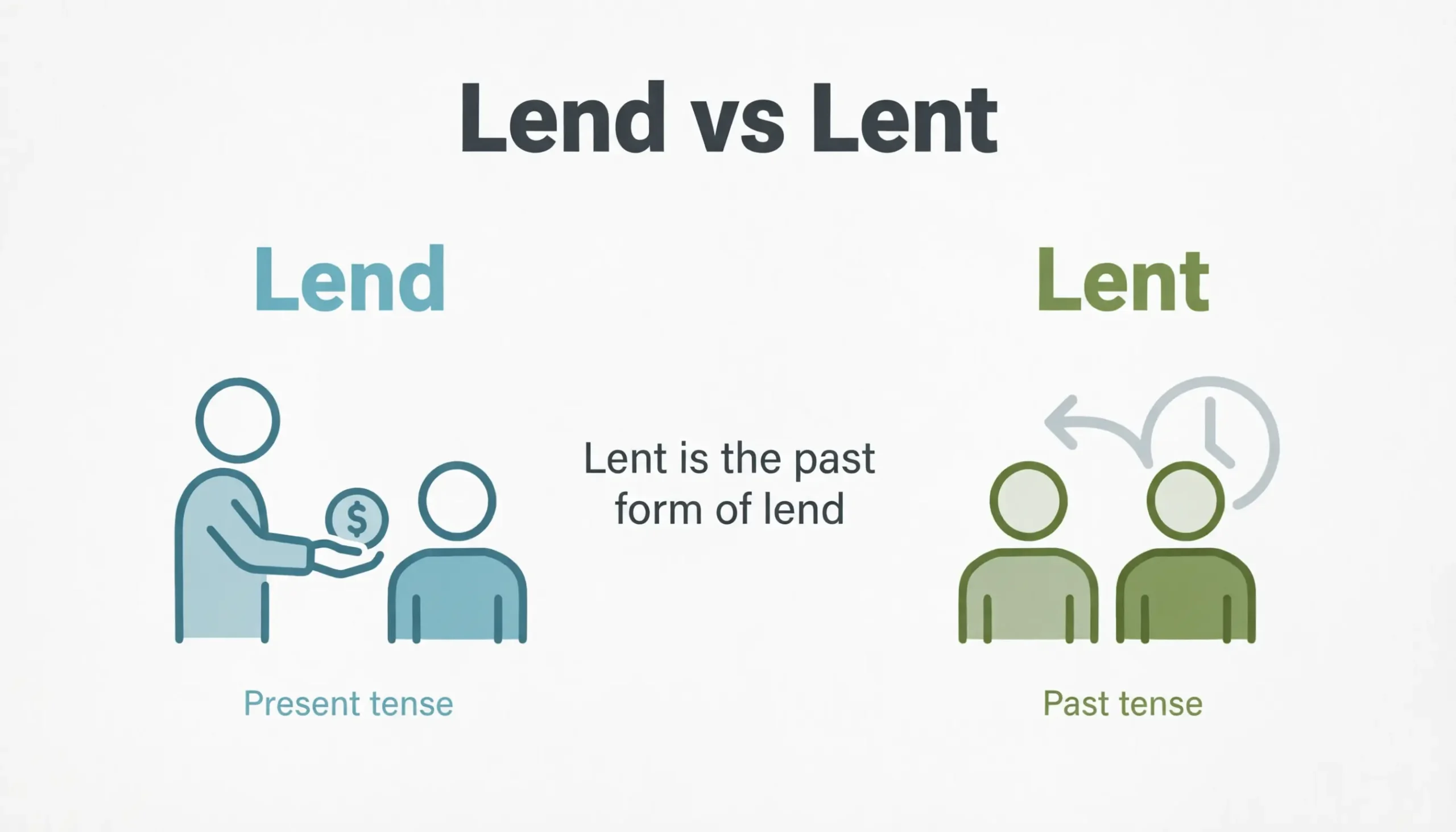
“Lend” is the present tense meaning to give something temporarily, while “lent” is the past tense and past participle form of lend.
Many English learners and writers get confused about lend or lent. The words look similar, sound related, and come from the same verb. But they are not used in the same way. One talks about the present or future, while the other talks about the past.
People often search for “lend vs lent” because they want to avoid grammar mistakes in school work, emails, business writing, or social media posts. A sentence like “Can you lent me your book?” may sound close to correct, but it is wrong. Small grammar mistakes like this can make writing look less professional.
The good news is that the difference is simple. Once you understand when to use each word, it becomes easy to write correctly. In this guide, you will learn the quick answer, the history of the words, common mistakes, spelling rules, and real-life examples. You will also see comparison tables, FAQs, and usage tips for both American and British English.
By the end, you will know exactly when to use lend and when to use lent in everyday English.
Lend or Lent – Quick Answer
The difference between lend and lent is tense.
| Word | Meaning | Tense | Example |
| Lend | To give something temporarily | Present/Future | “I will lend you my pen.” |
| Lent | Past form of lend | Past | “She lent me her car yesterday.” |
Simple Rule
- Use lend for actions happening now or later.
- Use lent for actions that already happened.
Examples
- “Can you lend me some money?”
- “My friend lent me his laptop last week.”
The Origin of Lend or Lent
The word lend comes from Old English lǣnan, which meant “to grant” or “to allow someone to use something.” Over time, English grammar changed, but the basic meaning stayed the same.
The word lent developed as the past tense form of lend. English has many irregular verbs, and lend follows that pattern:
- Send → Sent
- Spend → Spent
- Lend → Lent
This is why the spelling changes from d to t in the past tense.
The confusion happens because many English verbs simply add -ed for the past tense. For example:
- Walk → Walked
- Play → Played
But lend is irregular, so the correct past tense is lent, not “lended.”
Word History Table
| Modern Word | Old English Root | Meaning |
| Lend | lǣnan | Give temporarily |
| Lent | Past form of lend | Gave temporarily |
British English vs American English Spelling
Unlike some English words, lend and lent are spelled the same in both British and American English.
There is no spelling difference between the two regions. The only difference is grammar use.
| Usage | British English | American English |
| Present tense | Lend | Lend |
| Past tense | Lent | Lent |
| Incorrect form | Lended | Lended |
Examples in Both Styles
- UK: “Could you lend me your umbrella?”
- US: “Can you lend me your charger?”
- UK: “He lent me £20.”
- US: “She lent me $20.”
Both countries follow the same grammar rule.
Which Spelling Should You Use?
You should use lend or lent based on the tense of your sentence, not your country.
Use “Lend” When:
- Talking about the present
- Talking about the future
- Making requests
Examples
- “Please lend me your notes.”
- “I can lend you my bike tomorrow.”
Use “Lent” When:
- Talking about the past
- Describing completed actions
Examples
- “My teacher lent me a dictionary.”
- “They lent us their camera last month.”
Audience-Based Advice
| Audience | Best Choice |
| US readers | Use standard grammar: lend/lent |
| UK readers | Use standard grammar: lend/lent |
| Global audience | Use lend for present, lent for past |
There is no regional spelling issue here. The only thing that matters is correct tense.
Common Mistakes with Lend or Lent
Many writers use the wrong tense or create incorrect forms like “lended.”
Common Errors and Corrections
| Incorrect | Correct |
| “Can you lent me your book?” | “Can you lend me your book?” |
| “He lended me money.” | “He lent me money.” |
| “I lend her my pen yesterday.” | “I lent her my pen yesterday.” |
| “She has lend me her car.” | “She has lent me her car.” |
Why These Mistakes Happen
People often:
- Mix present and past tense
- Assume every verb adds “-ed”
- Forget that lend is irregular
Easy Grammar Tip
Think of these pairs:
| Present | Past |
| Send | Sent |
| Spend | Spent |
| Lend | Lent |
This pattern helps you remember the correct form.
Lend or Lent in Everyday Examples
Understanding real-life examples makes grammar easier.
Emails
- “Could you lend me the report for one day?”
- “Sarah lent me the files yesterday.”
News Writing
- “The bank will lend money to small businesses.”
- “The company lent support to the local project.”
Social Media
- “Can someone lend me a phone charger?”
- “My cousin lent me this amazing jacket!”
In Formal Writing
- “The library lends books to students.”
- “The museum lent rare paintings to the event.”
In Conversations
| Situation | Correct Usage |
| Asking now | “Can you lend me your pen?” |
| Talking about yesterday | “He lent me his pen.” |
Lend vs Lent – Google Trends & Usage Data
Search interest for lend vs lent is high among:
- English learners
- Students
- Business writers
- ESL users
Many people search this keyword because they are unsure about verb tense.
Countries With High Search Interest
| Country | Common Reason |
| United States | Grammar learning |
| United Kingdom | School writing |
| India | ESL education |
| Pakistan | English learning |
| Canada | Business communication |
Usage Trends
- Lend is more common in requests and daily conversation.
- Lent appears more in storytelling and past events.
Online Usage Examples
| Context | More Common Word |
| Requests | Lend |
| Past stories | Lent |
| Business emails | Lend |
| News reports | Lent |
Lend or Lent Comparison Table
| Feature | Lend | Lent |
| Part of speech | Verb | Verb |
| Tense | Present/Future | Past |
| Meaning | Give temporarily | Gave temporarily |
| Example | “Please lend me money.” | “She lent me money.” |
| Common mistake | Using in past tense | Using in present tense |
| Correct grammar | Yes | Yes |
FAQs About Lend or Lent
Is “lent” the past tense of “lend”?
Yes. “Lent” is the correct past tense and past participle of “lend.”
Is “lended” a real word?
No. “Lended” is incorrect in modern English.
Which is correct: “lend me” or “lent me”?
Both are correct, but they depend on tense.
- Present: “Lend me your pen.”
- Past: “He lent me his pen.”
Can I use “lent” in present tense?
No. “Lent” only refers to past actions.
Why do people confuse lend and lent?
Because the words are very similar and English has many irregular verbs.
Do British and American English use different spellings?
No. Both use lend and lent in the same way.
What is the past participle of lend?
The past participle is lent.
Example:
- “She has lent me her car.”
Is “lend” formal or informal?
“Lend” works in both formal and informal English.
What is an easy way to remember the difference?
Remember:
- Send → Sent
- Spend → Spent
- Lend → Lent
Conclusion
The difference between lend or lent is simple once you understand verb tense. Lend is the present or future form, while lent is the past form. You use lend when asking for something or talking about an action happening now. You use lent when the action already happened.
Many people make mistakes because English has irregular verbs. Some writers incorrectly use “lended,” but the correct past tense is always lent. The good news is that both British and American English follow the same grammar rule, so there is no regional spelling difference to worry about.
Learning the correct usage helps your writing look clearer and more professional. If you are writing emails, homework, business messages, or social media posts, using the right word improves communication.
A simple memory trick is to compare the pattern:
- Send → Sent
- Spend → Spent
- Lend → Lent
If you remember this pattern, you will rarely confuse the two words again.

I hold a degree in English Literature and Linguistics and have worked extensively on educational blogs, comparison websites, and digital learning platforms. My writing focuses on simplifying complex language rules, highlighting British vs American English differences, and providing practical examples for everyday usage.