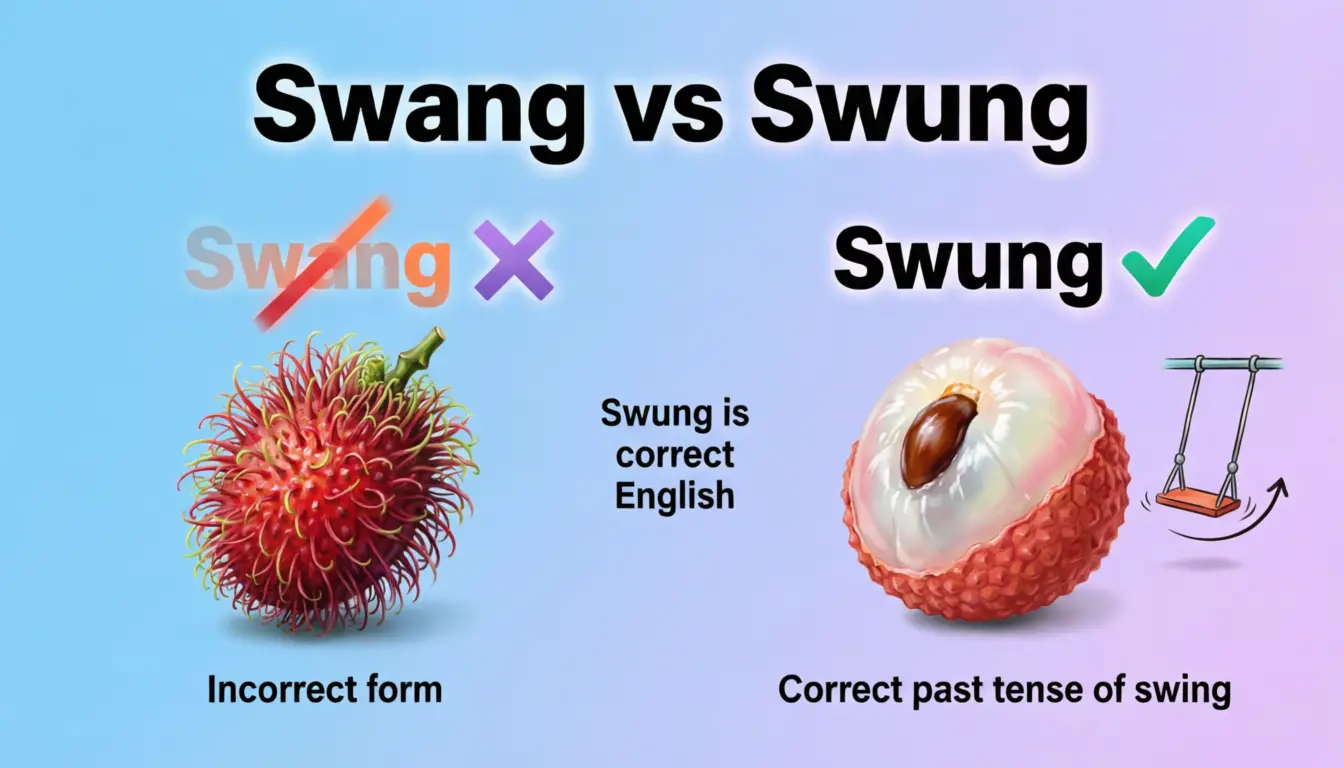
“Swung” is used in standard English to describe something that has moved back and forth or been moved in a swinging motion, whereas “swang” is generally considered incorrect in modern usage
Many English learners and writers search for “swang vs swung” because the two words sound similar. People often hear “swang” in songs, casual speech, or regional dialects. Because of this, they wonder if it is a correct past tense of “swing.”
The confusion is common in both speaking and writing. Some people use “swang” by mistake, while others use it as slang or dialect speech. In standard English, though, only one form is accepted in formal writing.
If you are writing emails, school work, blog posts, business content, or social media captions, it is important to know which word is correct. Using the wrong form can make your writing look unprofessional or unclear.
This guide explains the difference between “swang” and “swung” in simple language. You will learn the correct grammar, word history, common mistakes, and real-life examples. You will also see how British English and American English treat these words and which spelling or form you should use for your audience.
By the end, you will know exactly when to use “swung” and why “swang” is usually considered nonstandard English.
Swang vs Swung – Quick Answer
“Swung” is the correct past tense and past participle of “swing.”
✅ Correct:
- He swung the bat.
- The door swung open.
- She swung her bag over her shoulder.
❌ Incorrect in standard English:
- He swang the bat.
- The door swang open.
“Swang” is considered nonstandard English. It may appear in regional dialects, song lyrics, or informal speech, but it is not correct in formal writing.
Simple Rule
- Present tense → swing
- Past tense → swung
- Past participle → swung
Examples
| Verb Form | Correct Usage |
| Present | I swing the racket. |
| Past | I swung the racket. |
| Past Participle | I have swung the racket before. |
The Origin of Swang vs Swung
The word “swing” comes from Old English. Over time, English verbs changed forms as the language evolved.
“Swung” became the accepted past tense because English follows irregular verb patterns. Similar verbs also change vowels in the past tense.
Examples:
- Sing → sang
- Ring → rang
- Swing → swung
Many people mistakenly create “swang” because they compare “swing” to verbs like “sing” and “ring.” Since “sing” becomes “sang,” they assume “swing” should become “swang.”
But English grammar does not work that way for this verb.
Why “Swang” Exists
“Swang” appears mainly in:
- Southern American dialects
- Informal speech
- Music lyrics
- Cultural slang
It is sometimes used for style, rhythm, or regional identity. However, dictionaries and grammar guides still recognize “swung” as the standard form.
British English vs American English Spelling
Unlike many English word differences, “swang vs swung” is not really a spelling issue between British and American English.
Both British English and American English use “swung” as the correct standard form.
British English
✅ The gate swung shut.
American English
✅ The gate swung shut.
“Swang” may appear in informal American dialects more often, but it is still not standard grammar.
Comparison Table
| Usage | British English | American English |
| Standard past tense | Swung | Swung |
| Formal writing | Swung | Swung |
| Informal dialect use | Rare | Sometimes “swang” |
| Accepted in dictionaries | Yes | Yes |
| “Swang” accepted formally? | No | No |
Key Point
No matter where your audience lives, “swung” is the safe and correct choice.
Which Spelling Should You Use?
You should use “swung” in almost every situation.
Use “Swung” For:
- School writing
- Business emails
- News articles
- Academic papers
- Blog posts
- Professional communication
When Might “Swang” Appear?
You may see “swang” in:
- Song lyrics
- Regional speech
- Fiction dialogue
- Informal social media posts
Audience-Based Advice
| Audience | Best Choice |
| United States | Swung |
| United Kingdom | Swung |
| Canada | Swung |
| Australia | Swung |
| Global audience | Swung |
If your goal is clear and professional English, always choose “swung.”
Common Mistakes with Swang vs Swung
Many writers use the wrong form because they follow incorrect patterns.
Mistake 1: Copying Other Irregular Verbs
❌ He swang the rope.
✅ He swung the rope.
People think:
- Sing → sang
- Ring → rang
- Therefore, swing → swang
But the correct form is “swung.”
Mistake 2: Using Slang in Formal Writing
❌ The company swang into action.
✅ The company swung into action.
“Swang” sounds informal and unprofessional in business or academic content.
Mistake 3: Mixing Past Tense and Present Tense
❌ She swing the bat yesterday.
✅ She swung the bat yesterday.
Always use “swung” for past actions.
Mistake 4: Wrong Past Participle
❌ He has swang the club before.
✅ He has swung the club before.
“Swung” is both the past tense and past participle.
Swang vs Swung in Everyday Examples
Here are real-life situations showing correct usage.
Emails
✅ I swung by your office this morning.
✅ She swung the meeting in our favor.
News Writing
✅ The election swung toward the new candidate.
✅ Stock prices swung sharply today.
Social Media
✅ He swung for the fence!
✅ The mood swung quickly online.
Informal users may still write:
❌ “He swang at the ball.”
In Formal Writing
✅ The chandelier swung from the ceiling.
✅ Public opinion swung after the debate.
Formal writing should always use “swung.”
Swang vs Swung – Google Trends & Usage Data
Search interest for “swang vs swung” is strong because many people are unsure which word is correct.
Usage Trends
- “Swung” is far more common worldwide.
- “Swang” appears mostly in spoken language and dialect searches.
- American users search “swang” more often than British users.
Countries Where “Swung” Dominates
- United States
- United Kingdom
- Canada
- Australia
- New Zealand
Why People Search This Keyword
Users often want to know:
- Is “swang” a real word?
- Which form is grammatically correct?
- Can “swang” be used in formal writing?
The answer is simple:
✅ “Swung” is standard English.
❌ “Swang” is nonstandard.
Comparison Table: Swang vs Swung
| Feature | Swang | Swung |
| Standard English | No | Yes |
| Past tense of “swing” | No | Yes |
| Past participle | No | Yes |
| Used in formal writing | No | Yes |
| Found in dialect speech | Yes | Sometimes |
| Dictionary accepted form | Usually nonstandard | Yes |
| Best choice for writers | No | Yes |
FAQs About Swang vs Swung
Is “swang” a real word?
“Swang” exists in some dialects and slang, but it is not standard English.
What is the correct past tense of “swing”?
The correct past tense is “swung.”
Can I use “swang” in formal writing?
No. Formal writing should always use “swung.”
Why do people say “swang”?
People often copy patterns from words like “sing” and “sang.”
Is “swung” correct in British English?
Yes. British English uses “swung.”
Is “swung” correct in American English?
Yes. American English also uses “swung.”
Is “swang” grammatically wrong?
In standard grammar, yes. It is considered nonstandard.
Which is more common online?
“Swung” is much more common in books, articles, and professional writing.
Can “swang” appear in songs?
Yes. Artists sometimes use it for style or rhythm.
Conclusion
The difference between “swang vs swung” is simple once you know the grammar rule. “Swung” is the correct past tense and past participle of “swing.” It is accepted in both British English and American English and should be used in formal, professional, and everyday writing.
“Swang,” on the other hand, is mostly a nonstandard form. While it may appear in regional dialects, casual speech, music, or social media, it is not considered correct in standard English grammar. Using it in business writing, academic work, or published content can make your writing look incorrect.
Many people become confused because English has irregular verbs like “sing” and “sang.” They expect “swing” to follow the same pattern. However, English developed differently for this verb, and “swung” became the accepted form over time.
If you want your writing to sound clear, natural, and professional, always choose “swung.” It works for global audiences, improves grammar accuracy, and avoids confusion for readers everywhere.
Meta Description:

I hold a degree in English Literature and Linguistics and have worked extensively on educational blogs, comparison websites, and digital learning platforms. My writing focuses on simplifying complex language rules, highlighting British vs American English differences, and providing practical examples for everyday usage.