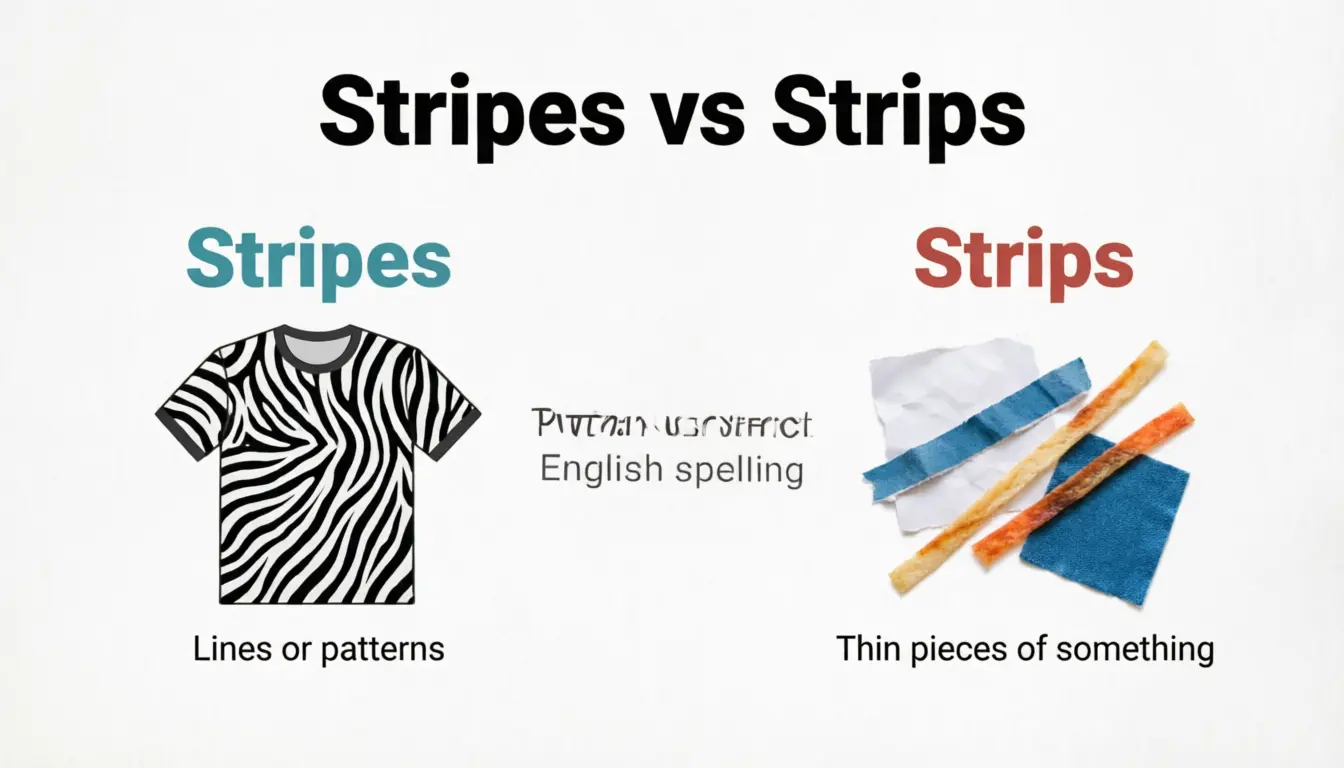
“Stripes” are long, narrow lines or bands of color, while “strips” are long, narrow pieces of something that has been cut or removed.
Many English learners and even native speakers get confused by “stripes” and “strips.” The words look similar, sound close, and both relate to long narrow shapes. Because of this, people often search for “stripes or strips” to learn which word is correct in writing and speech.
The confusion usually happens in daily situations. For example, should you say “zebra stripes” or “zebra strips”? Is it “paper strips” or “paper stripes”? These small differences matter because each word has a different meaning.
The good news is that the rule is simple. “Stripes” usually means lines, bands, or patterns. “Strips” usually means narrow pieces cut from something. Knowing this difference can improve your grammar, writing, emails, school work, and social media posts.
In this guide, you will learn the quick answer, word origins, spelling rules, common mistakes, real-life examples, and usage trends. By the end, you will know exactly when to use stripes and when to use strips with confidence.
Stripes or Strips – Quick Answer
Here is the simple answer:
| Word | Meaning | Example |
| Stripes | Lines or bands of color/design | The tiger has black stripes. |
| Strips | Long narrow pieces cut from something | She cut paper into strips. |
Easy Examples
- Correct: The flag has red and white stripes.
- Correct: He used strips of tape.
- Incorrect: The tiger has black strips.
- Incorrect: She cut paper into stripes.
Quick Tip
- Use stripes for patterns or lines.
- Use strips for pieces or sections.
The Origin of Stripes or Strips
The words come from the same language family but developed different meanings over time.
Origin of “Stripe”
The word stripe comes from old Germanic and Middle English words meaning a line, stroke, or mark. Over time, it became connected to colored bands or patterns.
Examples:
- zebra stripes
- racing stripes
- striped shirt
Origin of “Strip”
The word strip also comes from Germanic roots. It originally meant removing or cutting away something. Later, it came to mean a long narrow piece.
Examples:
- strips of cloth
- bacon strips
- film strips
Why the Confusion Exists
The confusion exists because:
- both words start with “strip”
- both involve long narrow shapes
- pronunciation is similar
But their meanings changed in different ways:
- stripe = pattern
- strip = piece
British English vs American English Spelling
Unlike many English words, “stripes” and “strips” are spelled the same in both British and American English.
The difference is not about region. It is about meaning.
Comparison Table
| Usage | British English | American English |
| Color patterns | stripes | stripes |
| Narrow pieces | strips | strips |
| Zebra lines | stripes | stripes |
| Paper pieces | strips | strips |
Examples in British English
- The player wore blue stripes.
- Cut the cloth into strips.
Examples in American English
- The road has yellow stripes.
- Use strips of tape.
So, there is no UK vs US spelling difference here.
Which Spelling Should You Use?
The correct word depends on what you want to say.
Use “Stripes” When Talking About Patterns
Choose stripes if you mean:
- lines
- bands
- designs
- markings
Examples:
- striped pajamas
- road stripes
- zebra stripes
Use “Strips” When Talking About Pieces
Choose strips if you mean:
- narrow cuts
- slices
- sections
- pieces
Examples:
- chicken strips
- strips of paper
- test strips
Audience-Based Advice
| Audience | Best Choice |
| US readers | Use the meaning-based rule |
| UK readers | Use the meaning-based rule |
| Global audience | Keep usage simple and clear |
Because both countries use the same spelling, the only important thing is choosing the correct meaning.
Common Mistakes with Stripes or Strips
People often mix these words because they both describe narrow shapes.
Mistake 1: Using “Strips” for Animal Patterns
❌ The tiger has orange and black strips.
✅ The tiger has orange and black stripes.
Mistake 2: Using “Stripes” for Cut Pieces
❌ Cut the paper into stripes.
✅ Cut the paper into strips.
Mistake 3: Confusing Food Terms
❌ Bacon stripes
✅ Bacon strips
Mistake 4: Mixing Clothing and Material
❌ Strips shirt
✅ Striped shirt
Easy Memory Trick
- Stripe = style
- Strip = slice
Both words start differently after “strip,” which helps you remember the meaning.
Stripes or Strips in Everyday Examples
Here are real-life examples showing how people use these words.
Emails
- Please cut the document into strips for the activity.
- The new logo uses blue stripes.
News Writing
- The team wore red stripes during the match.
- Police found strips of cloth near the road.
Social Media
- Loving these rainbow stripes!
- Chicken strips are my favorite snack.
In Formal Writing
- The uniform contains vertical stripes.
- Scientists tested chemical strips in the lab.
In Advertising
- Stylish striped shirts now available.
- Cleaning strips remove stains quickly.
Stripes or Strips – Google Trends & Usage Data
Search data shows that both words are popular, but they appear in different contexts.
“Stripes” Is Popular For
- fashion
- animal patterns
- sports uniforms
- design
Countries where “stripes” is common:
- United States
- United Kingdom
- Canada
- Australia
“Strips” Is Popular For
- food
- crafts
- cleaning products
- medicine
Countries where “strips” is common:
- United States
- India
- Pakistan
- United Kingdom
Usage Difference
| Word | Most Common Context |
| stripes | patterns and design |
| strips | pieces and slices |
Search engines clearly treat these as different words with different meanings.
Comparison Table: Stripes vs Strips
| Feature | Stripes | Strips |
| Main Meaning | Lines or bands | Narrow pieces |
| Used for Patterns? | Yes | No |
| Used for Cut Pieces? | No | Yes |
| Common with Animals? | Yes | No |
| Common with Food? | Rare | Yes |
| Example | zebra stripes | bacon strips |
FAQs About Stripes or Strips
1. Is it stripes or strips on a zebra?
The correct word is stripes because zebras have colored patterns.
2. Are bacon strips correct?
Yes. Bacon is cut into long narrow pieces, so strips is correct.
3. Can “stripes” mean pieces?
Usually no. “Stripes” mostly refers to lines or patterns.
4. Is there a spelling difference between British and American English?
No. Both countries use the same spellings: stripes and strips.
5. Why do people confuse stripes and strips?
They look and sound similar, and both describe long narrow shapes.
6. What are racing stripes?
Racing stripes are colored lines painted on cars.
7. What are paper strips?
Paper strips are long narrow pieces of paper.
8. Is “striped” related to stripes?
Yes. “Striped” means covered with stripes or patterns.
9. Which word is more common?
Both are common, but they are used in different situations.
Conclusion
The difference between “stripes” and “strips” is simple once you know the rule. Stripes are lines, bands, or patterns, while strips are long narrow pieces cut from something. Even though the words look very similar, they cannot usually replace each other.
If you are talking about zebras, road markings, clothing patterns, or decorative designs, use stripes. If you are talking about bacon, paper, tape, cloth, or sliced material, use strips. This small grammar choice helps your writing sound natural and correct.
Another useful point is that there is no spelling difference between British English and American English. The spelling stays the same everywhere. Only the meaning changes.
A simple memory trick can help:
- Stripe = style or pattern
- Strip = slice or piece
By understanding the context, you can choose the correct word easily in emails, social media posts, school work, and professional writing. With practice, the confusion between stripes or strips becomes much easier to avoid.

I hold a degree in English Literature and Linguistics and have worked extensively on educational blogs, comparison websites, and digital learning platforms. My writing focuses on simplifying complex language rules, highlighting British vs American English differences, and providing practical examples for everyday usage.