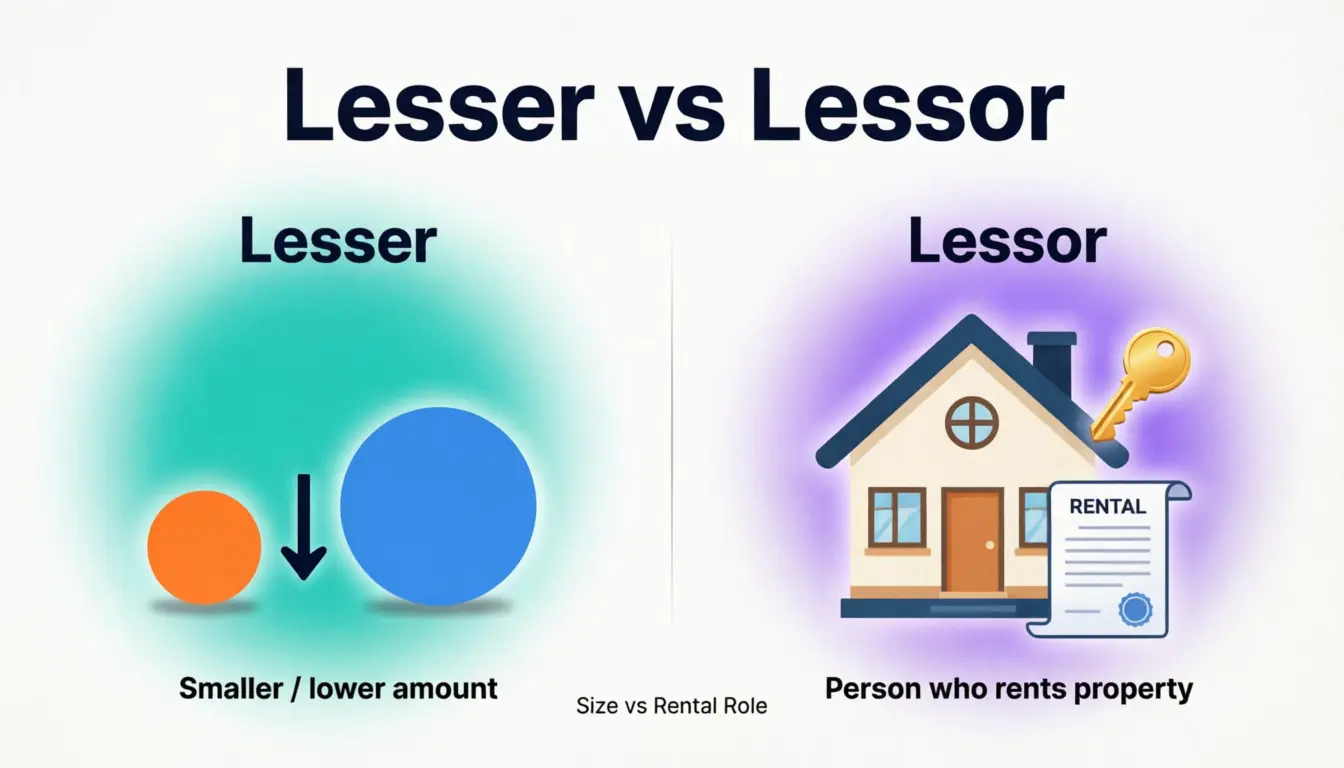
“Lesser” is an adjective meaning smaller, lower, or less important, while “lessor” is a legal noun referring to a person or company that rents property to someone else.
Many English words look alike but mean very different things. “Lesser” and “lessor” are perfect examples. They sound almost the same, but they are not interchangeable. This small spelling difference often confuses students, writers, business owners, and even native English speakers.
People usually search for “lesser vs lessor” because they see the words in legal papers, rental agreements, books, or online articles. One word relates to size, importance, or amount. The other belongs mostly to legal and property language. Using the wrong one can make your writing unclear or even incorrect in professional documents.
The confusion becomes stronger because both words come from the idea of “less.” However, they developed different meanings over time. “Lesser” is common in everyday English, while “lessor” appears mostly in contracts and leasing documents.
This guide explains the difference between lesser and lessor in simple language. You will learn their meanings, origins, spelling rules, common mistakes, and real-world examples. By the end, you will know exactly when to use each word with confidence.
Lessor vs Lesser – Quick Answer
Lesser
“Lesser” means smaller, lower, or less important.
Examples:
- She chose the lesser option.
- This is the lesser of two problems.
- A lesser-known actor won the award.
Lessor
“Lessor” is a legal term. It means a person or company that rents property to someone else.
Examples:
- The lessor signed the lease agreement.
- The tenant must pay the lessor every month.
- The building’s lessor changed the contract.
Quick Comparison Table
| Word | Meaning | Used In | Example |
| Lesser | Smaller or less important | Everyday English | A lesser risk |
| Lessor | Owner who rents property | Legal/Business English | The lessor approved the lease |
The Origin of Lesser vs Lessor
The word lesser comes from Old English and Germanic roots. It developed from the word “less,” which means smaller in amount or degree. Over time, English speakers used “lesser” to compare things with lower importance or value.
The word lessor has a different history. It comes from Old French legal language connected to leasing and renting property. The word became common in legal English during the Middle Ages. Lawyers and property owners used it in contracts and rental agreements.
Even though the two words sound alike, their meanings separated over time:
- Lesser stayed part of normal English conversation.
- Lessor became a specialized legal term.
This is why spelling matters. One extra letter changes the entire meaning of the word.
British English vs American English Spelling
Unlike many English words, “lesser” and “lessor” do not change spelling between British and American English. Both forms are standard in the UK and the US.
However, usage patterns can differ slightly:
- Lesser appears more often in general writing, books, journalism, and speech.
- Lessor appears mainly in legal contracts, lease documents, and business writing.
British vs American Usage Table
| Word | British English | American English | Notes |
| Lesser | Common | Common | Everyday adjective |
| Lessor | Legal usage | Legal usage | Property and leasing term |
Examples in British English
- A lesser-known football club won the match.
- The lessor renewed the flat agreement.
Examples in American English
- He accepted the lesser penalty.
- The lessor increased the office rent.
Because both spellings stay the same worldwide, the main challenge is understanding meaning, not regional spelling.
Which Spelling Should You Use?
The correct spelling depends on what you want to say.
Use “Lesser” When:
You mean:
- smaller
- lower
- less important
- less serious
Examples:
- Choose the lesser evil.
- She accepted a lesser role.
- This issue is of lesser importance.
Use “Lessor” When:
You talk about:
- leases
- landlords
- rental contracts
- property agreements
Examples:
- The lessor owns the apartment.
- The lessor signed the document.
Audience-Based Advice
| Audience | Recommended Word |
| US readers | Use the correct meaning-based spelling |
| UK readers | Use the correct meaning-based spelling |
| Global audience | Keep “lessor” for legal writing only |
| Students | Remember: “lessor” = lease |
| Businesses | Use “lessor” in contracts |
A simple memory trick:
- Lessor contains “or,” like landlord or owner.
- Lesser relates to “less.”
Common Mistakes with Lesser vs Lessor
Many writers confuse these words because they sound similar.
Mistake 1: Using “lessor” for comparison
❌ This is the lessor problem.
✅ This is the lesser problem.
Mistake 2: Using “lesser” in legal contracts
❌ The lesser signed the lease.
✅ The lessor signed the lease.
Mistake 3: Mixing meanings in business writing
❌ The lesser increased rent prices.
✅ The lessor increased rent prices.
Mistake 4: Assuming both words mean “less”
They do not mean the same thing.
| Incorrect Usage | Correct Usage |
| lesser agreement owner | lessor agreement owner |
| lessor-known actor | lesser-known actor |
| lesser of two evils | correct |
| lessor of two evils | incorrect |
Lesser vs Lessor in Everyday Examples
Emails
- We selected the lesser expense option.
- The lessor requested updated documents.
News Articles
- A lesser storm affected the region.
- The shopping mall’s lessor changed ownership.
Social Media
- “Choose the lesser evil.”
- “Our lessor finally fixed the building elevator.”
In Formal Writing
- The company faced a lesser financial risk.
- The lessor and tenant agreed on new terms.
In Academic Writing
- Scholars studied lesser-known poets.
- The lessor retained property rights.
Lesser vs Lessor – Google Trends & Usage Data
Search data shows that “lesser” is far more popular than “lessor.” This is because “lesser” appears in daily conversation, books, schools, and online discussions.
“Lessor” is searched less often because it belongs mostly to legal and rental language.
Usage by Context
| Word | Main Context |
| Lesser | General English |
| Lessor | Legal and leasing documents |
Popularity by Country
| Country | More Common Word |
| United States | Lesser |
| United Kingdom | Lesser |
| Canada | Lesser |
| Australia | Lesser |
| Legal Industry Worldwide | Lessor |
Why “Lessor” Gets Searches
People often search:
- landlord vs lessor
- lessor meaning
- lease agreement terms
- lessor definition
Why “Lesser” Gets Searches
Common searches include:
- lesser meaning
- lesser-known
- lesser evil
- lesser vs greater
Comparison Table: Lesser vs Lessor
| Feature | Lesser | Lessor |
| Part of Speech | Adjective | Noun |
| Meaning | Smaller or less important | Property owner in lease |
| Common Usage | Daily English | Legal English |
| Related Topic | Comparison | Renting |
| Example | lesser risk | lessor agreement |
| Difficulty Level | Easy | Specialized |
| Used in Contracts | Rarely | Frequently |
FAQs About Lesser vs Lessor
Is “lessor” a real word?
Yes. “Lessor” is a legal word for someone who rents property to another person.
What does “lesser” mean?
“Lesser” means smaller, lower, or less important.
Can I use “lesser” instead of “lessor”?
No. The meanings are completely different.
Is “lessor” another word for landlord?
Yes, in many legal situations, the lessor is the landlord or property owner.
Which word is more common?
“Lesser” is much more common in everyday English.
Do British and American English spell them differently?
No. Both varieties use the same spellings.
How can I remember the difference?
Think:
- lessor = lease
- lesser = less
Is “lesser-known” correct?
Yes. “Lesser-known” is a very common phrase.
Is “lessor” only used in legal writing?
Mostly yes. It usually appears in leases and contracts.
Conclusion
Understanding the difference between “lesser” and “lessor” is important because the two words have very different meanings. Even though they sound similar, one belongs to everyday English while the other belongs mostly to legal language.
“Lesser” is the more common word. It describes something smaller, weaker, lower, or less important. You will often see it in conversations, books, news stories, and online writing. Phrases like “lesser evil” or “lesser-known” appear frequently in modern English.
“Lessor,” however, is a specialized legal noun. It refers to a person or company that rents property to another person. You will mainly find it in lease agreements, rental contracts, and business documents. In many situations, “lessor” works similarly to “landlord.”
The easiest way to avoid mistakes is to remember the context. If you are comparing importance or size, use “lesser.” If you are talking about leasing or renting property, use “lessor.”
Choosing the correct spelling improves clarity, professionalism, and reader trust. Small spelling differences can create big meaning changes, especially in formal writing.

I hold a degree in English Literature and Linguistics and have worked extensively on educational blogs, comparison websites, and digital learning platforms. My writing focuses on simplifying complex language rules, highlighting British vs American English differences, and providing practical examples for everyday usage.