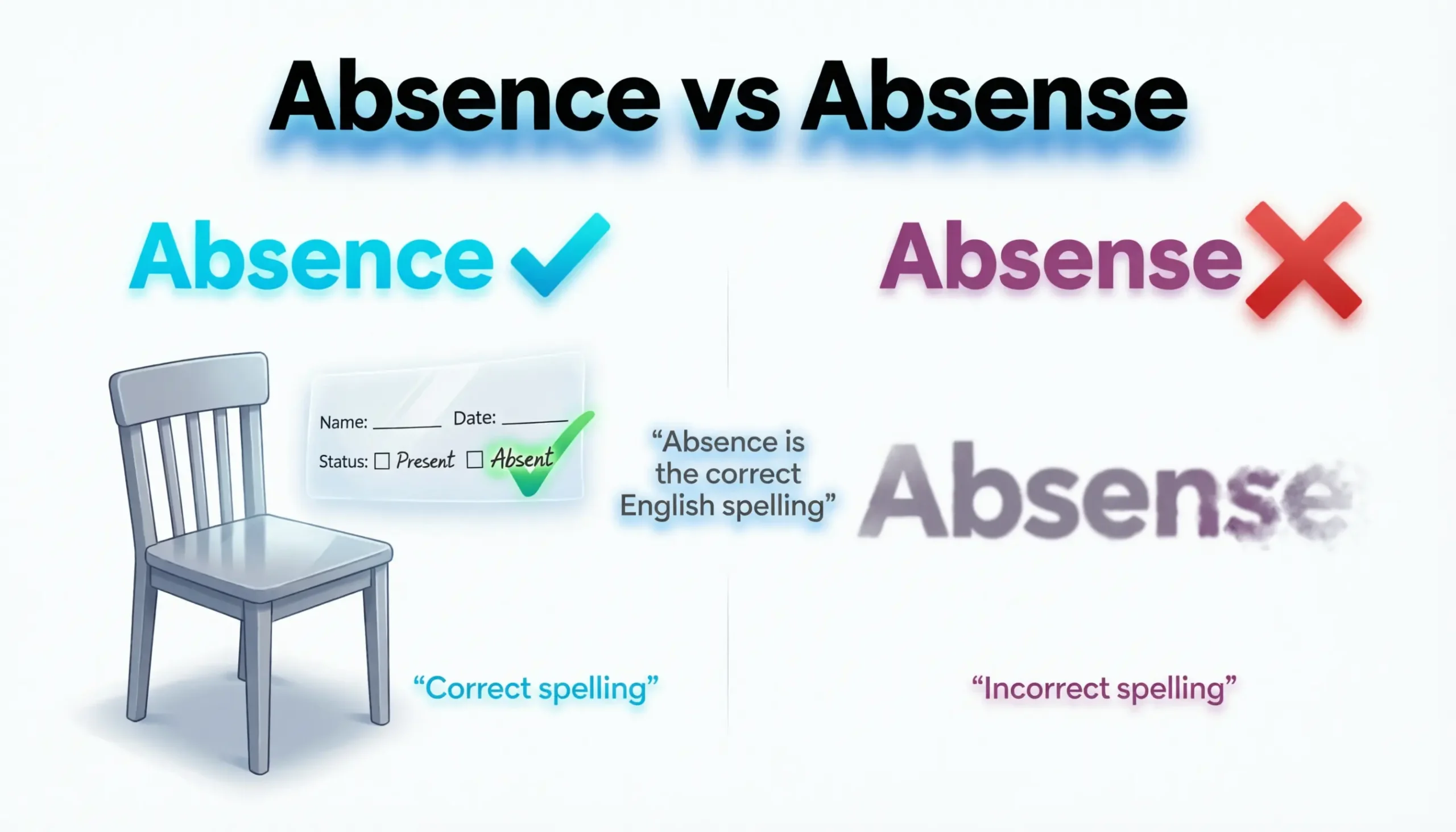
“Absence” is a noun meaning the state of being away or not present, whereas “absense” has no accepted meaning in English.
Have you ever typed “absense” and wondered if it was correct? You are not alone. Many English learners and native speakers confuse absence vs absense because the words sound almost the same. Spell-check tools often catch the mistake, but people still search for it every day.
The confusion happens because English spelling can be tricky. Some words use “-ence,” while others use “-ense.” Since both endings exist in English, it is easy to mix them up. People often want to know which spelling is correct for school, work emails, essays, social media posts, and professional writing.
The simple answer is this: “absence” is the correct spelling, while “absense” is incorrect. The word “absence” means the state of being away or not present. You may see it in phrases like “absence from school” or “in the absence of evidence.”
In this guide, you will learn the difference between absence vs absense, their origins, spelling rules, examples, common mistakes, and which form you should use in British and American English.
Absence vs Absense – Quick Answer
| Word | Correct? | Meaning |
| Absence | ✅ Yes | The state of being away or not present |
| Absense | ❌ No | Incorrect spelling of “absence” |
Correct Examples
- Her absence was noticed at the meeting.
- The teacher explained the reason for his absence.
- In the absence of proof, the case was closed.
Incorrect Examples
- ❌ Her absense was noticed.
- ❌ He explained his absense from work.
The correct spelling is always absence.
The Origin of Absence vs Absense
The word absence comes from the Latin word absentia, which means “being away.” Over time, the word entered Old French and later Middle English before becoming the modern English word “absence.”
The ending “-ence” is common in many English words that come from Latin. Examples include:
- presence
- silence
- patience
- confidence
People often write “absense” by mistake because English also has words ending in “-ense,” such as:
- defense
- license
- suspense
This mix of spelling patterns causes confusion. However, “absence” has always used the “-ence” ending in standard English.
British English vs American English Spelling
Unlike many English words, absence has the same spelling in both British English and American English.
For example:
| British English | American English |
| absence | absence |
| defence | defense |
| licence | license |
So while some words change between UK and US spelling rules, absence does not change.
Examples in British English
- His absence from the office caused delays.
- The school recorded her absence.
Examples in American English
- Her absence affected the project.
- The doctor explained his absence from the conference.
Comparison Table
| Feature | Absence | Absense |
| Correct English spelling | ✅ Yes | ❌ No |
| Used in American English | ✅ Yes | ❌ No |
| Used in British English | ✅ Yes | ❌ No |
| Found in dictionaries | ✅ Yes | ❌ No |
| Professional writing | ✅ Yes | ❌ No |
Which Spelling Should You Use?
You should always use absence.
If Your Audience Is American
Use absence in:
- school essays
- emails
- business writing
- news articles
If Your Audience Is British or Commonwealth
Use absence in:
- UK academic writing
- Australian English
- Canadian English
- legal documents
If Your Audience Is Global
Use absence because it is the only accepted spelling worldwide.
Using “absense” may make your writing look careless or unprofessional.
Common Mistakes with Absence vs Absense
Here are some frequent errors people make.
| Incorrect Sentence | Correct Sentence |
| His absense was surprising. | His absence was surprising. |
| She explained her absense. | She explained her absence. |
| We noticed your absense today. | We noticed your absence today. |
| The absense of rain hurt crops. | The absence of rain hurt crops. |
Why the Mistake Happens
People confuse the spelling because:
- The word sounds like it could end in “-sense.”
- English spelling rules are inconsistent.
- Similar words use “-ense.”
Easy Memory Trick
Think of:
- AbsENCE
- PresENCE
Both words end in “-ence.”
Absence vs Absense in Everyday Examples
Emails
- Your absence from today’s meeting was noted.
- Please provide a reason for your absence.
News Writing
- The player’s absence affected the team’s performance.
- Heavy rain caused the absence of tourists.
Social Media
- “Your absence online had us worried!”
- “The event felt strange in her absence.”
In Formal Writing
- The court discussed the absence of evidence.
- In the absence of leadership, the company struggled.
In School Writing
- The teacher marked his absence in the register.
- Frequent absence can affect grades.
Absence vs Absense – Google Trends & Usage Data
Search data shows that many users type “absense” into Google because they are unsure about the spelling. However, the correct word “absence” is far more popular in books, news, websites, and dictionaries.
Countries Where Confusion Is Common
The spelling mistake appears often in:
- the United States
- the United Kingdom
- India
- Pakistan
- Canada
This happens mostly among:
- English learners
- students
- fast typists
- mobile phone users
Usage Contexts
People usually search for “absence vs absense” when writing:
- school assignments
- office emails
- leave applications
- professional documents
The correct spelling used in all major dictionaries is absence.
Comparison Table: Absence vs Absense
| Aspect | Absence | Absense |
| Correct spelling | ✅ Yes | ❌ No |
| Dictionary word | ✅ Yes | ❌ No |
| Professional usage | ✅ Yes | ❌ No |
| Academic writing | ✅ Yes | ❌ No |
| Used worldwide | ✅ Yes | ❌ No |
| Meaning | Being away | Misspelling |
| Grammar acceptance | Standard English | Incorrect English |
FAQs About Absence vs Absense
Is “absense” ever correct?
No. “Absense” is always a spelling mistake.
What does “absence” mean?
It means being away, missing, or not present.
Why do people spell absence as absense?
Because the pronunciation sounds similar and many English words end in “-ense.”
Is absence used in British English?
Yes. British English and American English both use “absence.”
How do you remember the correct spelling?
Think of the word “presence.” Both words end with “-ence.”
Can I use absense in informal writing?
No. Even in casual writing, it is considered incorrect.
Is absence a noun?
Yes. “Absence” is a noun.
What is the adjective form of absence?
The adjective form is “absent.”
What is the opposite of absence?
The opposite is “presence.”
Conclusion
The debate around absence vs absense is simple once you know the rule. The only correct spelling is absence. The word “absense” is a common mistake caused by pronunciation and confusing English spelling patterns.
“Absence” comes from Latin roots and has kept its “-ence” ending throughout history. It is accepted in both British and American English without any spelling change. If you are writing an email, school paper, business report, or social media post, you should always choose “absence.”
A helpful way to remember the spelling is to connect it with similar words like “presence” and “silence.” These words also use the “-ence” ending.
Using the correct spelling improves your writing and makes your communication look more professional. Spell-check tools can help, but learning the rule will save time and avoid mistakes in the future.
So next time you hesitate between absence vs absense, remember this simple rule: absence is correct, absense is not.

I hold a degree in English Literature and Linguistics and have worked extensively on educational blogs, comparison websites, and digital learning platforms. My writing focuses on simplifying complex language rules, highlighting British vs American English differences, and providing practical examples for everyday usage.