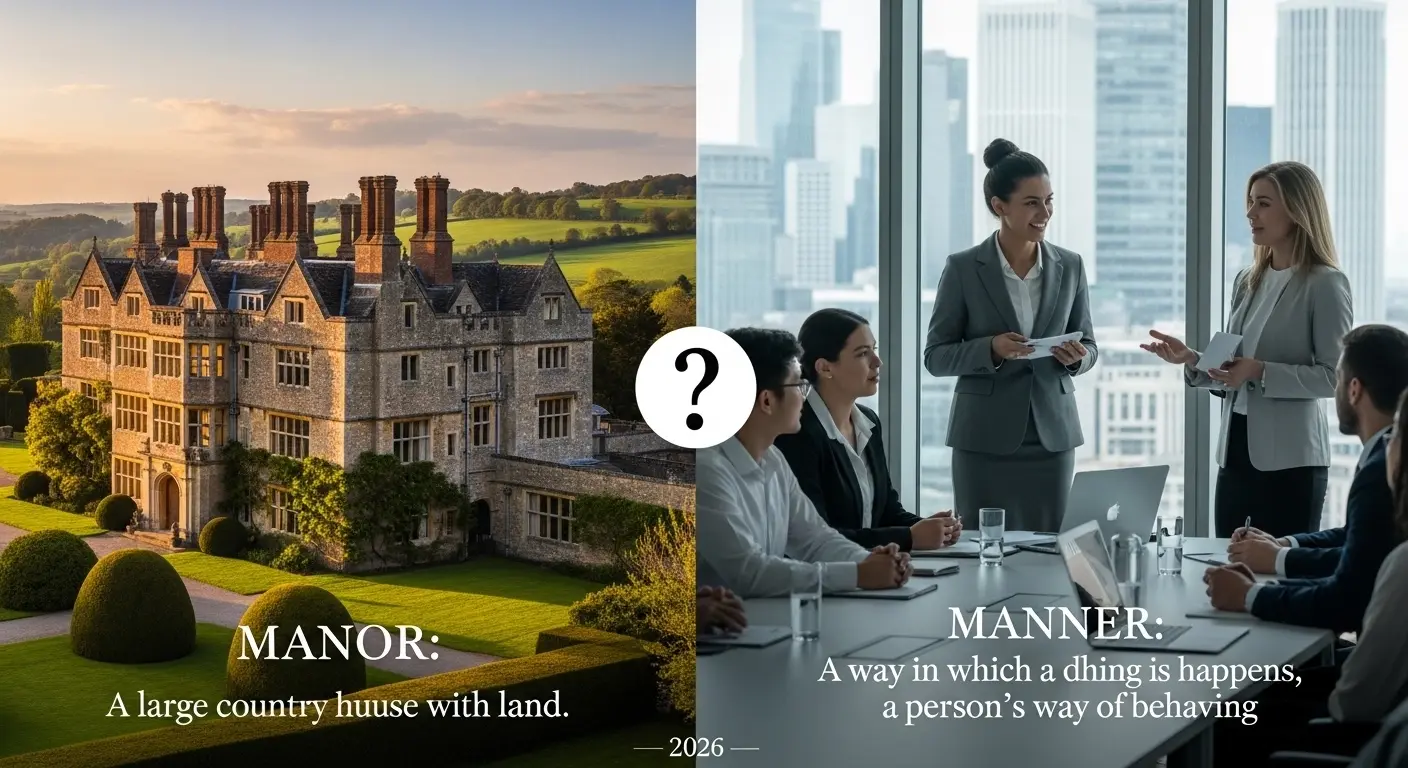
Have you ever typed “good manor” in a sentence and wondered if it looks right? You’re not alone. Many people confuse “manor” and “manner” because they sound the same. This is a classic case of homophones words that sound alike but have different meanings and spellings.
This confusion often appears in emails, essays, and even social media posts. A small mistake can change the meaning of your sentence or make your writing look less professional. That’s why people search for “manor or manner” to quickly understand the difference and avoid errors.
In simple terms, “manor” is related to land or a large house, while “manner” is about behavior or a way of doing something. Knowing when to use each word helps you write clearly and confidently.
This guide will give you a quick answer, explain the origin, show examples, and help you choose the correct word every time.
Manor or Manner – Quick Answer
Manor and manner sound the same, but they mean very different things:
- Manor = A large country house or estate
Example: He owns a beautiful manor in the countryside. - Manner = A way of doing something or behaving
Example: She spoke in a polite manner.
Quick Tip:
If you are talking about behavior or style, use manner.
If you are talking about a house or land, use manor.
The Origin of Manor or Manner
Understanding the origin makes it easier to remember the difference.
Manor
The word manor comes from Old French manoir, meaning “dwelling” or “house.” It was used in medieval times to describe a large estate owned by a lord. These estates were important in the feudal system.
Manner
The word manner comes from Latin manus, meaning “hand.” Over time, it came to mean “the way something is handled or done.” That’s why today it refers to behavior or style.
Why the Confusion Exists
Both words evolved in different ways but ended up sounding the same in modern English. This creates confusion, especially for learners and writers.
British English vs American English Spelling
Good news: there is no spelling difference between British and American English for “manor” and “manner.” Both forms are used the same way in both regions.
However, confusion still happens because of pronunciation and similar spelling.
Comparison Table
| Word | Meaning | British English | American English |
| Manor | Large house or estate | Manor | Manor |
| Manner | Way of doing or behavior | Manner | Manner |
Key Insight:
Unlike many English words, these do not change across regions. The difference is only in meaning.
Which Spelling Should You Use?
Choosing between manor and manner depends on what you want to say.
Use “Manor” if:
- You are talking about property, land, or a large house
- You are discussing history or estates
Example:
The old manor has stood for 200 years.
Use “Manner” if:
- You are talking about behavior or attitude
- You are describing how something is done
Example:
He answered in a calm manner.
Audience-Based Advice:
- US audience: Use standard meanings (no change needed)
- UK/Commonwealth: Same usage applies
- Global writing: Focus on context, not spelling
Common Mistakes with Manor or Manner
Here are some common errors and how to fix them:
❌ Wrong: She has a rude manor.
✅ Correct: She has a rude manner.
❌ Wrong: They live in a big manner.
✅ Correct: They live in a big manor.
Simple Rule:
- Behavior = manner
- Building/estate = manor
Manor or Manner in Everyday Examples
Emails
- Please respond in a professional manner.
- The event will be held at a historic manor.
News
- The old manor was turned into a hotel.
- He handled the situation in a calm manner.
Social Media
- “Love your kind manner!”
- “Visited a stunning manor today!”
Formal Writing
- The speaker addressed the audience in a respectful manner.
- The king ruled from his grand manor.
Manor or Manner – Google Trends & Usage Data
Search data shows that “manner” is used far more often than “manor.”
Why?
- “Manner” is used in daily speech and writing
- “Manor” is more specific and less common
Popular Usage by Context:
- Manner: Education, business, communication
- Manor: History, travel, real estate
By Country:
- Both words are used globally
- “Manner” appears more in everyday searches
- “Manor” appears more in travel and historical content
Comparison Table (Side-by-Side)
| Feature | Manor | Manner |
| Meaning | Estate or large house | Way of doing something |
| Usage | Rare, specific | Common, everyday |
| Context | Property, history | Behavior, style |
| Example | A royal manor | A polite manner |
| Part of Speech | Noun | Noun |
FAQs:
1. Is “good manor” correct?
No. The correct phrase is “good manner.”
2. What does “manor” mean in simple words?
It means a large house or estate, often in the countryside.
3. What does “manner” mean?
It means a way of doing something or behaving.
4. Are manor and manner interchangeable?
No. They have completely different meanings.
5. Why do people confuse manor and manner?
Because they sound the same (homophones).
6. Is “table manners” correct?
Yes. “Manners” refers to behavior while eating.
7. Can “manor” be used in modern writing?
Yes, but mostly in real estate, travel, or historical topics.
8. How can I remember the difference?
- Manner = manners (behavior)
- Manor = mansion (house)
Conclusion:
The difference between manor and manner is simple once you understand their meanings. Even though they sound alike, they belong to completely different contexts. Manor refers to a large house or estate, often linked with history or countryside living. On the other hand, manner describes behavior, attitude, or the way something is done.
This confusion is common because English has many homophones. But with a small memory trick “manner for behavior, manor for buildings” you can avoid mistakes easily. In everyday writing, you will use manner much more often, especially in emails, conversations, and professional communication.
Choosing the correct word improves clarity and shows strong language skills. If you are writing for school, work, or online content, using the right spelling builds trust with your audience.
Keep practicing with examples, and soon the difference between manor and manner will feel natural. Clear writing always starts with choosing the right word.

I hold a degree in English Literature and Linguistics and have worked extensively on educational blogs, comparison websites, and digital learning platforms. My writing focuses on simplifying complex language rules, highlighting British vs American English differences, and providing practical examples for everyday usage.