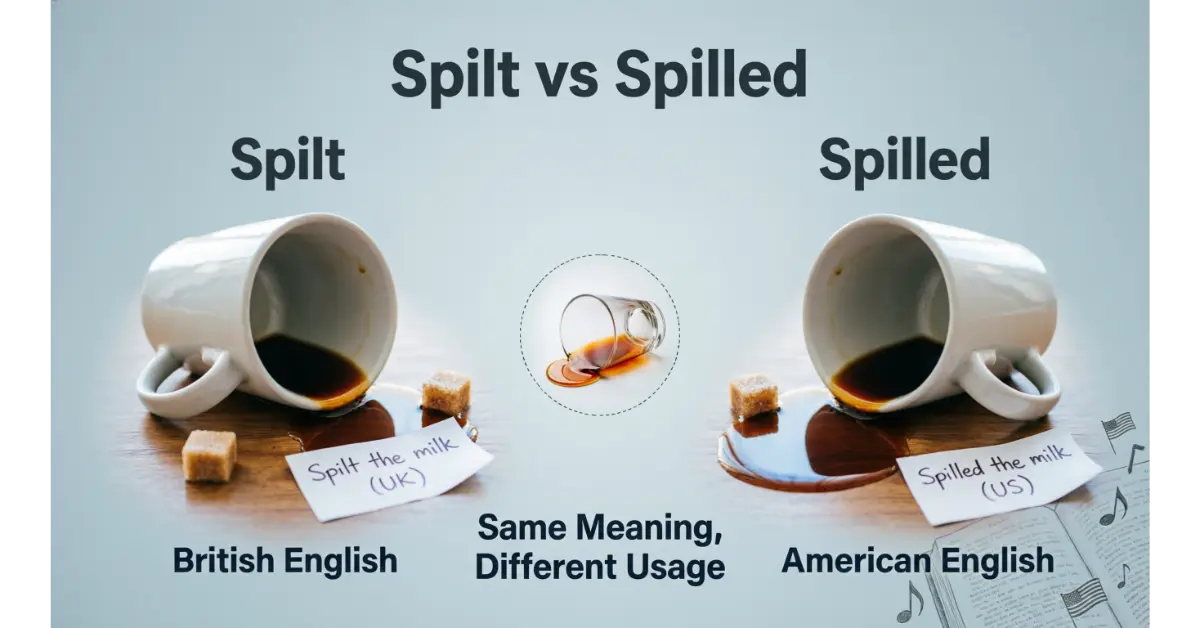
“Spilt” and “spilled” are both correct forms of the verb spill, but they differ by regional preference. “Spilt” is more common in British English, while “spilled” is preferred in American English. Both mean to accidentally cause a liquid or substance to flow out of its container.
Have you ever written “I spilt my coffee” and wondered if it should be “I spilled my coffee” instead? You are not alone. Many English learners, writers, students, and professionals get confused by spilt vs spilled because both words appear in books, websites, newspapers, and everyday conversations.
The good news is that both spilt and spilled are correct. They are different forms of the past tense and past participle of the verb spill. The main difference comes from regional spelling preferences. In some countries, one form is more common than the other.
Understanding when to use spilt or spilled can help you write more naturally for your audience. If you are preparing an email, writing a report, posting on social media, or creating content for an international audience, choosing the right form improves clarity and professionalism.
In this guide, you will learn the difference between spilt vs spilled, their history, British and American English preferences, common mistakes, real-world examples, and practical advice on which spelling to use.
Spilt vs Spilled – Quick Answer
Both spilt and spilled are correct past tense and past participle forms of the verb spill.
- Spilt is more common in British English.
- Spilled is more common in American English.
Examples
- British English: She spilt tea on the carpet.
- American English: She spilled coffee on the carpet.
Both sentences are grammatically correct. The choice depends mainly on your audience.
The Origin of Spilt vs Spilled
The verb spill comes from Old English and originally meant to destroy, waste, or cause something to fall out.
Over time, English developed two acceptable past-tense forms:
- Spilt follows the pattern of shortened irregular forms.
- Spilled follows the regular pattern of adding -ed to a verb.
English contains many verbs with both forms. For example:
| Base Verb | Short Form | Regular Form |
| spill | spilt | spilled |
| burn | burnt | burned |
| dream | dreamt | dreamed |
| learn | learnt | learned |
As English spread around the world, different regions favored different spellings. This is why both forms still exist today.
British English vs American English Spelling
The biggest difference between spilt and spilled is regional preference.
British English
British English often prefers shorter forms ending in -t.
Examples
- The milk spilt across the floor.
- He spilt water on his laptop.
- She spilt the paint accidentally.
American English
American English generally prefers regular -ed endings.
Examples
- The milk spilled across the floor.
- He spilled water on his laptop.
- She spilled the paint accidentally.
Comparison Table
| Feature | Spilt | Spilled |
| Meaning | Past tense of spill | Past tense of spill |
| Correct Spelling | Yes | Yes |
| British English | Preferred | Accepted |
| American English | Less common | Preferred |
| Formal Writing UK | Common | Common |
| Formal Writing US | Rare | Common |
| Everyday Conversation | Common in UK | Common in US |
Which Spelling Should You Use?
The best spelling depends on who will read your writing.
Use “Spilled” If:
- Your audience is in the United States.
- You write for American businesses.
- You follow American English style guides.
- You want the most globally recognized form.
Use “Spilt” If:
- Your audience is in the United Kingdom.
- You write for Australia, New Zealand, or other Commonwealth countries.
- You follow British English conventions.
For Global Audiences
If your readers come from many countries, spilled is often the safer choice because it appears more frequently in international publications and online content.
Common Mistakes with Spilt vs Spilled
Many writers make simple mistakes when using these words.
Mistake 1: Thinking One Is Wrong
❌ Spilt is incorrect.
✅ Both spilt and spilled are correct.
Mistake 2: Mixing Styles
❌ The company organised the event and spilled tea everywhere.
✅ British style: The company organised the event and spilt tea everywhere.
✅ American style: The company organized the event and spilled tea everywhere.
Mistake 3: Using Different Forms in the Same Document
❌ The juice spilt on the table. Later, more water spilled on the floor.
✅ Choose one style and stay consistent.
Mistake 4: Assuming “Spilt” Is Informal
❌ Spilt should never appear in professional writing.
✅ Spilt is accepted in formal British English.
Spilt vs Spilled in Everyday Examples
Understanding real-life usage makes the difference easier to remember.
In Emails
British English
I apologize for the delay. I accidentally spilt coffee on my notes.
American English
I apologize for the delay. I accidentally spilled coffee on my notes.
In News Reports
British Style
The tanker spilt oil into the river.
American Style
The tanker spilled oil into the river.
On Social Media
- I just spilt my drink all over the sofa!
- I just spilled my drink all over the sofa!
In Formal Writing
British
Several litres of fuel were spilt during the incident.
American
Several gallons of fuel were spilled during the incident.
Spilt vs Spilled – Google Trends & Usage Data
Search trends and language databases show clear regional preferences.
Where “Spilt” Is More Popular
- United Kingdom
- Australia
- New Zealand
- Ireland
Where “Spilled” Is More Popular
- United States
- Canada
- International business publications
Why “Spilled” Appears More Often Online
The United States produces a large share of English-language content on the internet. As a result, spilled often appears more frequently in global search results and digital publications.
Usage Summary
| Country/Region | Preferred Form |
| United States | Spilled |
| Canada | Spilled |
| United Kingdom | Spilt |
| Australia | Spilt |
| New Zealand | Spilt |
| International Audience | Usually Spilled |
Spilt vs Spilled Comparison Table
| Category | Spilt | Spilled |
| Word Type | Verb (past tense) | Verb (past tense) |
| Meaning | Liquid came out accidentally | Liquid came out accidentally |
| British English | Preferred | Less common |
| American English | Less common | Preferred |
| Formal Use | Yes | Yes |
| Informal Use | Yes | Yes |
| Grammar | Correct | Correct |
| Global Recognition | Moderate | High |
FAQs About Spilt vs Spilled
Is spilt correct English?
Yes. Spilt is a correct past tense and past participle form of spill, especially in British English.
Is spilled correct English?
Yes. Spilled is correct and is the preferred form in American English.
Which is older, spilt or spilled?
Both forms have existed for a long time, but spilt developed as a shortened form while spilled follows the regular -ed pattern.
Do British people say spilt?
Yes. British English commonly uses spilt in both speech and writing.
Do Americans use spilt?
Some Americans use it, but spilled is much more common.
Can I use spilt in formal writing?
Yes. It is acceptable in formal British English.
Which spelling should international writers use?
Many international writers choose spilled because it is widely recognized around the world.
Are spilt and spilled different in meaning?
No. They have exactly the same meaning.
Is one more grammatically correct than the other?
No. Both forms are grammatically correct.
Conclusion
The debate over spilt vs spilled is not about right versus wrong. Both words are correct forms of the verb spill, and both mean that something accidentally flowed, dropped, or came out. The real difference lies in regional language preferences.
If you write primarily for a British, Australian, or Commonwealth audience, spilt will often sound more natural and familiar. If your audience is American, spilled is the standard choice and appears more frequently in everyday writing, journalism, and business communication.
For international content, many writers prefer spilled because it is widely recognized across the world. However, there is nothing incorrect about using spilt when following British English conventions.
The most important rule is consistency. Choose the spelling that matches your audience and use it throughout your document. By understanding the difference between spilt and spilled, you can write with greater confidence, avoid confusion, and communicate clearly in any English-speaking setting.

I hold a degree in English Literature and Linguistics and have worked extensively on educational blogs, comparison websites, and digital learning platforms. My writing focuses on simplifying complex language rules, highlighting British vs American English differences, and providing practical examples for everyday usage.