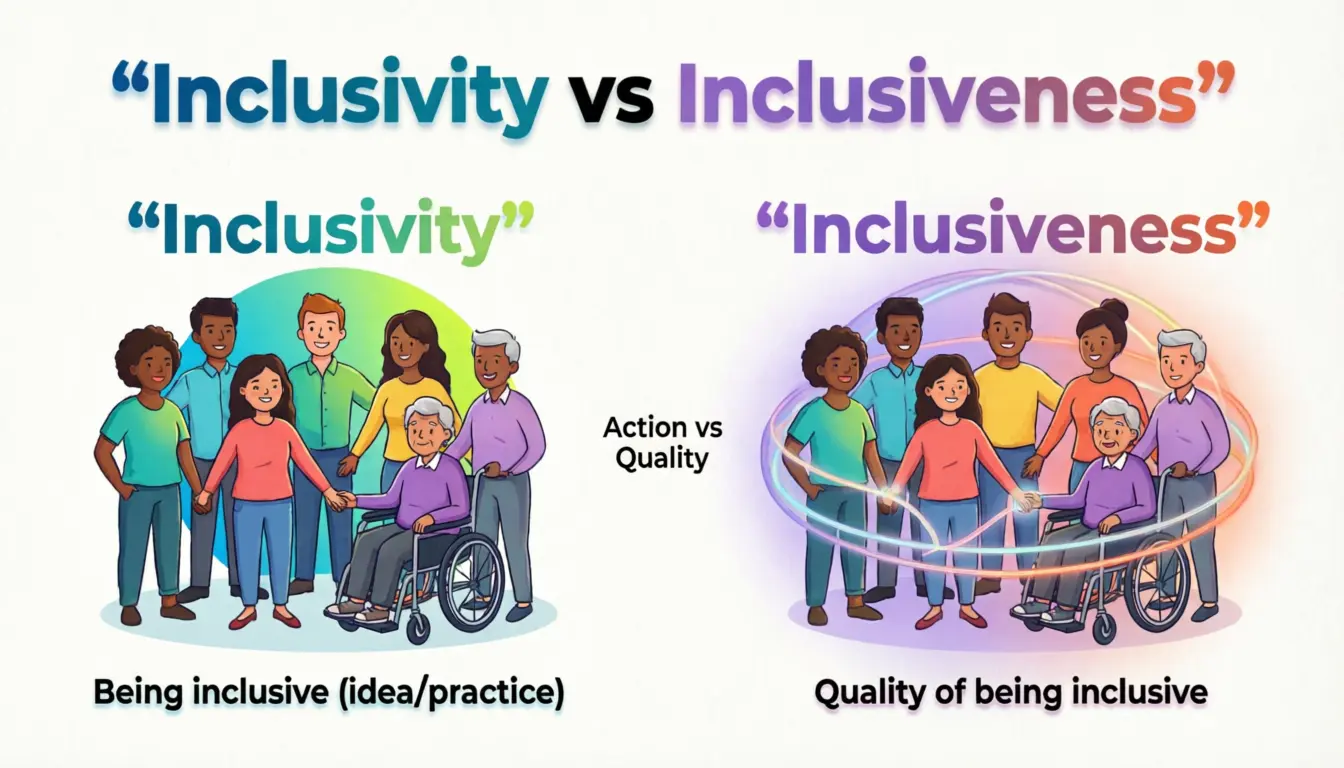
“Inclusivity” is the more modern and commonly used term referring to the practice or policy of including people of all backgrounds, while “inclusiveness” means the quality of being inclusive or open to everyone.
Many people search for “inclusivity vs inclusiveness” because the two words look almost the same. They also sound similar and often appear in schools, workplaces, government policies, and social media posts. This can make writers wonder: Are these words different? Is one more correct? Which one should I use in formal writing?
The good news is that both words are correct. However, they are not always used in exactly the same way. In some contexts, one may sound more natural than the other. Style guides, business language, and regional preferences can also affect which term people choose.
Understanding the difference helps you write clearly and professionally. It also helps avoid awkward wording in reports, emails, diversity policies, blog posts, and academic work. if you write for a US audience, a UK audience, or a global audience, knowing the right usage can improve your communication.
This guide explains the meaning, origin, spelling style, common mistakes, examples, and modern usage trends of inclusivity vs inclusiveness in very simple English.
Inclusivity vs Inclusiveness – Quick Answer
Inclusivity and inclusiveness both describe the idea of including all people fairly and equally.
- Inclusivity is more common in modern business, diversity, and social discussions.
- Inclusiveness is often used to describe the quality or state of being inclusive.
Simple Examples
- “The company promotes inclusivity in the workplace.”
- “The teacher is known for her inclusiveness toward all students.”
In many cases, the words can replace each other without changing the meaning.
| Word | Meaning | Common Use |
| Inclusivity | Practice of including everyone | Diversity, workplace, policy |
| Inclusiveness | Quality of being inclusive | General writing, descriptions |
The Origin of Inclusivity vs Inclusiveness
Both words come from the adjective inclusive.
The word inclusive comes from the Latin word includere, which means “to shut in” or “to include.”
Over time, English created two noun forms:
- Inclusiveness
- Inclusivity
Why Two Forms Exist
English often creates nouns using different endings:
- -ness → describes a quality or condition
- -ity → describes a state, system, or concept
This is why both words developed naturally.
Historical Usage
- Inclusiveness appeared earlier in traditional English writing.
- Inclusivity became more popular in modern social, political, and workplace discussions during recent decades.
Today, both are accepted in standard English.
British English vs American English Spelling
Unlike words such as “colour” and “color,” inclusivity and inclusiveness are not different spellings of the same word. They are separate word forms used in both British and American English.
Still, usage style can vary slightly.
American English
American writers often prefer inclusivity in:
- Corporate language
- DEI discussions
- Education policies
- Social justice topics
Example:
- “The university values inclusivity.”
British English
British writers may use both words equally, though inclusiveness can sound slightly more traditional.
Example:
- “The event was praised for its inclusiveness.”
Comparison Table
| Feature | Inclusivity | Inclusiveness |
| Word Type | Noun | Noun |
| Meaning | Inclusion of all people | Quality of being inclusive |
| Common in US | Very common | Common |
| Common in UK | Common | Very common |
| Formal Usage | Modern and professional | Traditional and descriptive |
| Workplace Language | Frequently used | Less frequent |
| Academic Writing | Common | Common |
Which Spelling Should You Use?
The best choice depends on your audience and writing style.
Use “Inclusivity” When:
- Writing for US readers
- Creating workplace policies
- Discussing diversity and equity
- Writing modern business content
- Posting on social media about inclusion
Example:
- “Our company supports inclusivity and equal opportunity.”
Use “Inclusiveness” When:
- Writing formal descriptions
- Creating educational content
- Writing for UK audiences
- Discussing general human behavior
Example:
- “Her inclusiveness made everyone feel welcome.”
For Global Audiences
If your audience is worldwide, inclusivity is usually the safer choice because it is widely used in modern international communication.
Common Mistakes with Inclusivity vs Inclusiveness
Many people confuse these words or use them awkwardly.
Here are common mistakes and corrections.
| Incorrect | Correct |
| “The company values inclusive.” | “The company values inclusivity.” |
| “Her inclusivity personality helped others.” | “Her inclusive personality helped others.” |
| “Inclusiveness policy” | “Inclusivity policy” |
| “We need more inclusive.” | “We need more inclusivity.” |
Mistake 1: Using the Adjective Instead of the Noun
Wrong:
- “The school supports inclusive.”
Correct:
- “The school supports inclusivity.”
Mistake 2: Mixing Formal and Informal Tone
“Inclusivity” sounds more modern and professional in business writing.
Mistake 3: Thinking One Word Is Incorrect
Both words are correct English words.
Inclusivity vs Inclusiveness in Everyday Examples
Here are real-life examples showing how both words appear in daily communication.
Emails
- “We are improving inclusivity in our hiring process.”
- “Thank you for promoting inclusiveness in the classroom.”
News Articles
- “The campaign focuses on inclusivity and equal access.”
- “The festival was praised for its inclusiveness.”
Social Media
- “Inclusivity matters.”
- “We need more inclusiveness in online communities.”
Formal Writing
- “The organization developed a framework for inclusivity.”
- “The report examined social inclusiveness in urban planning.”
Schools
- “Teachers should encourage inclusiveness among students.”
In Workplaces
- “HR teams often discuss inclusivity training.”
Inclusivity vs Inclusiveness – Google Trends & Usage Data
Search interest shows that inclusivity has grown strongly in recent years.
This is especially true in:
- The United States
- Canada
- Australia
- International business communities
Why Inclusivity Became More Popular
Modern workplace culture often uses terms like:
- Diversity
- Equity
- Inclusion
- Belonging
Because of this, inclusivity became common in professional language.
Where “Inclusiveness” Is Still Popular
“Inclusiveness” remains common in:
- Educational writing
- Government reports
- British English discussions
- General descriptive writing
Usage Trend Summary
| Region | More Common Word |
| United States | Inclusivity |
| Canada | Inclusivity |
| Australia | Inclusivity |
| United Kingdom | Both are common |
| Academic Writing | Both |
| Corporate Writing | Inclusivity |
Inclusivity vs Inclusiveness Comparison Table
| Aspect | Inclusivity | Inclusiveness |
| Meaning | Inclusion of everyone | Quality of being inclusive |
| Tone | Modern | Traditional |
| Business Usage | Very common | Moderate |
| Education Usage | Common | Very common |
| Social Media Usage | Very common | Common |
| UK English | Accepted | Accepted |
| US English | Preferred | Accepted |
| Professional Feel | Strong | Neutral |
| Easy Replacement | Often | Often |
FAQs About Inclusivity vs Inclusiveness
Is inclusivity a real word?
Yes. Inclusivity is a correct English word widely used in business, education, and social discussions.
Is inclusiveness more correct than inclusivity?
No. Both words are correct. The better choice depends on context and audience.
Which word is more common today?
“Inclusivity” is more popular in modern workplace and diversity language.
Can I use inclusivity and inclusiveness interchangeably?
Often yes, but slight tone differences exist.
Is inclusivity formal?
Yes. It is commonly used in professional and formal communication.
Which word should I use in academic writing?
Both are acceptable. Check your style guide or choose the term that best matches your tone.
Do British people say inclusiveness?
Yes. British English commonly uses both inclusiveness and inclusivity.
Why is inclusivity popular in workplaces?
Modern diversity and inclusion programs often use the word “inclusivity” because it sounds active and policy-focused.
Is inclusiveness outdated?
No. It is still widely used and fully correct.
Conclusion
The debate around inclusivity vs inclusiveness is mostly about style and context, not correctness. Both words describe the idea of including people fairly and making everyone feel welcome. However, they are used slightly differently in modern English.
Inclusivity is now more common in workplaces, diversity programs, social discussions, and professional communication. It sounds modern, direct, and policy-focused. This is why many companies, universities, and organizations prefer it today. people also search for Inclusivity vs diversity, Inclusiveness synonym, Inclusiveness in the workplace, Difference between inclusion and inclusive education, Inclusiveness examples, etc.
Inclusiveness, on the other hand, focuses more on the quality or character of being inclusive. It often appears in education, descriptive writing, and traditional English usage. Many British writers still use it naturally.
If you write for a global or professional audience, inclusivity is usually the best choice. If you want a softer or more descriptive tone, inclusiveness may fit better.
The most important thing is consistency. Pick one form based on your audience and use it clearly throughout your writing. Both words are correct, accepted, and useful in modern English.

I hold a degree in English Literature and Linguistics and have worked extensively on educational blogs, comparison websites, and digital learning platforms. My writing focuses on simplifying complex language rules, highlighting British vs American English differences, and providing practical examples for everyday usage.