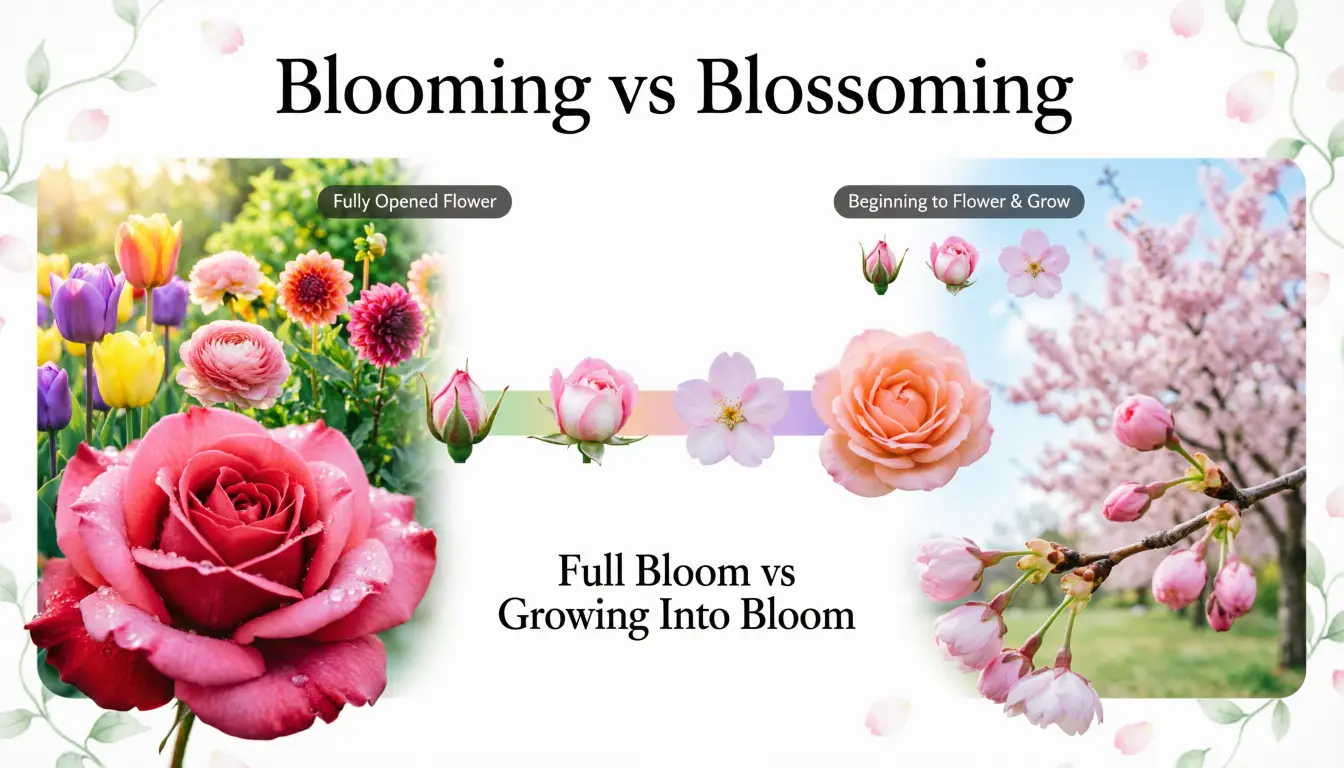
“Blooming” and “blossoming” are both correct words, but they have slightly different uses. “Blooming” refers to the act of producing flowers or being in flower, while “blossoming” can mean flowering but is also commonly used figuratively to describe growth, development, or flourishing potential in a person, relationship, or idea.
Have you ever read a sentence like “The garden is blooming” and another that says “The garden is blossoming,” then wondered if they mean the same thing? Many English learners, writers, and even native speakers search for blooming vs blossoming because both words describe flowers and growth. At first glance, they seem interchangeable, but there are subtle differences in meaning, tone, and usage.
Understanding these differences can help you choose the right word in essays, business writing, creative content, social media posts, and everyday conversations. While both words relate to flowers opening and things developing, one often focuses on the flower itself, while the other can suggest broader growth and progress.
In this guide, you’ll learn the meaning of blooming and blossoming, their origins, differences, usage examples, common mistakes, style recommendations, and practical exercises. By the end, you’ll know exactly when to use each word and how to avoid confusion.
Blooming vs Blossoming – Quick Answer
Blooming and blossoming are closely related words, but they are not always identical.
- Blooming usually means producing flowers or being in flower.
- Blossoming means flowering, but it can also mean developing, growing, or thriving.
Examples
✅ The roses are blooming in the garden.
✅ The apple trees are blossoming this spring.
Quick rule: Use blooming when talking mainly about flowers. Use blossoming when discussing growth, development, or success.
The Origin of Blooming vs Blossoming
Both words come from Old English and have been used for centuries.
Blooming
The word bloom comes from Old Norse and Old English roots meaning “flower” or “mass of flowers.” Over time, it became associated with flowers opening and showing their beauty.
Blossoming
The word blossom comes from Old English blostma, meaning flower or bloom. It originally referred to flowers on fruit trees such as apple, pear, and cherry trees.
Why the Difference Exists
Although both words refer to flowers, English speakers gradually gave them slightly different meanings:
| Word | Original Meaning | Modern Meaning |
| Blooming | Producing flowers | Flowering; flourishing |
| Blossoming | Having blossoms | Growing, developing, thriving |
Today, blossoming often carries a more figurative meaning than blooming.
British English vs American English Spelling
Unlike words such as analysed and analyzed, blooming and blossoming have the same spelling in British and American English.
Comparison Table
| British English | American English | Correct? |
| Blooming | Blooming | ✔ |
| Blossoming | Blossoming | ✔ |
| Blooming flowers | Blooming flowers | ✔ |
| Blossoming trees | Blossoming trees | ✔ |
Example:
British English
- The garden is blooming beautifully.
- The orchard is blossoming this spring.
American English
- The garden is blooming beautifully.
- The orchard is blossoming this spring.
There is no spelling difference between the two varieties of English.
Which Spelling Should You Use?
Since both words are spelled the same worldwide, your choice depends on meaning rather than location.
Use Blooming When:
- Talking about flowers opening.
- Describing colorful gardens.
- Referring directly to floral growth.
Example:The tulips are blooming early this year.
Use Blossoming When:
- Talking about flowers on trees.
- Describing personal growth.
- Discussing business or economic development.
Example: Her career is blossoming quickly.
For Global Audiences
Choose the word that best matches your meaning:
- Flowers → Blooming
- Growth and success → Blossoming
Common Mistakes with Blooming vs Blossoming
Many writers use these words incorrectly.
| Incorrect | Correct |
| His business is blooming into a successful company. | His business is blossoming into a successful company. |
| The apple tree is blooming with blossoms. | The apple tree is blossoming. |
| Her talents are blooming every day. | Her talents are blossoming every day. |
| The roses are blossoming colors. | The roses are blooming beautifully. |
Tips
- Think flowers = blooming.
- Think development = blossoming.
- Both can describe flowers, but blossoming is more common for growth and progress.
Blooming vs Blossoming in Everyday Examples
Email Writing
Blooming
“The roses in front of the office are blooming beautifully.”
Blossoming
“Our partnership is blossoming into a long-term success.”
News Writing
Blooming
“Thousands of wildflowers are blooming across the valley.”
Blossoming
“The local economy is blossoming thanks to new investments.”
Social Media
Blooming
“Look at these blooming sunflowers! “
Blossoming
“My photography skills are finally blossoming!”
Formal Writing
Blooming
“The species begins blooming in late spring.”
Blossoming
“The research field is blossoming with new discoveries.”
Blooming vs Blossoming – Google Trends & Usage Data
Search behavior shows that people often look for both terms when discussing flowers, gardening, and personal development.
Blooming Is Popular For:
- Gardening
- Flower care
- Seasonal flowers
- Nature writing
Blossoming Is Popular For:
- Personal growth
- Business success
- Relationships
- Creative writing
Usage by Context
| Context | Preferred Word |
| Gardens | Blooming |
| Roses | Blooming |
| Fruit trees | Blossoming |
| Careers | Blossoming |
| Businesses | Blossoming |
| Confidence | Blossoming |
Overall, blooming appears more frequently in gardening content, while blossoming is common in motivational and business writing.
Blooming vs Blossoming Comparison Table
| Feature | Blooming | Blossoming |
| Flower-related | ✔ | ✔ |
| Personal growth | Sometimes | ✔ |
| Business growth | Rare | ✔ |
| Nature writing | ✔ | ✔ |
| Figurative meaning | Limited | Strong |
| Common with trees | Sometimes | ✔ |
Blooming vs Blossoming in Academic Writing
Academic writers usually choose the word based on context.
Blooming
Used in:
- Botany
- Agriculture
- Environmental studies
Example:
“The species begins blooming during early spring.”
Blossoming
Used in:
- Sociology
- Psychology
- Education
- Economics
Example:
“The region’s technology sector is blossoming.”
Academic Tip
Use blooming for biological processes and blossoming for development or progress.
Blooming vs Blossoming in Business English
Business professionals often prefer blossoming because it suggests growth and success.
Example:
- The startup is blossoming into a major company.
- A blossoming market attracted investors.
- The partnership is blossoming rapidly.
Blooming is less common in business communication unless discussing products related to flowers or gardening.
Common Style Guide Recommendations
Most major style guides do not prescribe one word over the other. Instead, they recommend choosing the term that best fits the intended meaning.
General Guidance
| Situation | Recommended Word |
| Flowers opening | Blooming |
| Fruit trees flowering | Blossoming |
| Career growth | Blossoming |
| Economic growth | Blossoming |
| Garden description | Blooming |
Consistency and clarity matter more than preference.
Real Examples from Published Sources
Blooming
- Gardening magazines often discuss flowers blooming during spring.
- Botanical studies describe plant blooming cycles.
Blossoming
- Business publications write about blossoming industries.
- Educational articles discuss blossoming talent and creativity.
These examples show how blossoming is commonly used metaphorically, while blooming remains strongly connected to flowers.
Blooming vs Blossoming Quiz
Choose the correct answer.
1. The cherry trees are ______ this spring.
A. Blooming
B. Blossoming
Answer: B
2. Her artistic talent is ______ rapidly.
A. Blossoming
B. Blooming
Answer: A
3. The roses are ______ beautifully.
A. Blooming
B. Blossoming
Answer: A
4. The startup company is ______.
A. Blossoming
B. Blooming
Answer: A
5. The tulips are ______ in the garden.
A. Blooming
B. Blossoming
Answer: A
Fill in the Blanks Exercise
Complete the sentences.
- The apple orchard is __________ this spring.
- The young athlete’s career is __________ quickly.
- The roses are __________ near the fence.
- The city’s tourism industry is __________.
- Colorful flowers are __________ throughout the park.
Answers
- blossoming
- blossoming
- blooming
- blossoming
- blooming
FAQs
1. Are blooming and blossoming the same?
Not exactly. Both refer to flowering, but blossoming often suggests growth and development.
2. Which is more common in gardening?
Blooming is generally more common in gardening discussions.
3. Can blossoming describe people?
Yes. It often describes personal growth, confidence, or success.
4. Can blooming describe personal growth?
It can, but blossoming sounds more natural in most cases.
5. Is blossoming only for trees?
No. It can refer to trees, people, businesses, relationships, and ideas.
6. Which word sounds more formal?
Blossoming often sounds slightly more formal and literary.
7. Is blooming used in business English?
Occasionally, but blossoming is usually preferred.
8. Do British and American English spell them differently?
No. Both spellings are identical in British and American English.
9. Which word should I use in creative writing?
Use blooming for vivid flower imagery and blossoming for emotional or personal growth.
Conclusion
The debate over blooming vs blossoming is not about correct versus incorrect usage. Both words are valid and widely used in English. The key difference lies in their emphasis. Blooming focuses more on flowers opening and displaying their beauty, while blossoming often extends beyond flowers to describe growth, development, success, and transformation.
When writing about gardens, roses, tulips, and other flowering plants, blooming is often the best choice. When discussing careers, businesses, relationships, confidence, or skills that are developing over time, blossoming usually sounds more natural and expressive.
Fortunately, there is no British-versus-American spelling issue to worry about. The spellings remain the same worldwide. By understanding the subtle distinction between these words, you can write more clearly and choose the term that perfectly matches your message. Whether something is blooming in a garden or blossoming into something greater, both words celebrate beauty, growth, and positive change.

I am an Emily Carter Brooks U.S.A based linguistics writer known for my clear, reader-friendly explanations of English grammar and vocabulary differences. I have contributed to multiple online language resources and specializes in spelling variations, pronunciation confusion, and British vs American English comparisons. I’m passionate about helping learners improve their English through practical, everyday communication. engaging, and stress-free.