“Proved” is the standard past tense and past participle in most contexts, while “proven” is more commonly used as an adjective meaning shown to be true or reliable.
Have you ever typed “ingage” and wondered if it was correct? You are not alone. Many English learners and native speakers search for engage vs ingage because the two words sound almost identical when spoken. This creates confusion, especially in emails, business communication, social media posts, and academic writing.
The good news is that the answer is simple. One spelling is accepted in standard English, while the other is considered a spelling mistake. Yet thousands of people search for this comparison every month because pronunciation can make the words seem interchangeable.
Understanding the difference is important if you want your writing to look professional and accurate. Whether you are writing a job application, a marketing message, a blog post, or a social media caption, using the correct spelling can improve credibility and clarity.
In this guide, you’ll learn the quick answer, the origin of the word, spelling rules, common mistakes, usage examples, and trends showing which version people use most often. By the end, you’ll know exactly when to use engage and why ingage should generally be avoided.
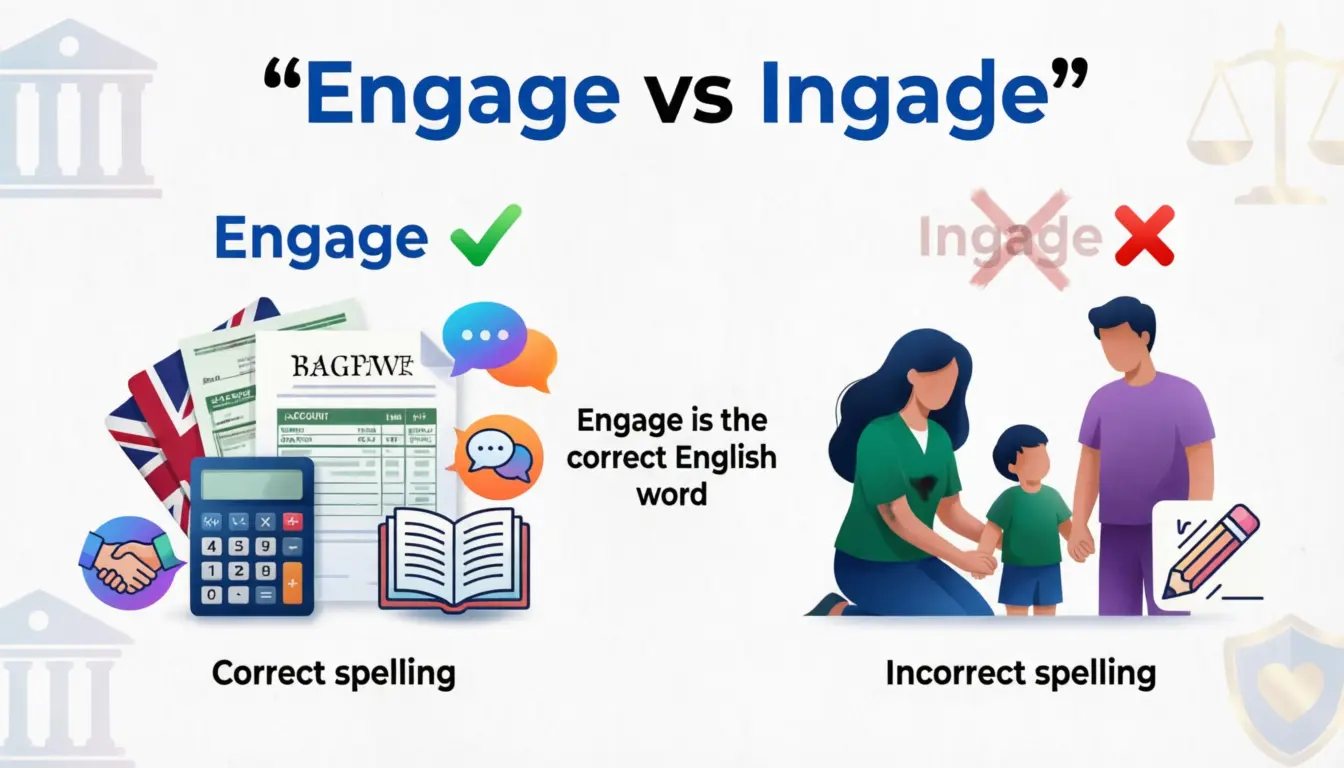
Engage vs Ingage – Quick Answer
Engage is the correct spelling.
Ingage is considered a misspelling in modern English and is not accepted in standard dictionaries.
Examples
✅ Correct:
- We need to engage with customers more effectively.
- The teacher used games to engage students.
- Please engage with the discussion.
❌ Incorrect:
- We need to ingage with customers.
- The teacher tried to ingage students.
Quick rule: Always use engage in formal and informal writing.
The Origin of Engage vs Ingage
The word engage comes from the Old French word engager, which means “to pledge” or “to involve.”
The French prefix en- means “in” or “into,” while the root relates to a pledge or commitment. Over time, English adopted the spelling engage, and it became the standard form.
Why Does “Ingage” Exist?
The confusion comes from pronunciation.
In spoken English, the first syllable of engage often sounds similar to “in.” Because of this, some writers assume the word starts with the letter i and write ingage.
Historically, some older texts occasionally used alternative spellings, but modern English standardized the form as engage.
Today:
- Engage = accepted spelling
- Ingage = spelling error
British English vs American English Spelling
Unlike many English words, there is no spelling difference between British and American English.
Both countries use engage.
Comparison Table
| English Variant | Correct Spelling |
| American English | Engage |
| British English | Engage |
| Australian English | Engage |
| Canadian English | Engage |
| New Zealand English | Engage |
| Ingage | Incorrect |
Examples
| Region | Example |
| United States | We must engage customers online. |
| United Kingdom | The charity hopes to engage volunteers. |
| Australia | Schools engage students through activities. |
No major English-speaking country recognizes ingage as the standard spelling.
Which Spelling Should You Use?
The answer is simple: use engage everywhere.
If Your Audience Is American
Use engage.
Examples
- Companies should engage with customers through social media.
If Your Audience Is British
Use engage.
Examples
- The organization hopes to engage local communities.
If Your Audience Is Global
Use engage.
It is recognized worldwide and appears in dictionaries, style guides, educational materials, and professional publications.
Professional Advice
If spell-check highlights ingage, accept the correction and change it to engage.
Common Mistakes with Engage vs Ingage
Many people make errors because the words sound alike.
Mistake #1: Writing by Sound
❌ Ingage the audience.
✅ Engage the audience.
Mistake #2: Ignoring Spell Check
❌ We must ingage our customers.
✅ We must engage our customers.
Mistake #3: Using Ingage in Business Writing
❌ The campaign aims to ingage users.
✅ The campaign aims to engage users.
Mistake #4: Social Media Typos
❌ How do you ingage followers?
✅ How do you engage followers?
Quick Correction Rule
Whenever you write ingage, replace it with engage.
Engage vs Ingage in Everyday Examples
Understanding real-world usage helps make the difference clear.
Emails
✅ We would like to engage with your team on this project.
❌ We would like to ingage with your team.
News Articles
✅ The government plans to engage citizens in the discussion.
❌ The government plans to ingage citizens.
Social Media
✅ Great content helps engage followers.
❌ Great content helps ingage followers.
In Formal Writing
✅ The program aims to engage participants.
❌ The program aims to ingage participants.
In Marketing
✅ Brands must engage customers consistently.
❌ Brands must ingage customers consistently.
Engage vs Ingage – Google Trends & Usage Data
Search data shows that engage is overwhelmingly more popular than ingage.
Usage Comparison
| Word | Status |
| Engage | Standard English |
| Ingage | Misspelling |
Why People Search for “Ingage”
Common reasons include:
- Pronunciation confusion
- Typing mistakes
- Learning English as a second language
- Auto-correct errors
- Uncertainty about spelling rules
Countries Where Searches Are Common
People frequently search engage vs ingage in:
- United States
- United Kingdom
- Canada
- Australia
- India
- Pakistan
The searches usually come from users checking whether ingage is a valid alternative spelling.
Contexts Where Engage Is Common
- Business communication
- Marketing
- Education
- Social media
- Customer service
- Public speaking
- Human resources
In all of these contexts, engage is the preferred spelling.
Engage vs Ingage Comparison Table
| Feature | Engage | Ingage |
| Correct spelling | Yes | No |
| Dictionary approved | Yes | No |
| Used in professional writing | Yes | No |
| Used in academic writing | Yes | No |
| Accepted worldwide | Yes | No |
| Common typo | No | Yes |
| Recommended for engaging content | Yes | No |
FAQs About Engage vs Ingage
1. Is ingage a real word?
No. Modern English dictionaries recognize engage, not ingage.
2. Why do people spell engage as ingage?
Because the pronunciation can sound similar to “in-gage.”
3. Is ingage acceptable in business writing?
No. Professional writing should always use engage.
4. Does British English use ingage?
No. British English uses engage, just like American English.
5. Is engage spelled differently in the UK?
No. The spelling remains engage.
6. Can I use ingage in informal writing?
It is not recommended because readers may see it as a spelling mistake.
7. Which spelling appears in dictionaries?
Engage appears in major dictionaries worldwide.
8. Does spell-check recognize ingage?
Most spell-check tools flag ingage as an error and suggest engage.
9. Which spelling should students use?
Students should always use engage in assignments, essays, and exams.
Conclusion
The debate between engage vs ingage is actually quite simple once you understand the spelling rules. Engage is the correct and universally accepted spelling in modern English. It appears in dictionaries, educational materials, professional documents, news articles, and everyday communication across the English-speaking world. On the other hand, ingage is generally considered a spelling mistake that results from pronunciation confusion.
There is no British-versus-American spelling difference here. Whether you are writing for readers in the United States, the United Kingdom, Canada, Australia, Pakistan, or anywhere else, engage is the spelling you should use. Using the correct form helps your writing look more professional and trustworthy.
If you ever feel unsure, remember this simple rule: engage is correct, ingage is incorrect. Modern spell-check tools, dictionaries, and style guides all support this standard. By choosing engage, you ensure that your message is clear, accurate, and understood by readers everywhere. That makes it the best choice for emails, academic writing, business communication, social media, and formal documents.

I hold a degree in English Literature and Linguistics and have worked extensively on educational blogs, comparison websites, and digital learning platforms. My writing focuses on simplifying complex language rules, highlighting British vs American English differences, and providing practical examples for everyday usage.