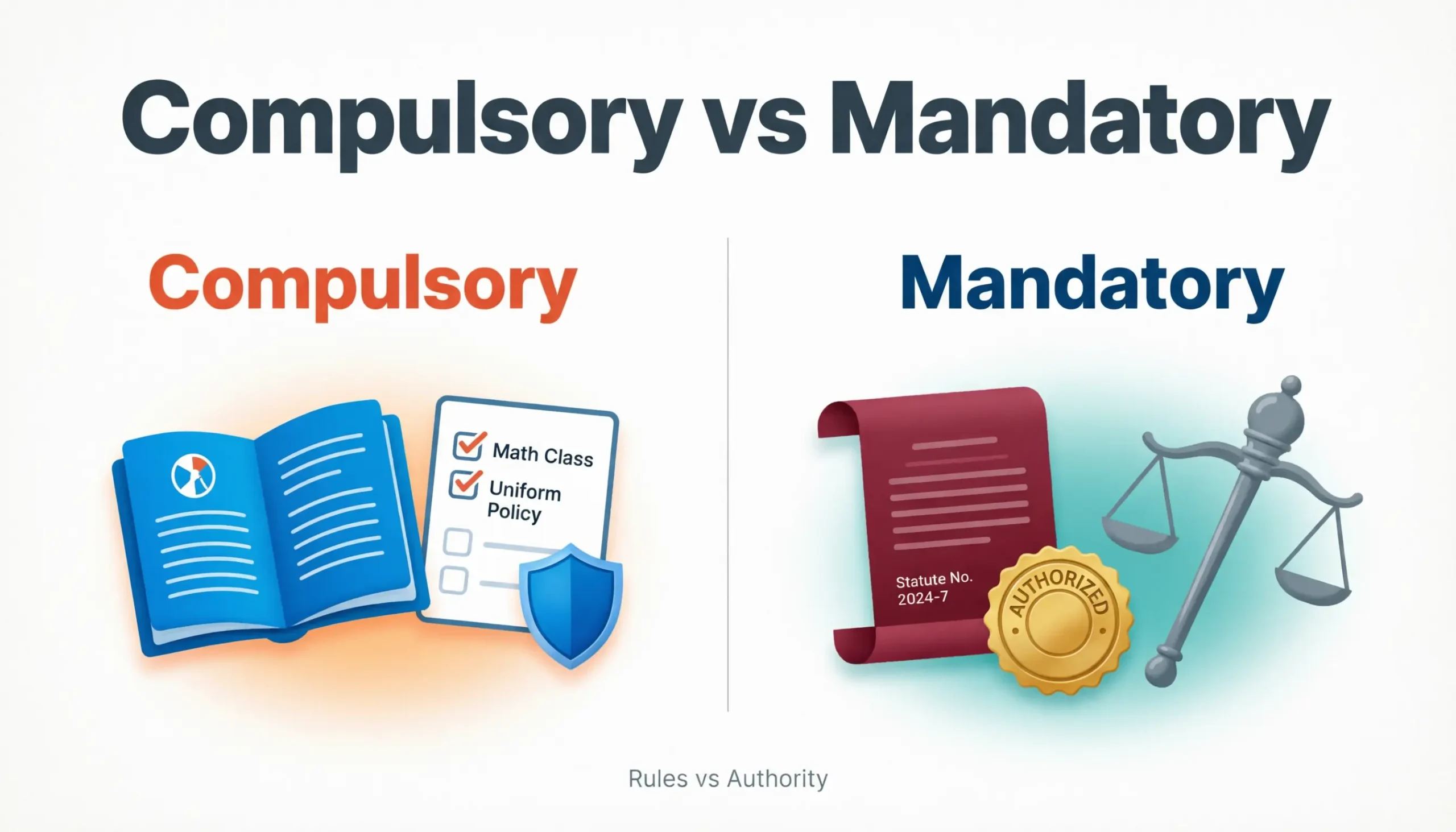
“Compulsory” usually refers to something required by rules, laws, or regulations, especially in education or official systems, while “mandatory” emphasizes that something must be done because it is officially required or enforced.
Many people search for “compulsory vs mandatory” because the two words seem almost the same. Both words mean that something is required and not optional. You may see them in school rules, laws, workplace policies, travel rules, and official documents. Because they are so close in meaning, writers often wonder which word is better to use.
The confusion becomes stronger because some countries use one word more often than the other. For example, British English commonly uses compulsory in education and law, while American English often prefers mandatory in business and government writing. This makes learners, students, bloggers, and professionals unsure about the correct choice.
The good news is that both words are correct. The main difference is usually tone, region, and context. In this guide, you will learn the meaning of each word, where they came from, how they are used in the UK and US, and which one you should choose for formal or casual writing.
You will also see easy examples, common mistakes, comparison tables, FAQs, and usage tips to help you write with confidence.
Compulsory vs Mandatory – Quick Answer
Both compulsory and mandatory mean something is required by rules, law, or authority.
- Compulsory is more common in British English.
- Mandatory is more common in American English and formal business language.
Simple Examples
| Word | Example Sentence | Meaning |
| Compulsory | School attendance is compulsory. | Required by law |
| Mandatory | Wearing a helmet is mandatory. | Required by rules |
Quick Difference
- Compulsory often sounds educational or legal.
- Mandatory sounds official, formal, or administrative.
In most situations, the meaning is nearly identical.
The Origin of Compulsory vs Mandatory
The word compulsory comes from the Latin word compellere, which means “to force.” English speakers started using it in legal and educational settings many centuries ago.
The word mandatory comes from the Latin word mandare, meaning “to order” or “to command.” It became popular in official and government language later.
Why the Difference Exists
The difference is not really about spelling. It is more about language habits and style preferences.
- British English kept using compulsory in schools, laws, and public rules.
- American English started using mandatory more often in workplaces, government notices, and official policies.
That is why you may hear:
- “Compulsory education” in the UK
- “Mandatory training” in the US
Both are correct English.
British English vs American English Spelling
There is no spelling difference between these words in British and American English. The difference is mainly about preference and usage.
British English Usage
British English often uses compulsory for:
- School subjects
- Military service
- Insurance
- Voting laws
Examples
- Mathematics is a compulsory subject.
- Seat belts are compulsory by law.
American English Usage
American English often uses mandatory for:
- Company rules
- Workplace training
- Government regulations
- Health policies
Examples
- Attendance is mandatory.
- Employees must complete mandatory training.
Comparison Table
| Feature | Compulsory | Mandatory |
| Meaning | Required | Required |
| Common in UK | Yes | Less common |
| Common in US | Less common | Yes |
| Tone | Traditional, educational | Official, professional |
| Common Contexts | Schools, laws | Business, government |
Which Spelling Should You Use?
The best choice depends on your audience.
Use “Compulsory” If:
- Your audience is in the UK, Australia, India, or other Commonwealth countries.
- You are writing about education or legal requirements.
- You want a traditional British tone.
Examples
- Physical education is compulsory for all students.
Use “Mandatory” If:
- Your audience is in the United States.
- You are writing business documents or official policies.
- You want a modern professional tone.
Examples
- Cybersecurity training is mandatory for all staff.
Best Choice for Global Audiences
If your readers come from many countries, either word works. Still, mandatory may feel more international in business writing, while compulsory is clearer in educational topics.
Common Mistakes with Compulsory vs Mandatory
People often mix these words incorrectly. Here are some common mistakes.
| Incorrect Usage | Correct Usage |
| The meeting is compulsory for employees. | The meeting is mandatory for employees. |
| Mandatory education starts at age five. | Compulsory education starts at age five. |
| Wearing uniforms is compulsory in the office. | Wearing uniforms is mandatory in the office. |
Mistake 1: Using “Compulsory” in Modern Business Writing
In many workplaces, mandatory sounds more natural.
✅ Correct:
- Attendance at the workshop is mandatory.
Mistake 2: Using “Mandatory” in Traditional Education Topics
In British education writing, compulsory is often preferred.
✅ Correct:
- English is a compulsory subject.
Mistake 3: Thinking One Word Is Wrong
Both words are correct. The choice depends on context and audience.
Compulsory vs Mandatory in Everyday Examples
Here are simple real-life examples.
Emails
- Completing this form is mandatory before Friday.
- Attendance at the orientation session is compulsory.
News Headlines
- Government announces compulsory vaccination policy.
- Mandatory ID checks begin at airports.
Social Media
- “Is attendance compulsory tomorrow?”
- “The company made overtime mandatory.”
In Formal Writing
- Wearing safety equipment is mandatory in the factory.
- Military service was once compulsory in several countries.
Compulsory vs Mandatory – Google Trends & Usage Data
Search trends show that both words are widely used, but popularity changes by region.
Countries That Prefer “Compulsory”
- United Kingdom
- Australia
- India
- New Zealand
These countries often use the word in schools and public law.
Countries That Prefer “Mandatory”
- United States
- Canada
These countries commonly use it in workplaces and government communication.
Context Differences
| Context | More Common Word |
| Education | Compulsory |
| Corporate Policies | Mandatory |
| Government Rules | Mandatory |
| Traditional Legal Writing | Compulsory |
Online Search Behavior
People usually search this topic because they want to know:
- Which word is correct
- Whether there is a grammar difference
- Which word sounds more professional
- Which word to use in academic or business writing
Detailed Comparison Table
| Aspect | Compulsory | Mandatory |
| Meaning | Required by rule or law | Required by rule or authority |
| Origin | Latin “compellere” | Latin “mandare” |
| Tone | Traditional | Formal and modern |
| Common Region | UK/Commonwealth | United States |
| Common Use | Education, law | Business, policies |
| Formality Level | Formal | Very formal |
| Interchangeable? | Usually yes | Usually yes |
FAQs About Compulsory vs Mandatory
1. Is compulsory the same as mandatory?
Yes. Both words mean something is required and not optional.
2. Which word is more formal?
Both are formal, but mandatory often sounds more official in business writing.
3. Is compulsory British English?
Yes. British English uses compulsory more often than American English.
4. Is mandatory American English?
Yes. Americans commonly use mandatory in workplaces and government language.
5. Can I use the words interchangeably?
In most cases, yes. The meaning is very similar.
6. Which word should I use in academic writing?
Use the version that matches your audience or style guide.
7. Which word sounds stronger?
Many people feel mandatory sounds stricter because it is common in official rules.
8. Is compulsory outdated?
No. It is still widely used, especially in British English.
9. Which word is better for content writing?
Use the word your audience searches for most. For US readers, “mandatory” may perform better.
Conclusion
The debate between compulsory vs mandatory is mostly about usage style, audience, and region rather than meaning. Both words describe something required by law, policy, or authority. In everyday English, they are often interchangeable, but each word carries a slightly different tone.
Compulsory is more common in British English and is often linked with education, public law, and traditional formal writing. You will frequently hear phrases like “compulsory education” or “compulsory voting” in Commonwealth countries.
Mandatory, on the other hand, is more common in American English and modern professional settings. It appears often in workplace rules, government policies, and official business communication. Phrases like “mandatory training” and “mandatory reporting” are very common in the United States.
The best choice depends on your audience. If you write for UK readers, compulsory may sound more natural. If your audience is American or corporate, mandatory is usually the better fit. For global audiences, both words are acceptable as long as you stay consistent throughout your writing.

I am an Emily Carter Brooks U.S.A based linguistics writer known for my clear, reader-friendly explanations of English grammar and vocabulary differences. I have contributed to multiple online language resources and specializes in spelling variations, pronunciation confusion, and British vs American English comparisons. I’m passionate about helping learners improve their English through practical, everyday communication. engaging, and stress-free.