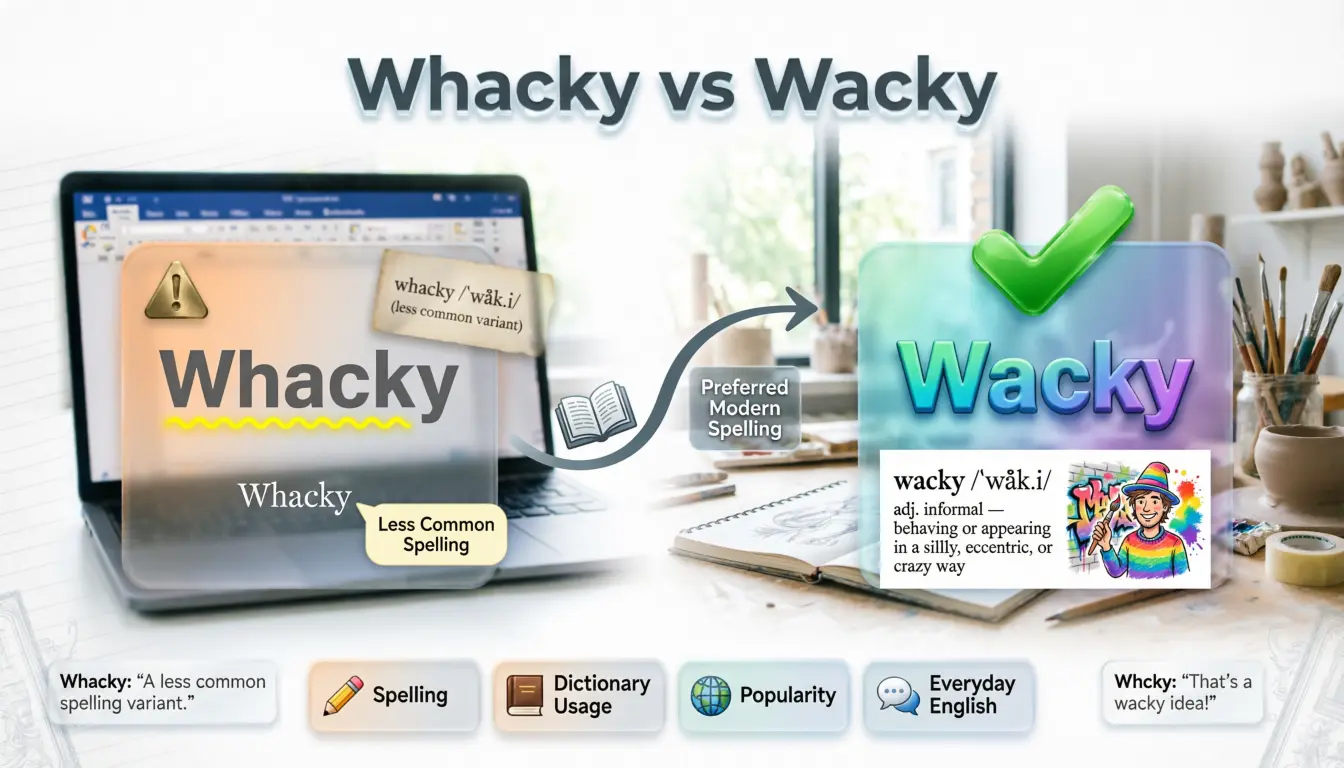
“Wacky” is the standard and more common spelling, while “whacky” is an accepted variant used less frequently. “Wacky” means funny, eccentric, bizarre, or amusingly unconventional. Although “whacky” appears in some dictionaries, “wacky” is the preferred spelling in modern English
You may have seen both whacky and wacky used online, in memes, comments, or even news headlines. They look similar.
They sound the same. Yet people often wonder: which one is correct? This is why many users search for “whacky or wacky” every day.
The confusion usually comes from pronunciation and informal writing. When people hear the word spoken, it sounds like it could include an H, just like whale or what. Spellcheck tools sometimes fail to catch this mistake, which adds to the problem.
Writers, students, bloggers, and even professionals want to know which spelling is safe to use.
This article solves that confusion once and for all. You will get a quick answer, a deep explanation, and clear advice on which spelling to use in emails, social media, news writing, and formal work.
We will also cover British vs American English, common mistakes, examples, trends, and FAQs.
By the end, you will never hesitate again when choosing between whacky or wacky.
Read more about;
Amoung or Among
Edited or Editted
Whacky or Wacky – Quick Answer
Wacky is the correct spelling.
Whacky is a common misspelling.
Simple explanation:
- ✅ Wacky means funny, strange, silly, or unusual.
- ❌ Whacky is not accepted in standard English dictionaries.
Examples:
- ✔️ He has a wacky sense of humor.
- ✔️ The movie had a wacky plot.
- ❌ He has a whacky sense of humor. (incorrect)
If you are writing for school, work, blogs, or content, always use “wacky.”
The Origin of Whacky or Wacky
To understand why wacky is correct, we need to look at history.
Where does “wacky” come from?
The word wacky comes from the noun “wack,” which appeared in American English in the early 1900s. Wack meant:
- Silly
- Not normal
Over time, wacky became the adjective form.
Why does “whacky” exist?
Whacky appeared later due to:
- Phonetic spelling (people write what they hear)
- Influence of words starting with “wh” (what, when, why)
- Informal internet writing
However, whacky was never recognized as a standard spelling. Major dictionaries list wacky, not whacky.
Key point:
The spelling difference does not come from British vs American English. It comes from mistakes in usage, not language rules.
British English vs American English Spelling
Unlike many spelling debates, whacky or wacky is not a UK vs US issue.
Important fact:
- British English: wacky
- American English: wacky
- Australian English: wacky
- Canadian English: wacky
There is no accepted variant spelling with an H.
Comparison Table: British vs American Usage
| Feature | British English | American English |
|---|---|---|
| Correct spelling | wacky | wacky |
| Accepted in dictionaries | Yes | Yes |
| “Whacky” accepted? | No | No |
| Used in formal writing | Yes | Yes |
Example sentences:
- UK: That’s a wacky idea, but it might work.
- US: He wore a wacky costume to the party.
Which Spelling Should You Use?
Your choice is easy because there is only one correct option.
Use wacky if:
- Your audience is American
- Your audience is British
- You write for a global audience
- You care about content and ranking
- You want to look professional
Avoid whacky if:
- You are writing articles or blogs
- You are sending emails
- You are posting on LinkedIn
- You are doing academic work
Professional Tip:
Search engines treat whacky as a spelling error. Using wacky improves:
- Content trust
- Readability
- Ranking potential
Professional rule:
If it matters, use wacky.
Common Mistakes with Whacky or Wacky
Many writers make the same errors again and again.
Mistake 1: Adding “H” for sound
❌ That’s a whacky idea.
✔️ That’s a wacky idea.
Mistake 2: Assuming British spelling uses “wh”
❌ British English prefers whacky.
✔️ Both use wacky.
Mistake 3: Trusting informal sources
Social media often uses whacky, but that does not make it correct.
Mistake 4: Inconsistent usage
❌ The story is wacky, but the ending is whacky.
✔️ The story is wacky, and the ending is wacky.
Quick correction tip:
If spellcheck highlights whacky, trust it.
Whacky or Wacky in Everyday Examples
Let’s see how wacky works in real life.
Emails
✔️ Sorry for the delay—today has been a bit wacky.
News
✔️ The actor is known for his wacky interviews.
Social Media
✔️ This filter makes everyone look wacky
Marketing
✔️ A wacky ad campaign helped the brand go viral.
Formal Writing
✔️ The novel uses wacky humor to explore serious themes.
In all contexts, wacky fits.
Whacky does not.
Whacky or Wacky in Academic Writing
In academic writing, wacky is the preferred and widely accepted spelling. It is recognized by major dictionaries and style guides, making it suitable for essays, research papers, and educational content. The spelling whacky is considered a less common variant and may appear outdated or inconsistent in formal contexts.
Since academic writing values clarity and consistency, using wacky helps maintain a professional tone. For example: “The study examined how wacky advertisements influence consumer attention.”
Whacky or Wacky in Business
In business communication, wacky is generally the better choice because it looks more polished and is the standard spelling in modern English. Companies often use the word to describe creative marketing campaigns, unusual product designs, or unconventional ideas.
While whacky may occasionally appear in branding or informal content, wacky is more recognizable to a global audience. For example: “The company launched a wacky advertising campaign that quickly went viral.”
Whacky or Wacky Quiz
Test your understanding of whacky vs wacky with this quick quiz.
1. Which spelling is the standard form in modern English?
a) Whacky
b) Wacky ✅
2. Which spelling is recommended for academic and business writing?
a) Wacky ✅
b) Whacky
3. Which sentence is correct?
a) The team came up with a wacky solution to the problem. ✅
b) The team came up with a whacky solution to the problem.
4. True or False: “Whacky” is an accepted variant but less common than “wacky.”
✅ True
5. Fill in the blank:
The designer created a ______ costume that everyone loved.
Answer: wacky
Whacky or Wacky – Google Trends & Usage Data
Search behavior shows clear patterns.
What people search:
- “whacky or wacky”
- “is whacky correct”
- “whacky vs wacky spelling”
Usage insights:
- Wacky appears far more often in books, articles, and media.
- Whacky spikes only in informal searches.
- English-learning countries search this keyword often.
By region:
- USA: wacky dominates
- UK: wacky dominates
- India & Pakistan: high confusion due to spoken English
- Global blogs: wacky preferred
Conclusion from trends:
People ask the question, but experts agree on the answer.
Comparison Table: Whacky vs Wacky
| Feature | Whacky | Wacky |
|---|---|---|
| Correct spelling | ❌ No | ✅ Yes |
| Dictionary accepted | ❌ No | ✅ Yes |
| British English | ❌ | ✅ |
| American English | ❌ | ✅ |
| User-friendly | ❌ | ✅ |
| Formal writing | ❌ | ✅ |
| Meaning | None (error) | Silly, funny, strange |
FAQs
1. Is “whacky” ever correct?
No. Whacky is always considered a spelling mistake.
2. Why do people spell wacky as whacky?
Because it sounds like it should have an H, similar to what or why.
3. Do dictionaries accept whacky?
No major English dictionary accepts whacky.
4. Is wacky informal?
Yes, it is informal, but still correct English.
5. Can I use wacky in professional writing?
Yes, when tone allows it, such as marketing or creative writing.
6. Is wacky slang?
No. It is informal but not slang.
7. Which spelling is better for content?
Wacky is better for content and readability.
Conclusion
The debate around whacky or wacky is common, but the answer is simple. Wacky is the correct spelling. Whacky is a mistake that comes from sound-based guessing and casual writing habits.
There is no British or American spelling difference here. English speakers around the world agree on wacky.
Using the correct form helps your writing look clean, professional, and trustworthy. It also helps with search engine rankings and reader confidence.
If you remember one thing, remember this:
If it looks funny, sounds funny, or feels strange, it’s wacky without an H.
Use wacky in emails, blogs, news, marketing, and everyday writing. Avoid whacky unless you are quoting a mistake.
Clear spelling builds clear communication.
Related Topics:
Whacky or Wacky Synonyms
If you’re looking for whacky or wacky synonyms, the correct spelling is wacky. Common synonyms include unbelievable, quirky, zany, eccentric, goofy, bizarre, oddball, and offbeat. These words describe someone or something that is amusingly unusual, unconventional, or delightfully strange.
Whacky or Wacky Meaning
The whacky or wacky meaning refers to behavior, ideas, or situations that are funny, silly, or pleasantly unusual. While whacky is sometimes seen as an alternative spelling, wacky is the standard form used in modern English dictionaries and writing.
Whacky or Wacky in English
In English, wacky is the preferred and widely accepted spelling. It appears in dictionaries, books, newspapers, and academic resources. Although whacky is occasionally used, it is considered a less common variant and is generally avoided in formal writing.
Whacky or Wacky Funny
The phrase whacky or wacky funny is often used to describe a unique style of humor that is playful, absurd, or completely unexpected. A wacky comedy, joke, or character makes people laugh through exaggerated, quirky, and unconventional behavior rather than ordinary humor.
Wacky Person Meaning
A wacky person is someone with an energetic, quirky, or unconventional personality. Calling someone wacky is usually meant as a lighthearted compliment, suggesting they are fun, creative, and enjoy doing things differently, rather than being serious or predictable.
Wacky Synonyms
Some of the best wacky synonyms include zany, goofy, eccentric, odd, bizarre, whimsical, unconventional, off-the-wall, and outlandish. Each synonym carries a slightly different shade of meaning, but they all describe something amusingly strange or delightfully unconventional.
Wacky Races
Wacky Races is a classic animated television series featuring a group of eccentric racers competing in hilarious and unpredictable contests. The show’s colorful characters and outrageous vehicles perfectly capture the playful and chaotic meaning of the word wacky.
Wacky Wednesday
Wacky Wednesday is a popular children’s book by Dr. Seuss that encourages readers to spot funny and unusual things hidden throughout the illustrations. The title reflects the idea of a day filled with silly, unexpected, and delightfully wacky events, making it a favorite among young readers.
Read More About:
- Diverges or Converges – Which One is Correct and When to Use It?
- Inhume or Inhumane – Which One Is Correct?
- Present or Gift – Which One Is Correct?
- Scale or Balance – Which One Is Correct?

I am an Emily Carter Brooks U.S.A based linguistics writer known for my clear, reader-friendly explanations of English grammar and vocabulary differences. I have contributed to multiple online language resources and specializes in spelling variations, pronunciation confusion, and British vs American English comparisons. I’m passionate about helping learners improve their English through practical, everyday communication. engaging, and stress-free.