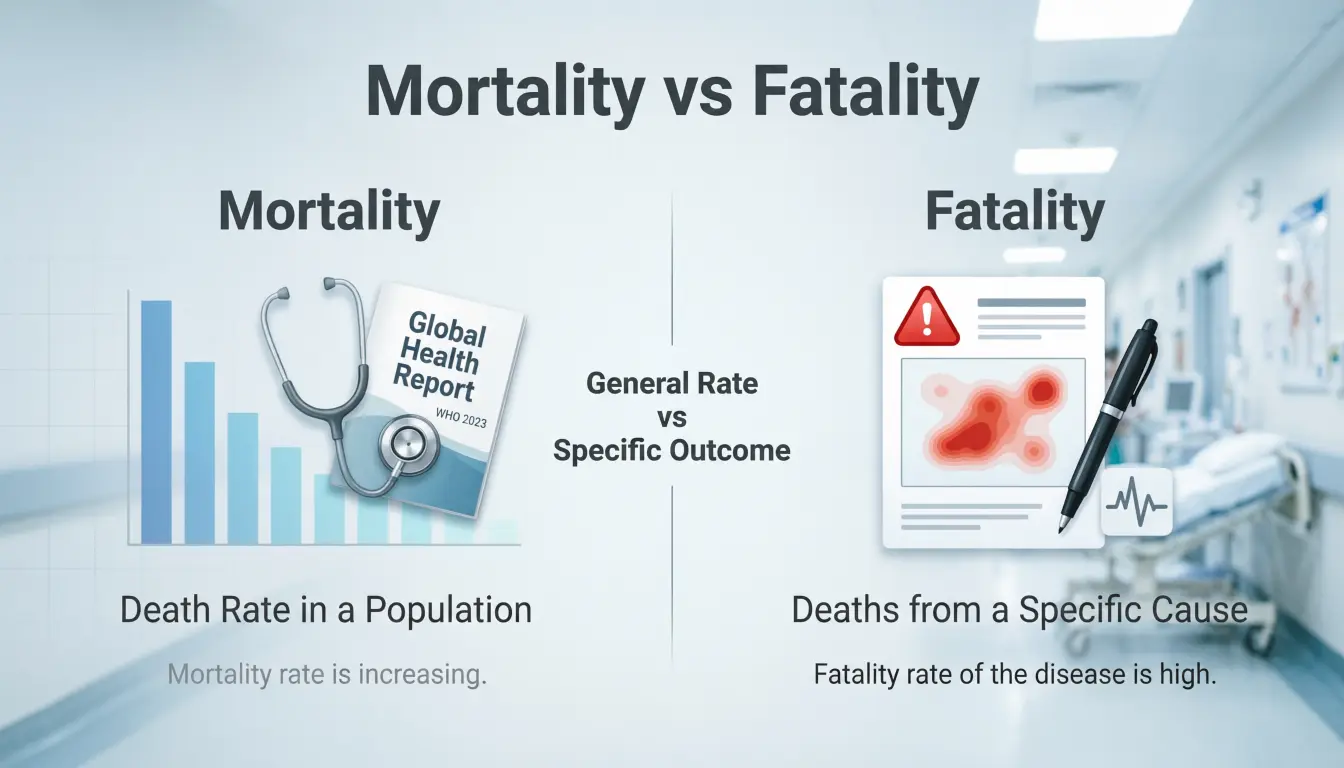
“Mortality” and “fatality” are both correct words, but they are used in different ways. “Mortality” refers to death in general or the rate of death in a population, while “fatality” refers to a specific death caused by an accident, disease, or event.
Many people use mortality and fatality as if they mean the same thing. Both words relate to death, so the confusion is understandable. However, these terms have different meanings and are used in different situations.
People often search for “mortality vs fatality” when reading news reports, medical studies, health statistics, or safety reports. You may see phrases like mortality rate, fatality rate, or traffic fatalities and wonder whether they all describe the same thing. Understanding the difference can help you communicate more clearly and avoid mistakes in professional or academic writing.
In simple terms, mortality refers to deaths within a population, while fatality refers to a death caused by a specific event, accident, disease, or incident. The distinction becomes important in healthcare, public safety, insurance, journalism, and research.
This guide explains the meanings, origins, usage rules, spelling considerations, common mistakes, examples, trends, and practical advice for choosing the correct word.
Mortality vs Fatality – Quick Answer
Mortality means the state or rate of death within a population.
Fatality means a death resulting from a particular event, accident, disease, or cause.
Examples
- The city reported a lower mortality rate this year.
- The crash resulted in three fatalities.
- Doctors study infant mortality rates.
- News reports often mention road fatalities.
Quick Comparison
| Term | Meaning | Example |
| Mortality | Deaths within a population | Mortality rate increased during winter. |
| Fatality | A death caused by a specific incident | The fire caused two fatalities. |
The Origin of Mortality vs Fatality
Both words come from Latin but developed different meanings over time.
Mortality
The word mortality comes from the Latin word mortalitas, meaning “subject to death.” It entered English in the 14th century and was used to describe death among people generally.
Fatality
The word fatality comes from the Latin word fatalis, meaning “decreed by fate.” Later, English speakers began using it to describe deaths caused by accidents, disasters, diseases, or other specific events.
Why the Difference Exists
Although both words relate to death, their usage evolved differently:
- Mortality focuses on populations and statistics.
- Fatality focuses on individual deaths linked to a cause.
This distinction remains important in modern English.
British English vs American English Spelling
Unlike many English words, mortality and fatality have the same spelling in both British and American English.
Examples
| British English | American English |
| mortality rate | mortality rate |
| infant mortality | infant mortality |
| road fatalities | road fatalities |
| fatality count | fatality count |
Comparison Table
| Feature | British English | American English |
| Mortality spelling | Mortality | Mortality |
| Fatality spelling | Fatality | Fatality |
| Meaning difference | Same | Same |
| Professional usage | Same | Same |
There are no spelling differences between these words across major English varieties.
Which Spelling Should You Use?
Since both words are spelled the same worldwide, the choice depends on meaning rather than audience.
Use Mortality When:
- Discussing death rates.
- Talking about populations.
- Writing medical reports.
- Presenting health statistics.
Examples: The country reduced child mortality over the last decade.
Use Fatality When:
- Discussing deaths from a specific event.
- Reporting accidents.
- Describing disasters.
- Writing safety reports.
Examples: The earthquake caused hundreds of fatalities.
Audience-Based Advice
| Audience | Recommended Usage |
| US readers | Use the term that matches the meaning. |
| UK readers | Use the term that matches the meaning. |
| Commonwealth countries | Same rule applies. |
| Global audience | Use mortality for rates and fatality for event-related deaths. |
Common Mistakes with Mortality vs Fatality
Many writers confuse these terms because both involve death.
Mistake #1: Using Fatality for Population Statistics
❌ The country’s fatality rate fell last year.
✔ The country’s mortality rate fell last year.
Mistake #2: Using Mortality for Accident Deaths
❌ The plane crash caused ten mortalities.
✔ The plane crash caused ten fatalities.
Mistake #3: Assuming They Are Interchangeable
❌ Mortality and fatality always mean the same thing.
✔ They are related but have different uses.
Mistake #4: Mixing Medical and News Contexts
❌ Traffic mortality reached five people yesterday.
✔ Traffic fatalities reached five people yesterday.
Mortality vs Fatality in Everyday Examples
In Emails
Mortality
The report examines mortality trends among older people patients.
Fatality
The safety review investigated workplace fatalities.
In News Reports
Mortality
Researchers observed a decline in infant mortality.
Fatality
Authorities confirmed two fatalities after the storm.
On Social Media
Mortality
Better healthcare can reduce mortality rates.
Fatality
Officials reported one fatality in the accident.
In Formal Writing
Mortality
Mortality statistics provide insight into public health.
Fatality
The investigation examined the cause of each fatality.
Mortality vs Fatality – Google Trends & Usage Data
Search interest for mortality vs fatality remains steady because these words appear frequently in:
- Medical research
- Public health reports
- News articles
- Safety studies
- Government statistics
Mortality Is Common In:
- Healthcare
- Epidemiology
- Demographics
- Academic research
Fatality Is Common In:
- News reporting
- Transportation safety
- Workplace safety
- Disaster coverage
Popular Regions
| Country | Common Search Focus |
| United States | Medical and accident statistics |
| United Kingdom | Health reports and news |
| Canada | Public health and safety |
| Australia | Road safety and healthcare |
| India | Health studies and news reporting |
Generally, mortality appears more often in academic and medical contexts, while fatality appears more often in news and safety reporting.
Mortality vs Fatality Comparison Table
| Feature | Mortality | Fatality |
| Meaning | Death within a population | Death caused by a specific event |
| Context | Health and statistics | Accidents and disasters |
| Common Phrase | Mortality rate | Fatality rate |
| Focus | Groups of people | Individual deaths |
| Used In | Research, healthcare | News, safety reports |
| Formality | Highly formal | Formal and general |
Quick Quiz: Mortality vs Fatality
Choose the correct word.
1. The car accident resulted in one _____.
A. mortality
B. fatality
Answer: B. fatality
2. Researchers studied infant _____ rates.
A. mortality
B. fatality
Answer: A. mortality
3. The earthquake caused several _____.
A. fatalities
B. mortalities
Answer: A. fatalities
4. Public health experts monitor _____ statistics.
A. mortality
B. fatality
Answer: A. mortality
5. The workplace incident led to two _____.
A. fatalities
B. mortalities
Answer: A. fatalities
Fill in the Blanks
Complete the sentences using mortality or fatality.
- The fire caused three __________.
Answer: Fatality
- The hospital reported a decline in __ rates.
Answer: mortality
FAQs
1. What is the main difference between mortality and fatality?
Mortality refers to deaths within a population, while fatality refers to a death caused by a specific event or incident.
2. Is mortality the same as a fatality rate?
No. Mortality rate measures deaths in a population. Fatality rate measures deaths resulting from a particular cause or event.
3. Can I use mortality and fatality interchangeably?
No. They have different meanings and should be used in different contexts.
4. Which word is used in medical research?
Mortality is more common in medical and public health research.
5. Which word is used in accident reports?
Fatality is commonly used in accident, disaster, and safety reports.
6. Are there spelling differences between British and American English?
No. Both words are spelled the same in British and American English.
7. What is a mortality rate?
A mortality rate is the number of deaths in a population over a specific period.
8. What is a fatality rate?
A fatality rate measures deaths resulting from a specific disease, accident, or event.
9. Which word is more common in news articles?
Fatality is more common in news reports about accidents and disasters.
Conclusion
Understanding the difference between mortality vs fatality helps you communicate clearly and accurately. While both words relate to death, they serve different purposes in English. Mortality focuses on deaths within a population and is commonly used in healthcare, demographics, public health, and academic research. Fatality, on the other hand, refers to a death caused by a specific accident, disaster, disease, or event and appears frequently in news reports and safety discussions.
The good news is that there are no British or American spelling differences for either word. The real challenge is choosing the correct term for the situation. If you are discussing death rates among groups of people, use mortality. If you are referring to deaths caused by a particular incident, use fatality.
Remember this simple rule: mortality measures death in populations, while fatality counts deaths from specific causes or events. Following this guideline will make your writing more professional, accurate, and easier for readers to understand.

I am an Emily Carter Brooks U.S.A based linguistics writer known for my clear, reader-friendly explanations of English grammar and vocabulary differences. I have contributed to multiple online language resources and specializes in spelling variations, pronunciation confusion, and British vs American English comparisons. I’m passionate about helping learners improve their English through practical, everyday communication. engaging, and stress-free.