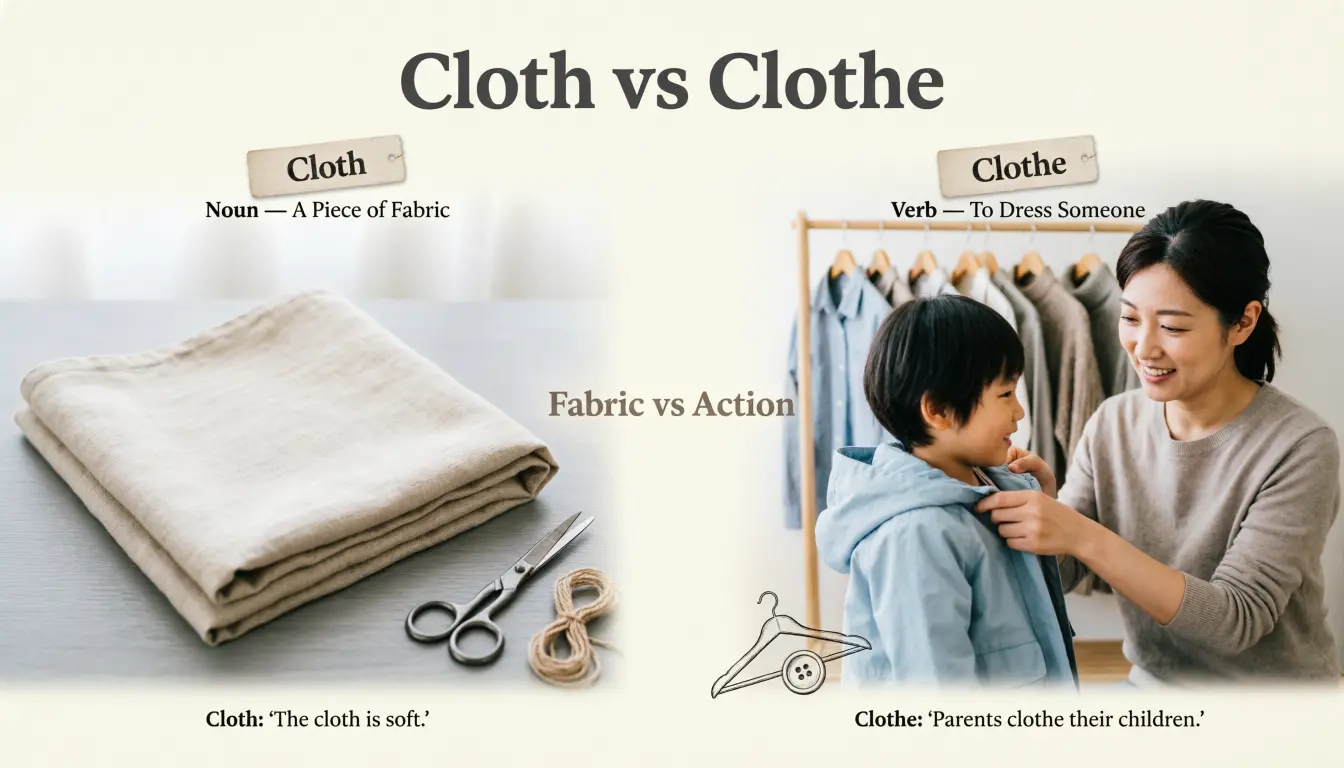
“Cloth” and “clothe” are both correct words, but they have different meanings. “Cloth” is a noun referring to fabric or material used for making clothes and other items, while “clothe” is a verb meaning to dress or provide someone with clothing.
Have you ever stopped while writing and wondered whether to use cloth or clothe? You are not alone. These two words look almost identical, but they have different meanings and uses. Because they differ by only one letter, many writers, students, and English learners often mix them up.
People search for cloth vs clothe because they want to know which spelling is correct in a sentence. Is it “a cloth” or “a clothe”? Should you say “cloth your child” or “clothe your child”? These questions are common because the words are closely related in meaning.
The confusion becomes even greater when writing emails, reports, social media posts, or academic papers. Using the wrong word can make a sentence sound strange or incorrect.
This guide explains the difference between cloth and clothe in simple language. You will learn their meanings, origins, correct usage, common mistakes, spelling rules, and real-world examples. By the end, you will know exactly when to use each word with confidence.
Cloth vs Clothe – Quick Answer
Cloth is a noun. It refers to fabric or a piece of material.
Clothe is a verb. It means to dress or provide clothing.
Examples
✅ The table was covered with a clean cloth.
✅ She bought a soft cotton cloth.
Quick Rule
- Cloth = Thing (noun)
- Clothe = Action (verb)
If you are talking about fabric, use cloth.
If you are talking about dressing someone, use clothe.
The Origin of Cloth vs Clothe
The words cloth and clothe come from the same Old English roots.
Cloth
The word cloth comes from the Old English word clāth, meaning fabric, garment, or covering. For hundreds of years, it has been used to describe material made from woven fibers.
Clothe
The word clothe developed from the noun cloth. English speakers added the ending -e to create a verb meaning “to cover with clothing” or “to dress.”
Why the Spelling Difference Exists
English often creates verbs from nouns.
Examples
| Noun | Verb |
| Bath | Bathe |
| Breath | Breathe |
| Cloth | Clothe |
The extra e often signals a change from a thing to an action.
British English vs American English Spelling
Unlike many English words, cloth and clothe are spelled the same way in both British English and American English.
There is no regional spelling difference.
Examples
| Meaning | British English | American English |
| Fabric | Cloth | Cloth |
| To dress | Clothe | Clothe |
| Table fabric | Table cloth | Table cloth |
| Dress a child | Clothe a child | Clothe a child |
Comparison Table
| Feature | Cloth | Clothe |
| Part of Speech | Noun | Verb |
| Meaning | Fabric or material | To dress someone |
| Example | A cleaning cloth | Clothe the poor |
| British English | Same spelling | Same spelling |
| American English | Same spelling | Same spelling |
Key Point
The difference is grammar, not regional spelling.
Which Spelling Should You Use?
The correct choice depends on what you want to say.
Use Cloth When:
- Talking about fabric
- Referring to material
- Mentioning cleaning cloths
- Discussing textiles
Examples
- I bought a silk cloth.
- The cloth was expensive.
- Use a damp cloth to clean the screen.
Use Clothe When:
- Talking about dressing someone
- Referring to providing clothing
- Describing an action
Examples:
- We must clothe the children.
- The organization helps clothe families.
- They clothe workers in protective gear.
Audience-Based Advice
| Audience | Recommended Usage |
| United States | Use cloth for fabric, clothe for dressing |
| United Kingdom | Use cloth for fabric, clothe for dressing |
| Australia | Same rule |
| Canada | Same rule |
| Global Audience | Follow standard grammar distinction |
No matter where your audience lives, the rule remains the same.
Common Mistakes with Cloth vs Clothe
Many writers accidentally use one word in place of the other.
Mistake 1
❌ Please use a clean clothe.
✅ Please use a clean cloth.
Reason: You need a noun, not a verb.
Mistake 2
❌ The charity clothes poor families.
✅ The charity clothes poor families.
Reason: The verb form changes to clothes in the present tense.
Mistake 3
❌ We bought a new clothe for the table.
✅ We bought a new cloth for the table.
Mistake 4
❌ Parents should cloth their children.
✅ Parents should clothe their children.
Easy Memory Trick
- Cloth = Fabric
- Clothe = Dress
The ending e reminds you that it is an action word.
Cloth vs Clothe in Everyday Examples
In Emails
Cloth
“Please wipe the equipment with a soft cloth.”
Clothe
“Our mission is to clothe families affected by the storm.”
In News Articles
Cloth
“The factory produces cotton cloth for export.”
Clothe
“The charity plans to clothe thousands of refugees.”
On Social Media
Cloth
“Just bought a beautiful linen cloth for my dining table.”
Clothe
“Donate today and help clothe children in need.”
In Formal Writing
Cloth
“The cloth industry contributes significantly to the economy.”
Clothe
“The program aims to clothe vulnerable populations.”
Cloth vs Clothe – Google Trends & Usage Data
Search interest shows that cloth is generally used more often than clothe.
Why Cloth Is More Popular
People frequently search for:
- Cleaning cloth
- Table cloth
- Cotton cloth
- Cloth fabric
- Microfiber cloth
These terms appear in daily life and shopping searches.
Why Clothe Is Less Common
The verb clothe appears mainly in:
- Charitable campaigns
- Formal writing
- Educational content
- Government reports
Usage by Country
| Country | More Common Search |
| United States | Cloth |
| United Kingdom | Cloth |
| Canada | Cloth |
| Australia | Cloth |
| India | Cloth |
Context Comparison
| Word | Common Context |
| Cloth | Fabric, textiles, cleaning |
| Clothe | Dressing people, charity work |
| Clothes | Everyday garments |
| Clothing | General apparel |
Because fabric-related searches are more frequent, cloth tends to appear more often in search data.
Cloth vs Clothe Comparison Table
| Feature | Cloth | Clothe |
| Word Type | Noun | Verb |
| Meaning | Fabric | To dress |
| Pronunciation | Klawth/Kloth | Klohth |
| Example Sentence | Use a clean cloth. | Please clothe the children. |
| Common Usage | Textiles, cleaning | Dressing people |
| Frequency | Higher | Lower |
Quick Quiz
Choose the correct answer.
1. Use a soft ______ to clean the table.
A. Cloth
B. Clothe
Answer: A. Cloth
2. The charity helps ______ homeless families.
A. Cloth
B. Clothe
Answer: B. Clothe
3. She bought a cotton ______.
A. Cloth
B. Clothe
Answer: A. Cloth
4. Parents must ______ their children.
A. Cloth
B. Clothe
Answer: B. Clothe
5. The silk ______ was expensive.
A. Cloth
B. Clothe
Answer: A. Cloth
Fill in the Blanks Exercise
Complete each sentence.
- Please use a clean ______ to wipe the screen.
- The charity works to ______ families in need.
- She bought a beautiful piece of ______.
- Parents should ______ their children properly.
- The factory produces cotton ______.
Answers
- cloth
- clothe
- cloth
- clothe
- cloth
FAQs
1. What is the difference between cloth and clothe?
Cloth is a noun meaning fabric. Clothe is a verb meaning to dress someone.
2. Is cloth or clothe used for fabric?
Cloth is the correct word for fabric or material.
3. Is clothe a real word?
Yes. Clothe is a verb that means to provide clothing or dress someone.
4. Why do people confuse cloth and clothe?
They look very similar and come from the same root word.
5. Which word is more common?
Cloth is generally more common because people often discuss fabrics and cleaning materials.
6. Is there a British and American spelling difference?
No. Both countries use cloth and clothe in the same way.
7. What is the plural of cloth?
The plural form is cloths.
8. Is clothes related to clothe?
Yes. Clothes refers to garments, while clothe means to dress someone.
9. Can cloth be used as a verb?
In modern English, cloth is almost always used as a noun.
Conclusion
Understanding cloth vs clothe is easier than it first appears. The key difference is that cloth is a noun and clothe is a verb. If you are talking about fabric, material, textiles, or cleaning products, use cloth. If you are describing the action of dressing someone or providing clothing, use clothe.
Both words share the same historical roots, which explains why they look so similar. However, their grammatical roles are different. This distinction remains the same in British English, American English, Canadian English, and other forms of English around the world.
A simple memory trick can help: cloth is a thing, clothe is an action. Whenever you are unsure, ask yourself whether you are talking about fabric or the act of dressing someone. The answer will quickly point you to the correct word.
By using the examples, comparison tables, quiz, and exercises in this guide, you can confidently choose the right word in emails, articles, reports, social media posts, and professional writing.

I hold a degree in English Literature and Linguistics and have worked extensively on educational blogs, comparison websites, and digital learning platforms. My writing focuses on simplifying complex language rules, highlighting British vs American English differences, and providing practical examples for everyday usage.