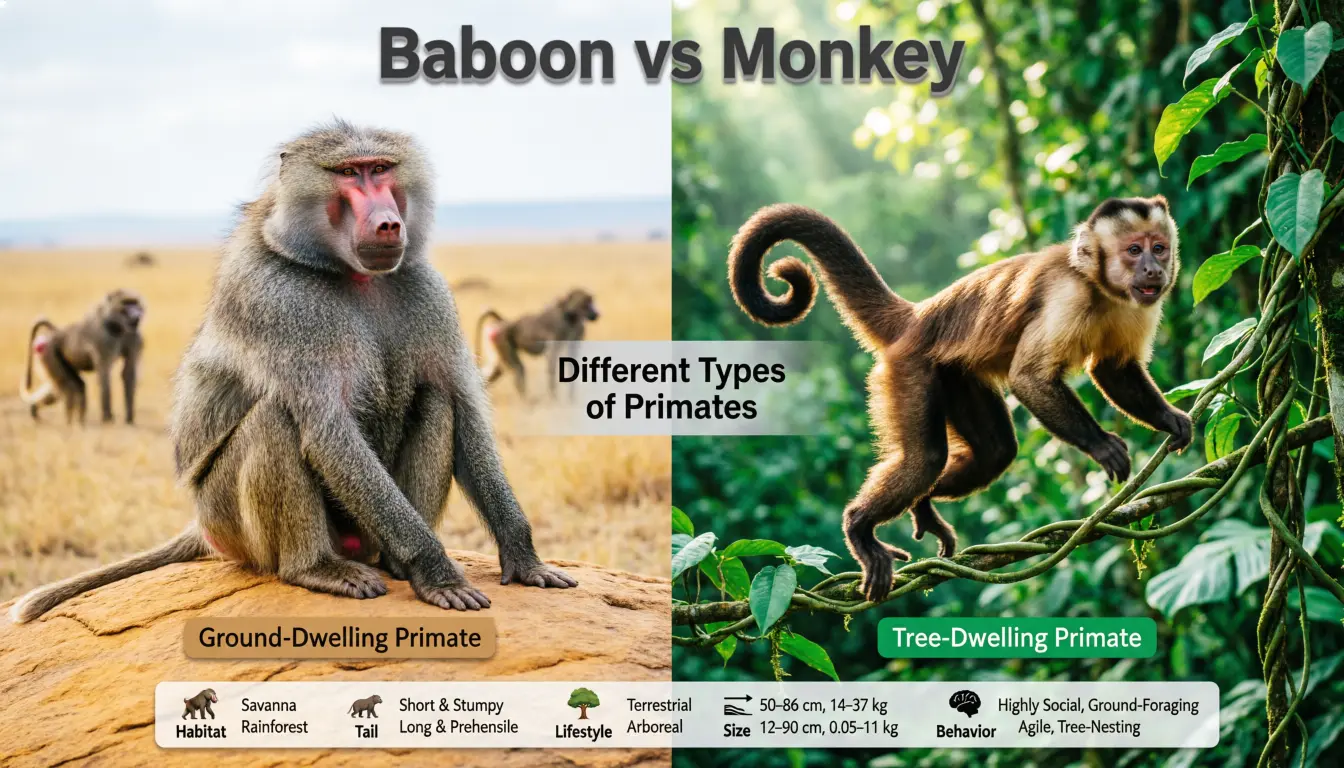
“Baboon” and “monkey” are both correct terms, but they do not refer to the same animal. “Baboon” is a specific type of large, ground-dwelling monkey known for its long snout and powerful build, while “monkey” is a broader term that includes many different species of primates, including baboons, macaques, capuchins, and others.
Have you ever looked at a picture of a baboon and wondered if it was just another type of monkey? Many people use the words baboon and monkey as if they mean the same thing. This confusion is common because baboons belong to the monkey family. However, not all monkeys are baboons.
People search for baboon vs monkey because they want to understand the differences in appearance, behavior, habitat, and classification. The two animals share many traits, but they also have important differences that make them unique.
Knowing the difference is useful for students, wildlife enthusiasts, travelers, and anyone interested in animals. It also helps avoid mistakes in school projects, articles, and everyday conversations.
In this guide, you will learn what separates a baboon from a monkey, where they live, how they behave, and which characteristics make baboons stand out from other monkeys. By the end, the confusion between baboons and monkeys will be gone.
Baboon vs Monkey – Quick Answer
A baboon is a type of monkey, but not all monkeys are baboons.
Baboons belong to the genus Papio and are among the largest monkeys in the world. They have long dog-like faces, strong jaws, and live mainly in Africa and parts of Arabia.
Monkeys are a broader group of primates that include hundreds of species found in Africa, Asia, Central America, and South America.
Examples
- A chacma baboon is a baboon and also a monkey.
- A capuchin monkey is a monkey but not a baboon.
- A spider monkey is a monkey but not a baboon.
The Origin of Baboon vs Monkey
Origin of the Word “Baboon”
The word baboon comes from the French word babouin, which was used centuries ago to describe large dog-faced monkeys.
Origin of the Word “Monkey”
The word monkey comes from Middle English and appeared in European literature during the 15th century. It became the common term for many tailed primates.
Why the Difference Exists
The difference exists because baboon refers to one specific group of monkeys, while monkey is a general category covering many species.
Think of it this way:
- Dog vs Animal
- Rose vs Flower
- Baboon vs Monkey
A baboon is a member of the larger monkey family.
British English vs American English Spelling
Unlike words such as “analysed” and “analyzed,” there is no spelling difference between British English and American English for baboon and monkey.
Comparison Table
| Term | British English | American English |
| Baboon | Baboon | Baboon |
| Monkey | Monkey | Monkey |
| Baboon troop | Baboon troop | Baboon troop |
| Monkey species | Monkey species | Monkey species |
Both regions use the same spelling.
Which Term Should You Use?
Your choice depends on the animal you are describing.
Use “Baboon” When:
- Referring specifically to baboons
- Discussing African wildlife
- Talking about Papio species
Use “Monkey” When:
- Referring to monkeys in general
- Discussing many primate species
- Comparing different monkey groups
For Global Audiences
Use the most accurate term possible.
- Specific animal → Baboon
- General category → Monkey
Common Mistakes with Baboon vs Monkey
Many people make these errors.
| Incorrect | Correct |
| All monkeys are baboons. | Baboons are one type of monkey. |
| Baboons are apes. | Baboons are monkeys. |
| Every monkey has a dog-like face. | Only some species, such as baboons, have dog-like faces. |
| Baboons live everywhere monkeys live. | Baboons mainly live in Africa and Arabia. |
Quick Tip
Remember:
Baboon = specific type.
Monkey = larger category.
Baboon vs Monkey in Everyday Examples
“Our zoo recently welcomed two young baboons.”
News
“Researchers studied monkey behavior in tropical forests.”
Social Media
“Look at this funny baboon climbing a rock!”
Formal Writing
“The baboon is one of the largest Old World monkey species.”
Baboon vs Monkey – Google Trends & Usage Data
Search interest in baboon vs monkey often increases when:
- Wildlife documentaries are released
- Zoo exhibits become popular
- Students research animal classification
- Nature programs discuss primates
Popular Countries for Searches
- United States
- United Kingdom
- Canada
- Australia
- South Africa
People commonly search:
- Is a baboon a monkey?
- Monkey vs baboon size
- Baboon characteristics
- Types of monkeys
The search intent is usually educational.
Baboon vs Monkey Comparison Table
| Feature | Baboon | Monkey |
| Classification | Specific monkey group | Broad primate category |
| Scientific Group | Papio | Multiple genera |
| Size | Usually larger | Small to large |
| Face | Dog-like snout | Varies by species |
| Tail | Short tail | Usually longer tail |
| Habitat | Africa and Arabia | Worldwide tropical regions |
| Species Count | 5 major species | 260+ species |
| Social Structure | Large troops | Varies widely |
Baboon vs Monkey in Academic Writing
Academic writing requires precision.
Correct Example
“Baboon social behavior differs from that of many other monkey species.”
Less Precise Example
“Monkey behavior differs from monkey behavior.”
Researchers prefer the term baboon when discussing baboon-specific studies.
Academic Tip
Use scientific names when possible:
- Baboon = Papio
- Monkey = broader primate classification
Baboon vs Monkey in Business English
Business writing occasionally references animals in branding, tourism, conservation, and education.
Examples
- “The safari featured several baboon troops.”
- “The report discussed monkey populations across Africa.”
Specificity improves professionalism.
Common Style Guide Recommendations
Most style guides recommend:
- Use accurate animal names.
- Avoid using monkey when baboon is intended.
- Capitalize only when starting a sentence.
- Use scientific names in technical documents.
Recommended Usage
✔ Baboon troop
✔ Monkey species
Real Examples from Published Sources
Wildlife Publication Example
“Baboons live in large social groups known as troops.”
Educational Source Example
“Monkeys are divided into Old World and New World monkeys.”
Conservation Report Example
“Baboons adapt well to different environments.”
These examples show how professionals distinguish between baboons and monkeys.
Baboon vs Monkey Quiz
Choose the correct answer.
1. Is a baboon a monkey?
A. No
B. Yes
Answer: B
2. Which is more specific?
A. Monkey
B. Baboon
Answer: B
3. Where do most baboons live?
A. Europe
B. Africa
Answer: B
4. Which group contains more species?
A. Monkey
B. Baboon
Answer: A
5. Do baboons have tails?
A. Yes
B. No
Answer: A
Fill in the Blanks Exercise
Fill in the correct word.
- A ______ is a type of monkey.
- Most baboons live in ______.
- A capuchin is a ______ but not a baboon.
- Baboons belong to the genus ______.
- The word monkey describes a broader ______.
Answers
- baboon
- Africa
- monkey
- Papio
- category
FAQs
1. Is a baboon a monkey?
Yes. A baboon is one type of monkey.
2. Are baboons and monkeys the same?
Not exactly. Every baboon is a monkey, but many monkeys are not baboons.
3. Are baboons apes?
No. Baboons belong to the monkey group, not the ape group.
4. Why do baboons look different from many monkeys?
They have longer snouts, larger bodies, and stronger jaws.
5. Which is bigger, a baboon or a monkey?
Baboons are generally larger than many monkey species.
6. How many baboon species exist?
There are five widely recognized baboon species.
7. Do baboons have tails?
Yes, although their tails are usually shorter than those of many monkeys.
8. Where are baboons found?
Mostly in Africa, with some populations in the Arabian Peninsula.
9. Why do people confuse baboons with monkeys?
Because baboons are members of the monkey family.
Conclusion
Understanding baboon vs monkey is easier once you know that a baboon is a specific type of monkey. The word monkey refers to a large group of primates that includes hundreds of species, while baboon refers to members of the genus Papio. This means every baboon is a monkey, but not every monkey is a baboon.
Baboons stand out because of their large size, dog-like faces, strong social groups, and African habitats. Other monkeys may look very different and live in various parts of the world. Knowing these distinctions helps students, writers, researchers, and animal lovers use the correct terminology.
When writing or speaking, choose baboon when discussing that specific animal and monkey when referring to the broader category. This approach improves accuracy and prevents confusion.
The next time someone asks whether a baboon is a monkey, you can confidently explain that baboons are part of the monkey family but they are only one branch of a much larger primate group.

I hold a degree in English Literature and Linguistics and have worked extensively on educational blogs, comparison websites, and digital learning platforms. My writing focuses on simplifying complex language rules, highlighting British vs American English differences, and providing practical examples for everyday usage.