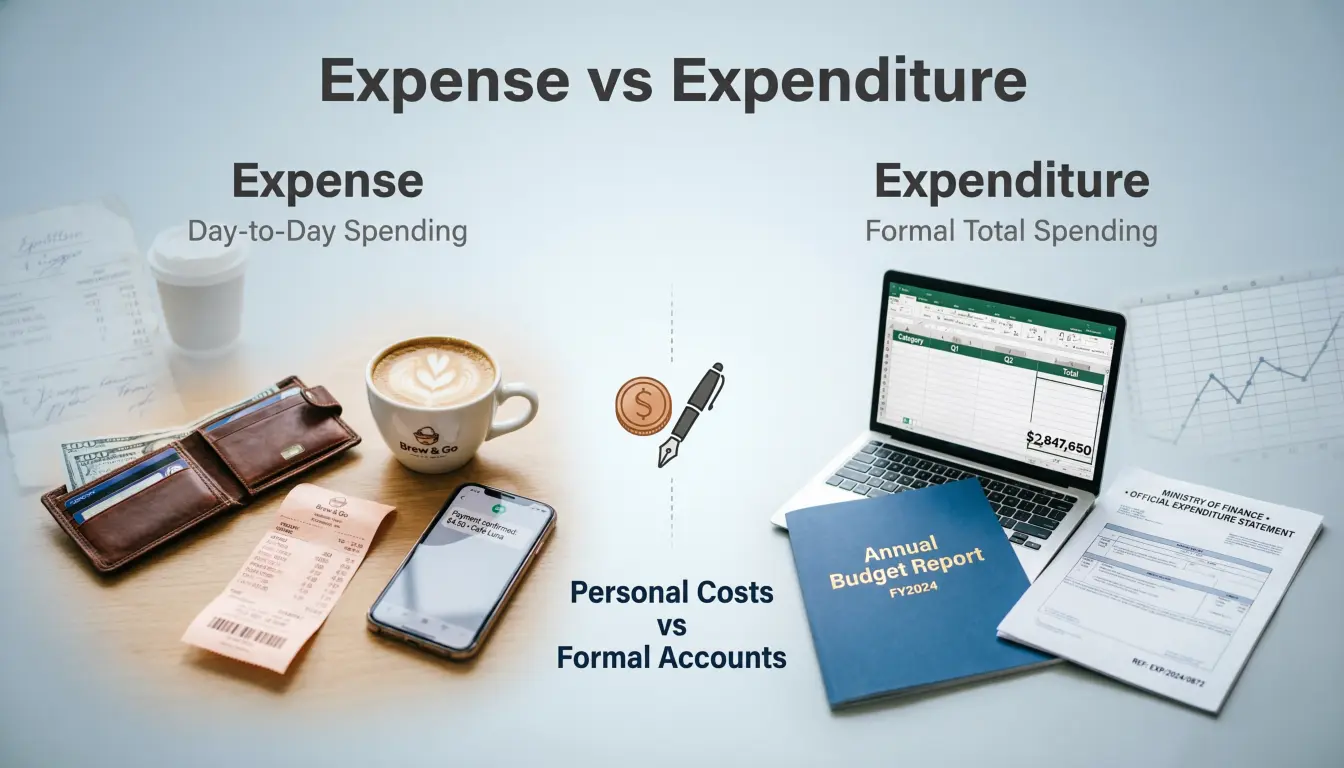
“Expense” and “expenditure” are both correct words, but they are used differently in finance and writing. “Expense” refers to money spent on everyday costs or operational items, while “expenditure” is a more formal term referring to the act of spending money or the total amount spent, often in budgets or official accounts.
Have you ever wondered whether you should use expense or expenditure? These two words often appear in accounting reports, business documents, news articles, and everyday conversations. Because both relate to spending money, many people assume they mean exactly the same thing.
The confusion becomes even greater when dealing with financial statements, tax records, budgets, and business reports. In some situations, the words can be used interchangeably. In others, choosing the wrong term can change the meaning of a sentence.
Understanding the difference between expense vs expenditure helps students, business owners, accountants, and writers communicate more clearly. While both words describe money spent, they are used in different contexts and levels of formality.
In this guide, you’ll learn the meaning of each term, where the words came from, how they are used in British and American English, common mistakes to avoid, and practical examples. By the end, you’ll know exactly when to use expense and when expenditure is the better choice.
Expense vs Expenditure – Quick Answer
Expense usually refers to a cost that has already been used or consumed in daily operations.
Expenditure refers to the act of spending money or the total amount spent, often in a broader or more formal financial context.
Examples
Expense:
- Rent is a monthly expense.
- Travel expenses increased this year.
- Office supplies are business expenses.
Expenditure:
- Government expenditure rose by 10%.
- Capital expenditure includes buying equipment.
- The company’s annual expenditure exceeded expectations.
Quick Comparison
| Expense | Expenditure |
| Day-to-day cost | Money spent in general |
| Common in accounting | Common in finance and economics |
| Less formal | More formal |
| Often appears on income statements | Often appears in budgets and reports |
The Origin of Expense vs Expenditure
Both words come from the Latin word expendere, meaning “to pay out” or “to weigh out money.”
Expense
The word expense entered English through Old French during the 14th century. It developed the meaning of a cost or charge incurred while conducting activities.
Expenditure
The word expenditure appeared later and retained a broader meaning. It refers to the process or total amount of spending money.
Why Both Words Exist
English often keeps multiple words from the same root that develop different uses over time.
For example:
- Expand → Expansion
- Depend → Dependence
- Expend → Expense / Expenditure
As financial language became more specialized, expense became common in accounting, while expenditure remained popular in formal financial reporting.
British English vs American English Spelling
Unlike many English word pairs, expense and expenditure have the same spelling in both British and American English.
The difference is not spelling but usage.
Examples:
American English
- Business expenses increased last quarter.
- Government expenditure reached record levels.
British English
- Travel expenses were claimed by employees.
- Public expenditure continues to rise.
Comparison Table
| Feature | Expense | Expenditure |
| British English | ✓ Common | ✓ Common |
| American English | ✓ Common | ✓ Common |
| Business Writing | Very Common | Common |
| Government Reports | Common | Very Common |
| Everyday Speech | Very Common | Less Common |
Which Spelling Should You Use?
Since both words share the same spelling worldwide, your choice depends on meaning and audience.
Use “Expense” When:
- Discussing daily business costs
- Writing emails
- Talking about personal finances
- Creating expense reports
Examples
“Please submit your travel expenses by Friday.”
Use “Expenditure” When:
- Writing formal reports
- Discussing government budgets
- Analyzing financial performance
- Talking about large-scale spending
Examples
“Capital expenditure increased significantly this year.”
Global Advice
- For general readers: expense
- For financial professionals: expense and expenditure
- For government or economic reports: expenditure
Common Mistakes with Expense vs Expenditure
Mistake 1: Treating Them as Exact Synonyms
❌ The office expense was $2 million.
✅ The office expenditure was $2 million.
Large-scale spending is often described as expenditure.
Mistake 2: Using Expenditure in Casual Conversation
❌ My coffee expenditure today was $5.
✅ My coffee expense today was $5.
Expense sounds more natural in everyday speech.
Mistake 3: Confusing Expense with Capital Spending
❌ The new factory was recorded as an expense.
✅ The new factory was recorded as capital expenditure.
Large investments are often classified as expenditures.
Mistake 4: Overusing Formal Language
❌ Employee expenditures must be submitted weekly.
✅ Employee expenses must be submitted weekly.
Expense is clearer in workplace communication.
Expense vs Expenditure in Everyday Examples
In Emails
Expense
Please submit all travel expenses before the end of the month.
Expenditure
The project’s total expenditure exceeded the approved budget.
In News Reports
Government expenditure on healthcare increased this year.
Rising fuel expenses continue to affect families.
On Social Media
My biggest expense this month was rent.
Public expenditure should be carefully monitored.
In Formal Writing
Capital expenditure is expected to rise next year.
Operating expenses remained stable during the quarter.
Expense vs Expenditure – Google Trends & Usage Data
Search interest shows that expense is generally more popular worldwide because people often search for personal finance, business costs, and expense management.
Expenditure receives fewer searches but remains common in:
- Government reports
- Economics
- Corporate finance
- Academic research
Usage by Context
| Context | Preferred Word |
| Personal Finance | Expense |
| Business Operations | Expense |
| Accounting | Expense |
| Government Spending | Expenditure |
| Economics | Expenditure |
| Capital Investments | Expenditure |
Usage by Country
| Country | More Common Term |
| United States | Expense |
| Canada | Expense |
| Australia | Expense |
| United Kingdom | Expense |
| Government Publications Worldwide | Expenditure |
Expense vs Expenditure Comparison Table
| Feature | Expense | Expenditure |
| Meaning | Cost incurred | Money spent |
| Formality | Less formal | More formal |
| Everyday Use | Very common | Less common |
| Accounting Use | Very common | Common |
| Government Reports | Common | Very common |
| Personal Finance | Common | Rare |
| Business Reports | Common | Common |
Quick Quiz
Choose the correct word.
1. The government increased healthcare _______.
A) Expense
B) Expenditure
Answer: B) Expenditure
2. Hotel costs are travel _______.
A) Expenses
B) Expenditures
Answer: A) Expenses
3. The company’s capital _______ rose this year.
A) Expense
B) Expenditure
Answer: B) Expenditure
4. Employees should submit business _______.
A) Expenses
B) Expenditures
Answer: A) Expenses
Fill in the Blanks
- Rent is a monthly __________.
- Government __________ increased during the year.
- Employees can claim travel __________.
- Capital __________ includes major investments.
- Food was my largest __________ last month.
Answers
- expense
- expenditure
- expenses
- expenditure
- expense
Frequently Asked Questions
1. What is the difference between expense and expenditure?
Expense is usually a cost incurred in daily operations, while expenditure refers to money spent more broadly.
2. Is expenditure more formal than expense?
Yes. “We generally consider ‘expenditure’ more formal.”
3. Can expense and expenditure be used interchangeably?
Sometimes, but not always. Context matters.
4. Which term is used in accounting?
Expense is more common in accounting records and income statements.
5. Which term is used in government budgets?
Expenditure is the preferred term.
6. Is capital expenditure an expense?
Not immediately. Capital expenditure often relates to long-term assets.
7. Which word is more common in everyday conversation?
Expense is much more common.
8. Are the spellings different in British and American English?
“We spell both words the same in both varieties of English.”
9. Which word should I use in business emails?
Expense is usually the better choice.
Conclusion
Understanding expense vs expenditure is important for clear communication, especially in business and finance. “While both words relate to money being spent, we do not always use them interchangeably.”
An expense usually refers to a day-to-day cost incurred during operations, such as rent, utilities, or travel costs. Expenditure, on the other hand, is a broader and more formal term that describes the act of spending money or the total amount spent.
In everyday conversations, emails, and workplace communication, expense is generally the preferred choice because it sounds natural and familiar. In government reports, economic studies, financial planning documents, and discussions of major investments, expenditure is often more appropriate.
Remember this simple rule: if you’re talking about routine costs, use expense. If you’re discussing overall spending, budgets, or large financial commitments, use expenditure.
Choosing the correct word helps your writing sound professional, accurate, and easy to understand. Knowing the distinction ensures you communicate confidently in both personal and professional situations.

I hold a degree in English Literature and Linguistics and have worked extensively on educational blogs, comparison websites, and digital learning platforms. My writing focuses on simplifying complex language rules, highlighting British vs American English differences, and providing practical examples for everyday usage.