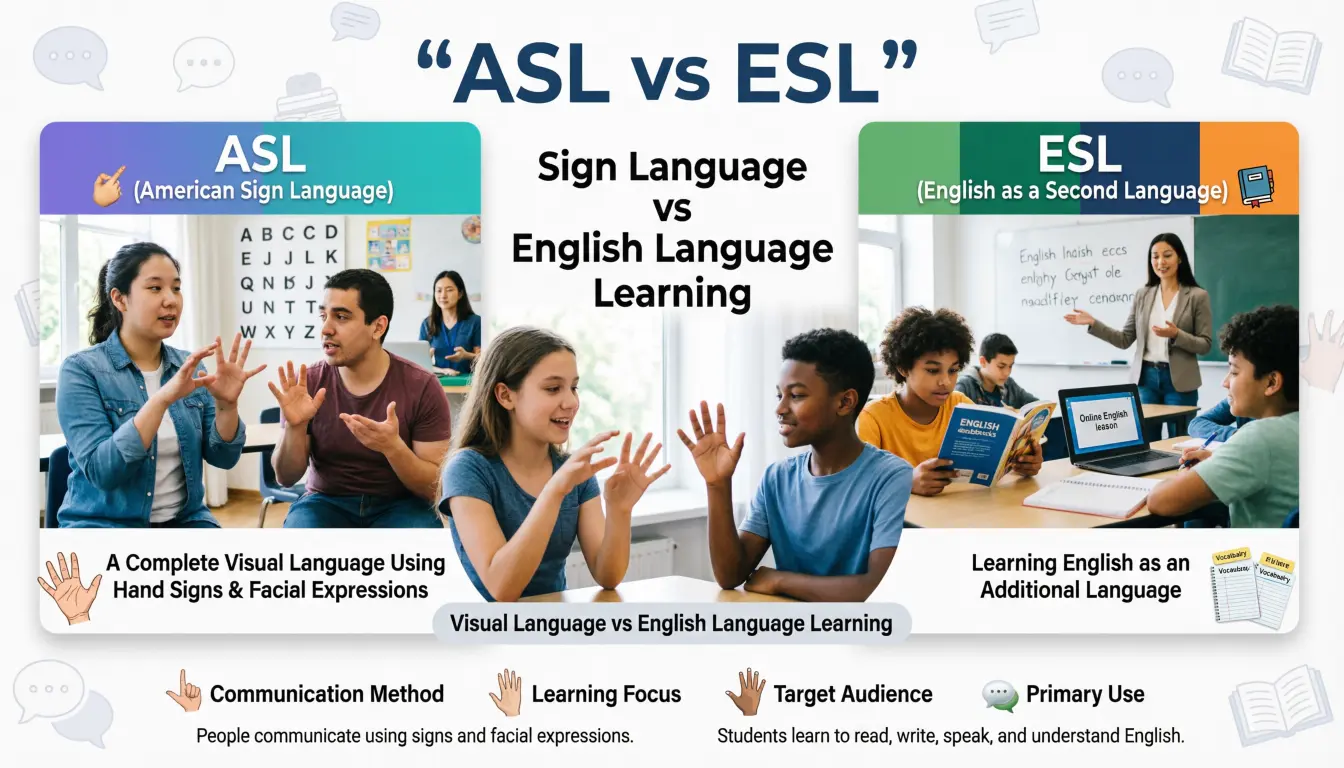
“ASL” and “ESL” are both common educational terms, but they refer to completely different concepts. ASL stands for American Sign Language, a complete visual language used primarily by the Deaf and partially deaf community in the United States and parts of Canada. ESL stands for English as a Second Language, a program or method of teaching English to people whose first language is not English.
Have you ever seen the terms ASL and ESL and wondered if they mean the same thing? Many people do. Students, parents, teachers, and job seekers often search for ASL vs ESL because the two abbreviations appear in schools, colleges, online courses, and education programs.
At first glance, they may seem related since both involve communication and learning. However, they represent two very different concepts.
ASL stands for American Sign Language, a complete visual language used mainly by Deaf and partially deaf communities in the United States and parts of Canada. ESL, on the other hand, means English as a Second Language, which refers to programs that help non-native speakers learn English.
Understanding the difference is important when choosing classes, applying to schools, reading educational materials, or searching for language resources. This guide explains what ASL and ESL mean, how they differ, where each is used, and which one may be right for you. By the end, you’ll clearly understand the purpose of each term and avoid common confusion.
ASL vs ESL – Quick Answer
The difference is simple:
- ASL (American Sign Language) is a visual language that uses hand signs, facial expressions, and body movements.
- ESL (English as a Second Language) is the teaching of English to people whose first language is not English.
Examples
- ASL: “She is taking an ASL class to communicate with her Deaf friends.”
- ESL: “He joined an ESL course to improve his English speaking skills.”
In short, ASL is a language, while ESL is an English learning program.
What Does ASL Mean?
ASL stands for American Sign Language. It is a natural language with its own grammar, sentence structure, and vocabulary. It is not simply English shown with hand signs.
People who are Deaf or hard of hearing commonly use ASL to communicate. Many hearing people also learn ASL to communicate with family members, friends, coworkers, or students.
Features of ASL
- Uses hand shapes and movements
- Includes facial expressions
- Has its own grammar
- Recognized as a complete language
Examples
“I learned basic ASL so I could communicate with my neighbor.”
What Does ESL Mean?
ESL stands for English as a Second Language. It refers to educational programs designed for people whose native language is not English.
ESL classes focus on:
- Reading
- Writing
- Listening
- Speaking
- Grammar
- Vocabulary
- Pronunciation
Examples
“Maria attends ESL classes every evening to improve her English.”
Key Differences Between ASL and ESL
| Feature | ASL | ESL |
| Full Form | American Sign Language | English as a Second Language |
| Type | Language | Education Program |
| Communication | Visual | Spoken and Written English |
| Users | Deaf and partially deaf people | Non-native English speakers |
| Goal | Daily communication | Learning English |
| Grammar | Unique grammar | English grammar |
History and Origin of ASL and ESL
Origin of ASL
American Sign Language developed during the early 1800s. It grew from local sign systems and French Sign Language. Over time, it became one of the most widely used sign languages in North America.
Today, ASL is taught in schools, colleges, and community programs. Many universities even allow ASL to satisfy foreign language requirements.
Origin of ESL
The term ESL became common during the twentieth century as English grew into an international language. Schools created ESL programs to help immigrants, international students, and workers improve their English skills.
Today, ESL education is offered worldwide in classrooms and online.
Which One Is Right for You?
Choose ASL if you:
- Want to communicate with Deaf people
- Work in healthcare or education
- Have Deaf family members
- Enjoy learning visual languages
Choose ESL if you:
- Are learning English
- Plan to study abroad
- Need English for work
- Want better communication in English-speaking countries
Some people even study both because they serve different purposes.
ASL vs ESL in Education
Both ASL and ESL are important in education, but they support different learners.
ASL in Schools
Many schools offer ASL as a language elective. Students learn signing, Deaf culture, and visual communication.
ESL in Schools
ESL programs help international students and immigrants succeed in English-speaking classrooms. Teachers provide extra support in reading, writing, and speaking English.
ASL vs ESL in Everyday Life
Emails
ASL
“Our office now offers ASL interpreters during meetings.”
ESL
“We provide free ESL classes for new employees.”
News
“Local colleges have expanded both ASL and ESL programs.”
Social Media
“I’m starting my first ASL lesson today!”
“My ESL teacher helped me improve my pronunciation.”
Formal Writing
“The university offers comprehensive ASL and ESL educational services.”
ASL vs ESL – Google Trends & Usage Data
Search interest for ASL is strongest in the United States and Canada because American Sign Language is mainly used there.
Searches for ESL come from around the world, including countries where people learn English for education, work, immigration, and travel.
People commonly search:
- ASL classes
- Learn ASL
- Free ASL course
- ESL programs
- Online ESL classes
- ESL teaching resources
Overall, ESL has broader global usage, while ASL has stronger regional popularity.
ASL vs ESL Comparison Table
| Topic | ASL | ESL |
| Meaning | American Sign Language | English as a Second Language |
| Purpose | Communication | English learning |
| Users | Deaf community | English learners |
| Communication Style | Visual signs | Spoken and written English |
| Grammar | Independent language | Standard English grammar |
| Used In | Schools, communities, workplaces | Schools, colleges, language centers |
ASL vs ESL in Academic Writing
Academic writing should always use the correct term based on context.
Use ASL when discussing:
- Deaf education
- Linguistics
- Sign language research
- Accessibility
Use ESL when discussing:
- English language instruction
- Language acquisition
- International education
- Teaching methods
Avoid using the two abbreviations interchangeably because they refer to different fields.
ASL vs ESL in Business English
Businesses often use both terms.
ASL
Companies may provide ASL interpreters to improve accessibility for Deaf employees and customers.
ESL
Organizations offer ESL training to help international employees improve workplace communication.
Using the correct abbreviation shows professionalism and clarity.
Common Style Guide Recommendations
Most educational and professional style guides recommend:
- Spell out the full term on first mention.
- Write American Sign Language (ASL) first.
- Write English as a Second Language (ESL) first.
- Use the abbreviation only after introducing the full name.
- Avoid assuming readers know the abbreviation.
Real Examples from Published Sources
Examples similar to those found in educational publications include:
- “The university offers ASL courses for undergraduate students.”
- “The district expanded ESL support for multilingual learners.”
- “Hospitals now provide certified ASL interpreters.”
- “Community centers offer free ESL classes for adults.”
These examples reflect how schools, government agencies, and organizations commonly use the terms.
Common Mistakes with ASL vs ESL
| Incorrect | Correct |
| ASL means English classes. | ESL refers to English classes. |
| ESL is a sign language. | ASL is the sign language. |
| ASL teaches spoken English. | ESL teaches spoken and written English. |
| The terms are interchangeable. | They have different meanings. |
Quiz
1. What does ASL stand for?
A. Advanced Spoken Language
B. American Sign Language ✅
C. Academic Study Language
D. American Speech Lessons
2. What does ESL stand for?
A. English as a Second Language ✅
B. English Sign Language
C. Easy Spoken Lessons
D. Educational Sign Learning
3. Which is a complete visual language?
A. ESL
B. ASL ✅
4. Which helps people learn English?
A. ESL ✅
B. ASL
5. Can someone learn both?
A. Yes ✅
B. No
Fill in the Blanks
- ______ stands for American Sign Language.
Answer: ASL
- ______ programs help people learn English.
Answer: ESL
FAQs
Is ASL the same as ESL?
No. ASL is a sign language, while ESL is an English learning program.
Is ASL considered a foreign language?
Many schools and universities recognize ASL as a language that can satisfy language requirements.
Who should take ESL classes?
Anyone whose first language is not English and wants to improve their English skills.
Can hearing people learn ASL?
Yes. Many hearing people learn ASL for work, school, or personal communication.
Which is harder to learn?
Difficulty depends on your background. ASL uses visual grammar, while ESL focuses on English speaking, reading, and writing.
Is ASL used outside the United States?
Yes. It is also used in parts of Canada and by some communities in other countries.
Can someone study ASL and ESL together?
Yes. They serve different purposes and can be learned at the same time.
Conclusion
Understanding ASL vs ESL is easier once you know what each abbreviation represents. Although both involve language and communication, they serve completely different purposes. American Sign Language (ASL) is a natural visual language used by Deaf and partially deaf communities. It has its own grammar, vocabulary, and cultural importance. English as a Second Language (ESL), meanwhile, refers to educational programs that help non-native speakers learn English for school, work, travel, and everyday communication.
Choosing between ASL and ESL depends entirely on your goals. If you want to communicate with Deaf individuals or explore sign language, ASL is the right choice. If your aim is to improve your English speaking, reading, writing, and listening skills, ESL is the better option. Knowing the difference also helps you select the correct courses, understand educational materials, and use the terms accurately in conversation and writing.
If you are a student, teacher, professional, or language learner, using ASL and ESL correctly ensures clear communication and avoids unnecessary confusion.

I hold a degree in English Literature and Linguistics and have worked extensively on educational blogs, comparison websites, and digital learning platforms. My writing focuses on simplifying complex language rules, highlighting British vs American English differences, and providing practical examples for everyday usage.