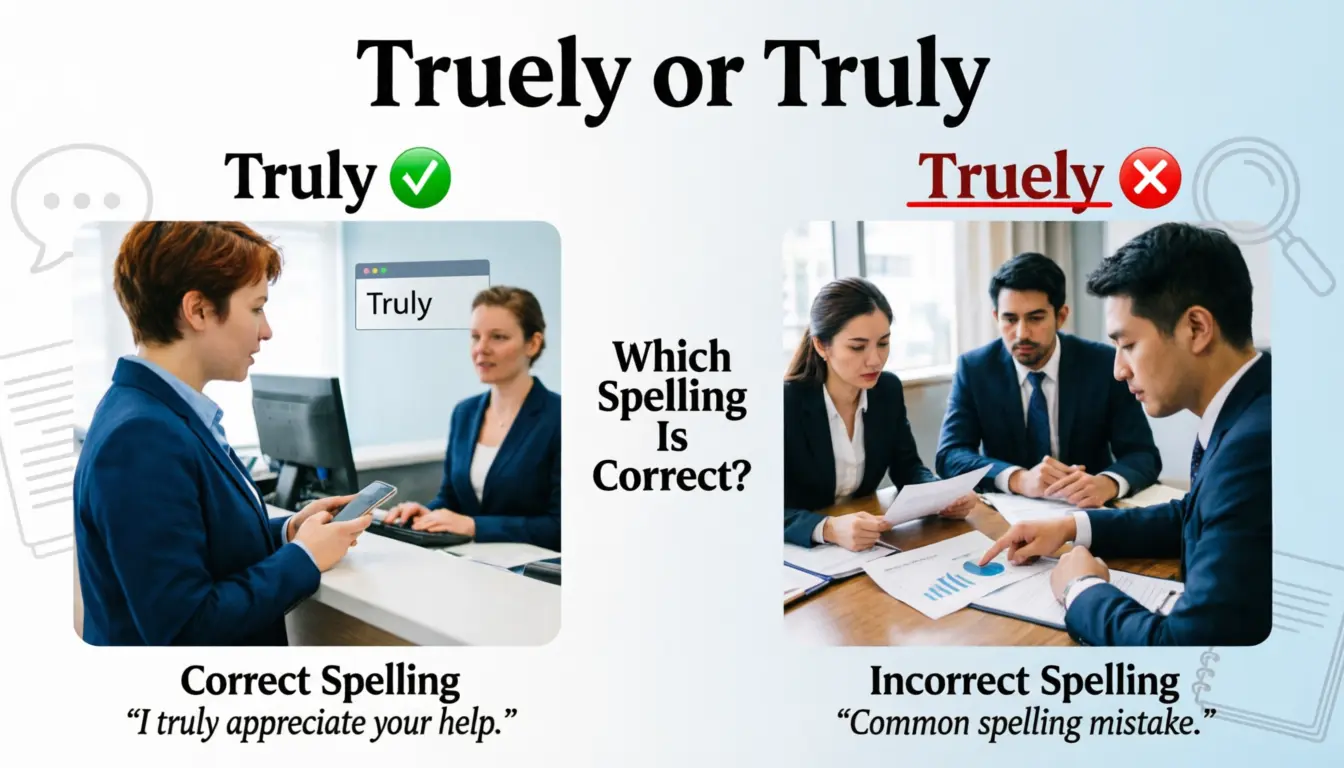
“Truly” is an adverb meaning in a truthful, genuine, or sincere manner, whereas “truely” has no accepted meaning in English.
Have you ever paused while writing and wondered, “Is it truelyor truly?” You’re not alone. This tiny spelling confusion trips up students, bloggers, professionals, and even native English speakers. Both words look right, both sound the same, and spell-check doesn’t always help so people often Google “truely or truly” to get a clear answer.
The confusion usually comes from how English words change when we add -ly. For example, nice → nicely or careful → carefully. So it feels logical that true should become truely. But English loves breaking its own rules, and this is one of those moments.
This article clears the confusion once and for all. You’ll get a quick answer, learn where the word comes from, see how British and American English treat it, and understand which spelling you should use for your audience. We’ll also cover common mistakes, show real-life examples, explain Google Trends data, and answer the most frequently asked questions all in simple, easy language.
By the end, you’ll never hesitate again. You’ll know exactly which spelling is correct and why and you’ll use it with confidence every time.
Truely or Truly – Quick Answer
The correct spelling is truly.
“Truely” is incorrect and should not be used in formal or informal writing.
Examples:
- ✅ I truly appreciate your help.
- ❌ I truely appreciate your help.
- ✅ She is truly talented.
No matter the sentence, truly is always the right choice.
The Origin of Truely or Truly
The word truly comes from the Old English word “trēowe”, meaning faithful or honest. Over time, true became the modern adjective, and truly became its adverb form.
Here’s where the confusion starts:
Normally, English adds -ly to adjectives without changing the spelling. But with true, the final “e” is dropped before adding -ly.
- true + ly → truly (not truely)
This spelling rule is old and fixed. “Truely” never became an accepted spelling, even though it looks logical.
British English vs American English Spelling
Good news: British English and American English agree on this one.
Both varieties use truly, and neither accepts truely.
Comparison Table
| English Type | Correct Spelling | Incorrect Spelling |
| British English | truly | truely |
| American English | truly | truely |
| Australian English | truly | truely |
| Canadian English | truly | truely |
There is no regional difference at all.
Which Spelling Should You Use?
Use truly in every situation.
- US audience: truly
- UK/Commonwealth audience: truly
- Global audience: truly
Whether you’re writing:
- Emails
- Blog posts
- Academic papers
- Social media captions
“Truly” is the only safe and correct choice.
Common Mistakes with Truely or Truly
Here are mistakes people often make:
- ❌ Writing truely because it “looks right”
✅ Use truly - ❌ Assuming spellings change by country
✅ They don’t truly is universal - ❌ Relying on pronunciation
✅ Same sound, different spelling - ❌ Using truely in casual texts
✅ Still wrong, even in informal writing
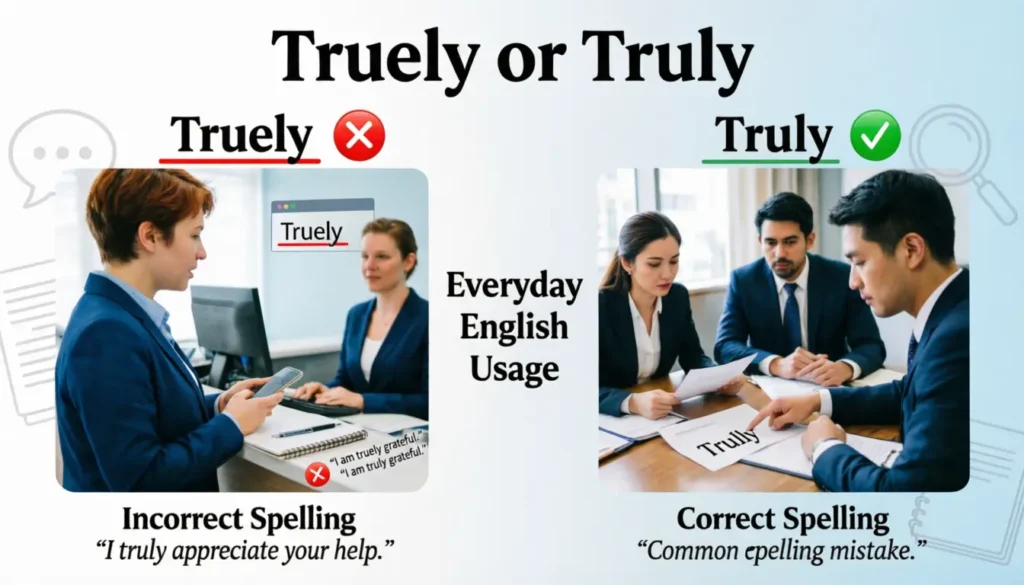
Truely or Truly in Everyday Examples
Emails
- ✅ I truly appreciate your quick response.
News Writing
- ✅ This was a truly historic moment.
Social Media
- ✅ I am truly grateful for all the support ❤️
Formal Writing
- ✅ The results truly reflect the research findings.
Truely or Truly – Google Trends & Usage Data
Search data shows that “truely or truly” is commonly searched worldwide. Most users are looking for:
- The correct spelling
- Grammar confirmation
- Writing confidence
“Truly” appears millions of times in books, news articles, and online content, while “truely” appears mainly in error-based searches. English-speaking countries like the US, UK, India, and Australia all show the same pattern.
Comparison Table: Keyword Variations
| Word | Correct? | Usage |
| truly | ✅ Yes | Standard English |
| truely | ❌ No | Spelling mistake |
FAQs:
1. Is “truely” ever correct?
No. It is always incorrect.
2. Why do people spell truly as truely?
Because most words keep the “e” before adding -ly.
3. Do British people spell it differently?
No. British English uses truly.
4. Is “truly” formal or informal?
It works in both.
5. Can spellcheck miss this mistake?
Yes, sometimes.
6. Is truly an adverb?
Yes. It describes actions or feelings.
7. Is truely in the dictionary?
No standard dictionary accepts it.
Conclusion:
So, what’s the final verdict on truely or truly? The answer is simple and clear: only “truly” is correct. While truely may look right at first glance, it has never been accepted in standard English. The confusion comes from normal spelling rules that don’t apply here English drops the final “e” in true before adding *-ly.
The good news is that you don’t need to worry about regional differences. British English, American English, and all major English varieties agree on this spelling. If you’re writing an email, a blog post, a school assignment, or a social media caption, truly is always the right choice.
If you remember just one thing, remember this:
True → Truly (no extra “e”)
Now that you know the rule, you can write with confidence and avoid a very common mistake. Next time you pause and think, “truely or truly?” you’ll already know the answer.
Overview:
Yours Truly or Truely
The correct phrase is “Yours truly,” not “Yours truely.” It is a common complimentary closing used in letters, emails, and formal correspondence. Since truly is the correct spelling of the adverb, “Yours truly” is the only grammatically accepted form.
Truely or Truly Meaning
When comparing truely or truly, the correct word is truly, which means honestly, genuinely, or sincerely. The spelling truely is considered a misspelling and is not recognized in standard English dictionaries.
Truely or Truly Synonym
Since truly is the correct spelling, its common synonyms include genuinely, sincerely, honestly, authentically, and really. The word truely has no synonyms because it is not a standard English word.
Truely or Truly Examples
Examples can help clarify the difference between truely or truly. Correct usage includes: “I am truly grateful for your support” and “She truly believes in her decision.” Using truely in these sentences would be incorrect.
Truely or Truly Grammar
From a grammar perspective, truly is the correct adverb form of the adjective true. English spelling rules drop the final e before adding -ly, which is why true becomes truly, not truely.
Truely or Truly Grateful
The correct phrase is “truly grateful.” It is commonly used to express sincere appreciation or thanks. For example, “I am truly grateful for your kindness.” The spelling truely grateful is grammatically incorrect.
Truely or Truly Oxford
According to major dictionaries, including the Oxford English Dictionary, truly is the accepted spelling. The form truely does not appear as a standard dictionary entry and is treated as a spelling error.
Is Truely a Word?
Many people ask, “Is truely a word?” The answer is no. While it occasionally appears in informal writing due to a spelling mistake, the correct English word is truly, which is recognized by dictionaries and grammar authorities worldwide.
Discover More Article:
- Hierarchical vs Hierarchal – What’s the Difference and Which Spelling Is Correct?
- Compair vs Compare – Which Spelling Is Correct?
- Remediated vs Remedied – What’s the Difference and Which Word Should You Use?

I am an Emily Carter Brooks U.S.A based linguistics writer known for my clear, reader-friendly explanations of English grammar and vocabulary differences. I have contributed to multiple online language resources and specializes in spelling variations, pronunciation confusion, and British vs American English comparisons. I’m passionate about helping learners improve their English through practical, everyday communication. engaging, and stress-free.