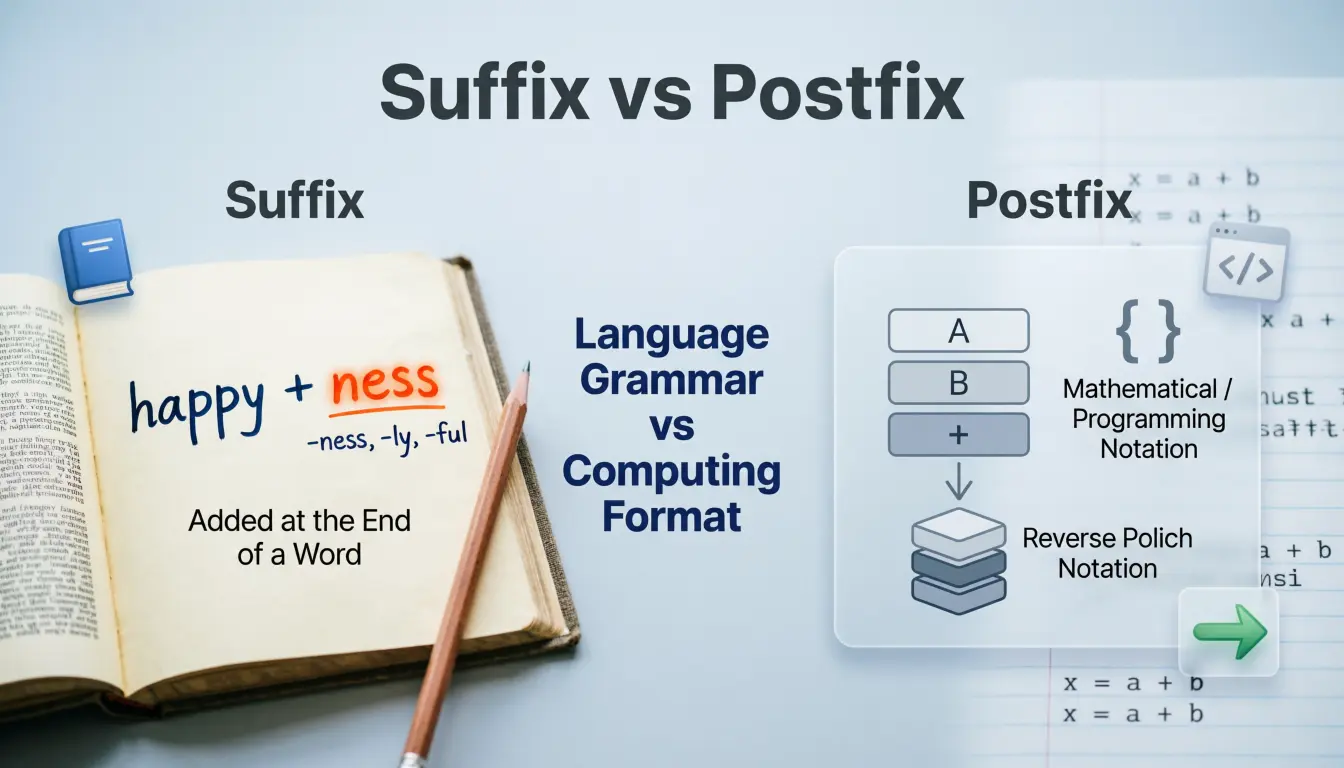
“Suffix” and “postfix” are both correct words, but they’re used in different contexts. “Suffix” is the standard linguistic term for a letter or group of letters added to the end of a word (e.g., -ness in happiness), while “postfix” is mainly used in mathematics and computer science to describe a notation where operators come after operands (e.g., postfix expressions like Reverse Polish Notation).
Have you ever seen the terms suffix and postfix and wondered if they mean the same thing? Many people come across these words while studying English grammar, linguistics, mathematics, or computer programming. Because both terms refer to something added at the end, they often create confusion.
The distinction is important because each word is used in different contexts. In English grammar, suffix is the standard term used to describe letters or groups of letters added to the end of a word. In computer science and mathematics, postfix usually refers to an operator or notation placed after an expression.
People search for suffix vs postfix because they want to know whether the words are interchangeable and which one is correct in a particular situation. Understanding the difference helps students, writers, programmers, and professionals communicate more accurately.
In this guide, you’ll learn the meaning of each term, their origins, usage differences, common mistakes, examples, trends, and practical advice on choosing the right word.
Suffix vs Postfix – Quick Answer
The short answer is:
- Suffix is a linguistic term for letters added to the end of a word.
- Postfix is a technical term for something placed after another element, especially in mathematics and programming.
Examples
Suffix:
- Happy → Happiness
- Kind → Kindness
- Teach → Teacher
Postfix:
- In programming: x++
- In mathematics: Postfix notation places operators after operands.
Key Difference
| Term | Meaning | Common Field |
| Suffix | Letters added to a word’s end | Grammar & Linguistics |
| Postfix | Element placed after another element | Programming & Mathematics |
The Origin of Suffix vs Postfix
The word suffix comes from the Latin suffixus, meaning “fastened underneath” or “attached.”
Linguists began using the term centuries ago to describe endings added to words that change meaning or grammatical function.
The word postfix comes from two Latin elements:
- post = after
- fixus = attached
Its literal meaning is “attached after.”
Postfix became popular in technical fields such as mathematics and computer science, where symbols or operators appear after the items they affect.
Although both words share the idea of something being added at the end, they developed in different disciplines and therefore have different meanings today.
British English vs American English Spelling
Unlike many English word pairs, suffix and postfix do not have British and American spelling variations.
Both countries use the same spellings:
- Suffix
- Postfix
Comparison Table
| Concept | British English | American English |
| Word ending in grammar | Suffix | Suffix |
| Technical ending notation | Postfix | Postfix |
| Alternative spelling | None | None |
| Preferred spelling | Suffix/Postfix | Suffix/Postfix |
Examples
British English
- The suffix -ing creates a present participle.
- The equation uses postfix notation.
American English
- The suffix -ness forms a noun.
- Programmers often use postfix operators.
There is no spelling difference between the two varieties of English.
Which Spelling Should You Use?
Your choice depends on context rather than country.
Use “Suffix” When:
- Talking about grammar
- Discussing word formation
- Teaching English
- Writing dictionaries
- Studying linguistics
Examples
“The suffix -ful means full of.”
Use “Postfix” When:
- Discussing programming
- Explaining mathematical notation
- Talking about technical systems
Examples
“The postfix increment operator increases the value after evaluation.”
“The postfix increment operator increases the value after evaluation.”
Audience-Based Advice
| Audience | Recommended Term |
| English learners | Suffix |
| Teachers | Suffix |
| Writers | Suffix |
| Programmers | Postfix |
| Mathematicians | Postfix |
| Global audience | Use the term that matches the context |
Common Mistakes with Suffix vs Postfix
Many people confuse these terms because both refer to something appearing at the end.
Mistake 1: Using Postfix in Grammar
❌ The postfix “-ly” changes an adjective into an adverb.
✅ The suffix “-ly” changes an adjective into an adverb.
Mistake 2: Using Suffix for Programming Operators
❌ The suffix operator x++ increases the value later.
✅ The postfix operator x++ increases the value later.
Mistake 3: Assuming They Mean Exactly the Same Thing
❌ Suffix and postfix are always interchangeable.
✅ They share a similar idea but belong to different fields.
Mistake 4: Ignoring Context
Always consider whether you are discussing language or technology.
Suffix vs Postfix in Everyday Examples
Although postfix is less common in daily conversation, both terms appear in real-world situations.
Emails
Suffix Example
“Please add the suffix ‘-ed’ to make the verb past tense.”
Postfix Example
“The software uses a postfix operator for counting.”
News Articles
Suffix
“Linguists studied the suffixes used in modern English.”
Postfix
“Developers updated the postfix processing system.”
Social Media
Suffix
“What’s your favorite English suffix?”
Postfix
“Learning postfix notation today!”
Formal Writing
Suffix
“The suffix ‘-tion’ commonly forms nouns.”
Postfix
“The programming language supports postfix expressions.”
Suffix vs Postfix – Google Trends & Usage Data
Search behavior shows that suffix is much more popular than postfix.
Why Suffix Is More Popular
- Used in schools worldwide
- Common in grammar lessons
- Appears in language learning materials
- Relevant to spelling and vocabulary
Why Postfix Is Less Popular
- Mostly used in technical fields
- Common among programmers
- Appears in mathematics and computer science courses
Countries Where “Suffix” Is Popular
- United States
- United Kingdom
- Canada
- Australia
- India
Countries With More Searches for “Postfix”
- United States
- India
- Germany
- Technical and programming communities worldwide
Usage Comparison
| Term | Popularity | Main Context |
| Suffix | Very High | Language & Grammar |
| Postfix | Moderate | Programming & Mathematics |
Overall, suffix receives significantly more general search traffic because language learners greatly outnumber programmers.
Suffix vs Postfix Comparison Table
| Feature | Suffix | Postfix |
| Meaning | Added to end of a word | Added after an expression |
| Field | Linguistics | Programming & Mathematics |
| Everyday Usage | Common | Less common |
| Used in Schools | Very often | Mainly technical courses |
| Example | Happiness | x++ |
| Changes Word Meaning | Yes | Usually no |
| Technical Term | Sometimes | Yes |
Quick Quiz: Suffix vs Postfix
Choose the correct answer.
1. Which term refers to letters added to the end of a word?
A. Prefix
B. Postfix
C. Suffix
Answer: C. Suffix
2. Which term is common in programming?
A. Suffix
B. Postfix
C. Both equally
Answer: B. Postfix
3. The ending “-ness” is a:
A. Postfix
B. Suffix
C. Operator
Answer: B. Suffix
4. The expression x++ uses a:
A. Suffix
B. Prefix
C. Postfix
Answer: C. Postfix
5. Are suffix and postfix always interchangeable?
A. Yes
B. No
Answer: B. No
Fill in the Blanks
Complete the sentences using suffix or postfix.
- The ending “-able” is a ________.
- The operator i++ is a ________ operator.
- English grammar uses many types of ________.
- Programmers often learn ________ notation.
- The ending “-ment” is a common ________.
Answers
- suffix
- postfix
- suffixes
- postfix
- suffix
FAQs
1. Is postfix the same as suffix?
No. A suffix is a word ending used in language, while postfix is a technical term used mainly in programming and mathematics.
2. Which term is used in English grammar?
Suffix is the correct grammatical term.
3. What is an example of a suffix?
Examples include:
- -ness
- -ly
- -tion
- -ful
4. What is an example of a postfix?
The operator x++ in programming is a postfix operator.
5. Can I use postfix instead of suffix?
Not in standard grammar. The correct term is suffix.
6. Which word is more common?
Suffix is much more common in everyday English.
7. Does British English use a different spelling?
No. Both British and American English use the same spellings.
8. Why do programmers use the word postfix?
Because it describes operators that appear after the value they affect.
9. Is postfix notation important in mathematics?
Yes. It is used in certain calculation methods and computer processing systems.
Conclusion
Understanding suffix vs postfix becomes easy once you know the context. A suffix is a grammatical element added to the end of a word, such as -ness, -ly, or -tion. It helps create new words or change grammatical meaning. A postfix, on the other hand, is a technical term used mainly in mathematics and computer programming to describe an operator or symbol that appears after the item it affects.
There is no British versus American spelling difference for these words. Both English varieties use suffix and postfix in exactly the same way. The key is choosing the term that fits your subject. If you are discussing language, vocabulary, spelling, or grammar, use suffix. If you are discussing code, equations, or notation systems, use postfix.
Most people encounter suffixes far more often than postfixes, which explains why suffix is the more popular search term. By understanding the distinction, you can avoid common mistakes and communicate clearly in both educational and professional settings.

I hold a degree in English Literature and Linguistics and have worked extensively on educational blogs, comparison websites, and digital learning platforms. My writing focuses on simplifying complex language rules, highlighting British vs American English differences, and providing practical examples for everyday usage.