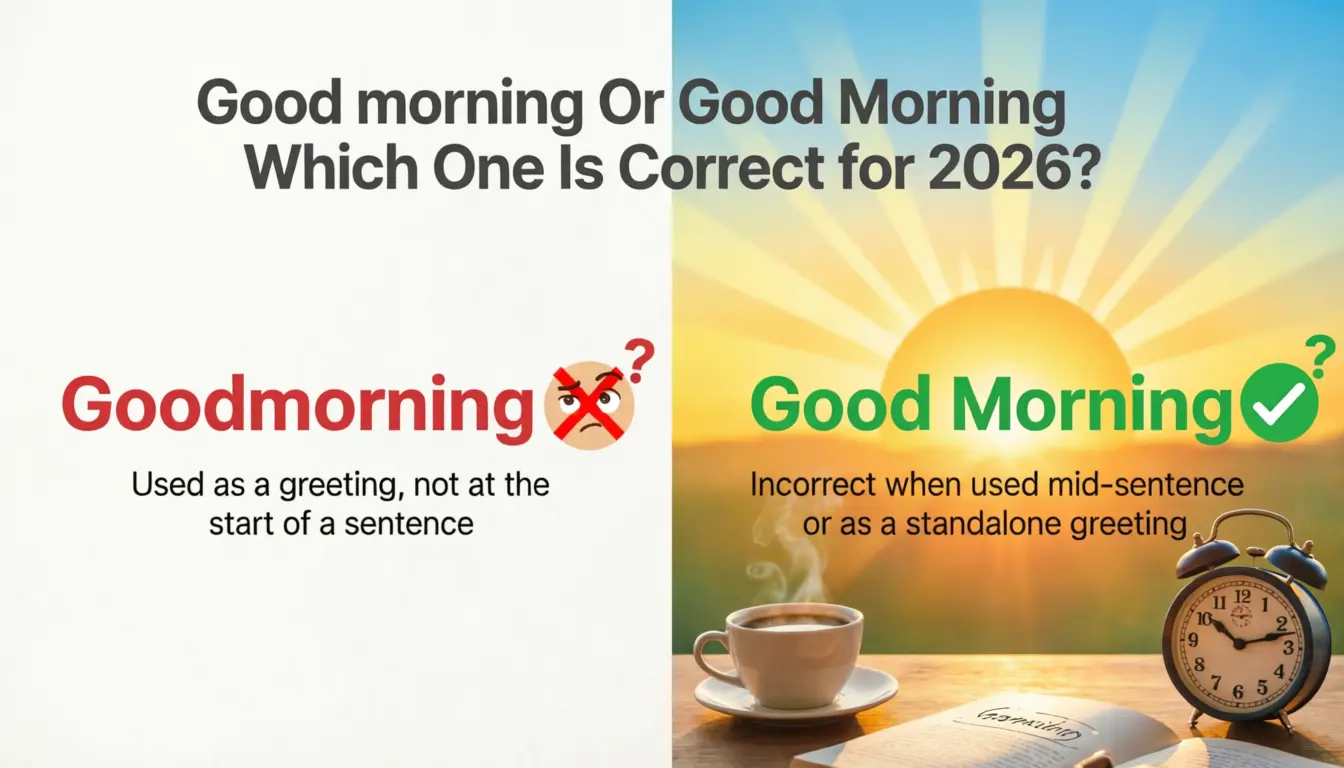
“Good morning” is a greeting used to wish someone well at the start of the day, whereas “goodmorning” is generally written as two separate words in standard English.
Have you ever typed “goodmorning” in a text and wondered if it was right? You are not alone. Many people search for “goodmorning or good morning” because the two forms look similar, but only one is correct in standard English.
This confusion happens because greetings are used every day in emails, text messages, social media posts, and formal letters. Since people often write fast, they combine the words into one. But English grammar has rules, and knowing the correct form helps your writing look clean and professional.
The short answer is simple: “good morning” is the correct spelling when used as a greeting. “Goodmorning” as one word is not accepted in standard English dictionaries.
In this guide, you will learn the difference between goodmorning or good morning, where the phrase came from, how British and American English use it, common mistakes, and when to use it correctly.
Goodmorning or Good Morning – Quick Answer
The correct spelling is good morning (two words).
✅ Correct: Good morning, Sarah.
✅ Correct: I sent a good morning message.
❌ Incorrect: Goodmorning, Sarah.
❌ Incorrect: He sent a goodmorning text.
Why?
“Good” is an adjective.
“Morning” is a noun.
Together, they form a phrase.
English keeps them separate because they work as two different words.
Think of it like:
- good night
- good evening
- good afternoon
We do not write:
- goodnight? (Only in some special noun uses)
- goodevening
- goodafternoon
So, when choosing between goodmorning or good morning, pick good morning.
The Origin of Goodmorning or Good Morning
The phrase good morning comes from old English greeting traditions.
The word “good” comes from Old English gōd, meaning pleasant or favorable.
The word “morning” comes from Old English morgen, meaning the early part of the day.
People began combining kind wishes with time-based greetings many centuries ago.
Examples:
- Good morning
- Good evening
- Good day
The idea was simple: wish someone a good part of the day.
Over time, the phrase stayed as two separate words because English grammar treated it as an adjective + noun combination.
Why does goodmorning appear?
Mostly because of:
- texting habits
- social media shortcuts
- design styles in graphics
For example:
“GoodMorning everyone ”
This style may look nice in images or hashtags, but it is not standard writing.
British English vs American English Spelling

There is no spelling difference between British and American English for this phrase.
Both use:
✅ Good morning
Both reject:
❌ Goodmorning
This makes it easier than many other spelling differences like:
| British English | American English |
| colour | color |
| organise | organize |
| travelled | traveled |
But for good morning, both are the same.
Comparison Table
| Version | Correct? | Used In |
| good morning | Yes | British English |
| good morning | Yes | American English |
| goodmorning | No | Informal/incorrect |
| GoodMorning | No | Styling/hashtags |
So if you are comparing goodmorning or good morning, both US and UK agree: use good morning.
Which Spelling Should You Use?
Your audience matters.
If your audience is in the United States
Use:
✅ Good morning
Example:
Good morning, team.
American business writing follows standard grammar.
If your audience is in the UK
Use:
✅ Good morning
Example:
Good morning, Mr. Brown.
British writing follows the same rule.
If your audience is global
Use:
✅ Good morning
It is understood everywhere.
For social media
You may see:
#GoodMorning
This is okay as a hashtag.
Example:
#GoodMorning everyone!
But in normal writing:
✅ Good morning everyone!
Best advice:
Formal or casual, use good morning.
Common Mistakes with Goodmorning or Good Morning
People often make these mistakes.
1. Joining the words
❌ Goodmorning, friends.
✅ Good morning, friends.
Wrong because it combines two separate words.
2. Forgetting capitalization
❌ good morning John
✅ Good morning, John.
Greeting at the start should be capitalized.
3. Missing comma
❌ Good morning John
✅ Good morning, John.
The comma makes it clearer.
4. Using it as one word in emails
❌ Goodmorning Sir
✅ Good morning, Sir.
Professional writing needs correct spacing.
5. Copying social media style
Graphic posts often show:
“GoodMorning”
That is style, not grammar.
Goodmorning or Good Morning in Everyday Examples
Here is how to use it in real life.
Emails
✅ Good morning, David. I hope you are well.
This is the standard opening.
News
✅ Good morning and welcome to today’s news update.
News presenters use the standard phrase.
Social Media
✅ Good morning, everyone! Have a great day.
Normal post.
Hashtag form:
✅ #GoodMorning
This is acceptable because hashtags remove spaces.
Formal Writing
✅ Good morning, everyone.
Used in speeches and meetings.
Text Messages
✅ Good morning
Simple and correct.
Business Meetings
✅ Good morning, everyone. Let’s begin.
Professional and polite.
Goodmorning or Good Morning – Google Trends & Usage Data
Search data shows that good morning is far more popular than goodmorning.
Why?
Because it is the correct form.
People search goodmorning mostly because:
- typing fast
- checking spelling
- copying hashtag styles
Countries where good morning is highly searched include:
United States
United Kingdom
Canada
Australia
India
Common contexts:
- greeting messages
- email openings
- morning wishes
- business communication
Usage pattern:
| Form | Popularity | Correctness |
| good morning | Very high | Correct |
| goodmorning | Low | Incorrect |
This shows that standard English strongly prefers good morning.
Comparison Table: Goodmorning or Good Morning
| Word Form | Grammar Status | Best Use |
| good morning | Correct | All writing |
| goodmorning | Incorrect | Avoid |
| Good Morning | Correct | Titles/headings |
| #GoodMorning | Acceptable | Hashtags only |
FAQs
Is goodmorning one word or two?
It is two words: good morning.
Is goodmorning wrong?
Yes, in standard English it is wrong.
Can I use goodmorning in text messages?
You can, but it is not grammatically correct.
Why do people write goodmorning?
Mostly for speed or style.
Is good morning formal?
Yes. It works in formal and casual writing.
Is good morning correct in emails?
Yes. It is a common email greeting.
Is there a British spelling of good morning?
No. British and American English use the same spelling.
Can I use GoodMorning as a hashtag?
Yes. Hashtags often join words.
Example:
#GoodMorning
Should I correct goodmorning in business writing?
Yes. Use good morning for professional writing.
Conclusion
The answer to goodmorning or good morning is clear: good morning is the correct form.
It follows normal English grammar because “good” and “morning” are two separate words working together as a phrase. This rule stays the same in both British and American English, so there is no regional difference to remember.
The one-word form, goodmorning, is common in fast typing, social media captions, and hashtags. But that does not make it correct in formal or standard writing.
If you are writing an email, a message, a speech, or a business note, always use good morning. It looks professional, clear, and correct.
A simple space between two words makes a big difference in how your writing is seen. Good grammar builds trust and improves communication.
So next time you pause and think about goodmorning or good morning, remember the easy rule: keep it separate, keep it correct.

I am an Emily Carter Brooks U.S.A based linguistics writer known for my clear, reader-friendly explanations of English grammar and vocabulary differences. I have contributed to multiple online language resources and specializes in spelling variations, pronunciation confusion, and British vs American English comparisons. I’m passionate about helping learners improve their English through practical, everyday communication. engaging, and stress-free.