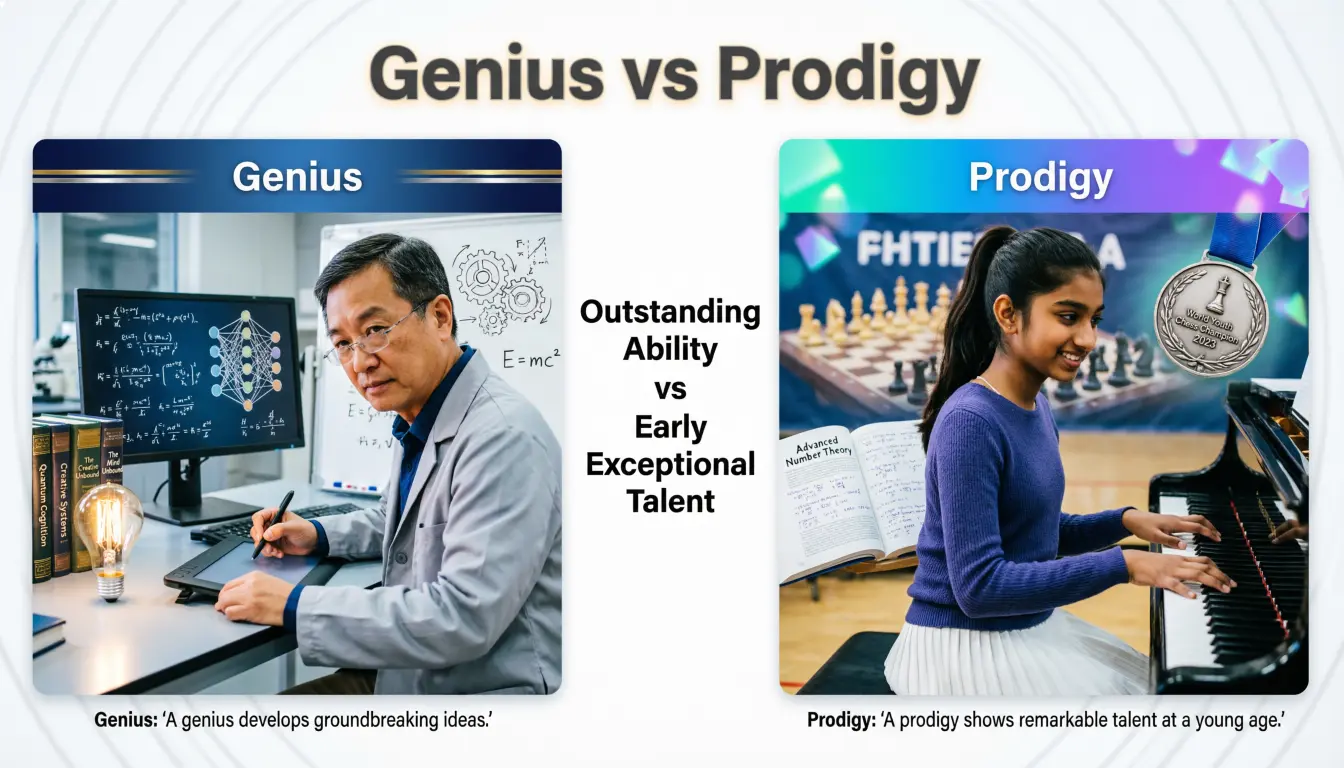
“Genius” and “prodigy” are both correct words, but they describe different kinds of exceptional ability. “Genius” refers to a person with extraordinary intellectual or creative power, often demonstrated over time, while “prodigy” refers to a young person who displays exceptional talent or skill at an unusually early age.
Have you ever heard someone called a genius and another person called a prodigy and wondered if they mean the same thing? Many people use these words as if they are interchangeable. However, there is an important difference between them.
The confusion often comes from the fact that both words describe people with exceptional abilities. A child who plays piano at a professional level may be called a prodigy. A scientist who changes the world with new ideas may be called a genius. Because both words suggest extraordinary talent, many writers and speakers struggle to choose the right one.
Understanding the difference between genius vs prodigy helps you communicate more clearly. If you are writing an article, school paper, social media post, or business document, using the correct word improves accuracy.
In this guide, you will learn the meanings, origins, usage examples, common mistakes, and practical advice for choosing between genius and prodigy. By the end, you will know exactly when each term should be used.
Genius vs Prodigy – Quick Answer
A genius is a person with exceptional intellectual or creative ability. A prodigy is usually a young person who demonstrates extraordinary talent at an early age.
Examples
- Genius: Albert Einstein was considered a genius because of his groundbreaking scientific ideas.
- Prodigy: Mozart was a musical prodigy who composed music as a child.
Quick Comparison
| Genius | Prodigy |
| Refers to extraordinary intelligence or creativity | Refers to exceptional talent at a young age |
| Can be any age | Usually a child or teenager |
| Focuses on ability level | Focuses on early achievement |
| Often lifelong recognition | Often highlights youth accomplishment |
The Origin of Genius vs Prodigy
Genius
The word genius comes from the Latin word genius, meaning a guiding spirit or innate talent. Over time, the meaning changed to describe a person with exceptional mental ability.
Prodigy
The word prodigy comes from the Latin word prodigium, meaning an extraordinary event or wonder. It later became associated with children who showed remarkable talent far beyond their years.
Why the Difference Exists
The distinction developed because society needed separate terms:
- Genius described exceptional intelligence or creativity.
- Prodigy described exceptional achievement at an unusually young age.
A prodigy may become a genius later in life, but not every prodigy grows into a recognized genius.
British English vs American English Spelling
Unlike words such as analysed and analyzed, genius and prodigy have the same spelling in both British and American English.
Comparison Table
| Concept | British English | American English |
| Genius | Genius | Genius |
| Prodigy | Prodigy | Prodigy |
| Meaning Difference | Same | Same |
| Usage Rules | Same | Same |
There are no spelling variations between regions. The difference is entirely about meaning.
Which Spelling Should You Use?
Since there are no spelling differences, the question becomes:
Use Genius When:
- Talking about exceptional intelligence.
- Referring to groundbreaking thinkers.
- Describing creative brilliance.
Example: The inventor was a genius who transformed modern technology.
Use Prodigy When:
- Referring to a talented child.
- Highlighting unusually early achievement.
- Describing young performers or athletes.
Examples: The chess prodigy won national competitions at age eight.
Global Advice
| Audience | Recommended Word |
| Academic readers | Use the word that matches the meaning |
| Business audience | Usually genius |
| Education sector | Often prodigy for children |
| Global audience | Both are accepted worldwide |
Common Mistakes with Genius vs Prodigy
Many people misuse these terms. Here are common errors.
Mistake 1: Calling Every Smart Child a Genius
❌ The ten-year-old pianist is a genius.
✔ The ten-year-old pianist is a prodigy.
Mistake 2: Assuming Every Prodigy Is a Genius
❌ Every prodigy becomes a genius.
✔ Some prodigies become geniuses, but not all do.
Mistake 3: Using Prodigy for Adults
❌ The 45-year-old engineer is a prodigy.
✔ The 45-year-old engineer is a genius.
Mistake 4: Confusing Talent with Intelligence
A prodigy may show talent in music, sports, or art. Genius usually suggests exceptional intellectual or creative power.
Genius vs Prodigy in Everyday Examples
In Emails
Genius Example
“Sarah came up with a genius solution to the project problem.”
Prodigy Example
“The young violin prodigy will perform at the event.”
In News Reports
Genius Example
“The scientist was praised as a genius for the breakthrough discovery.”
Prodigy Example
“The teenage math prodigy won an international competition.”
On Social Media
Genius Example
“That life hack is pure genius!”
Prodigy Example
“This young artist is a true prodigy.”
In Formal Writing
Genius Example
“The researcher demonstrated genius through innovative thinking.”
Prodigy Example
“The child prodigy displayed advanced musical skills.”
Genius vs Prodigy – Google Trends & Usage Data
Search interest shows that both terms are popular, but they are often searched in different contexts.
Genius Searches
People typically search for:
- Famous geniuses
- IQ and intelligence
- Scientific achievements
- Creative thinkers
Countries with strong interest often include:
- United States
- United Kingdom
- Canada
- Australia
Prodigy Searches
People often search for:
- Child prodigies
- Young musicians
- Young athletes
- Exceptional children
Interest frequently rises when young performers gain media attention.
Usage Context Comparison
| Search Intent | Genius | Prodigy |
| Intelligence | High | Low |
| Creativity | High | Medium |
| Children | Medium | Very High |
| Education | High | High |
| Talent Shows | Low | High |
Genius vs Prodigy Comparison Table
| Feature | Genius | Prodigy |
| Meaning | Exceptional intelligence or creativity | Exceptional talent at a young age |
| Typical Age | Any age | Usually young |
| Focus | Ability and innovation | Early achievement |
| Common Fields | Science, writing, invention | Music, sports, math, arts |
| Example | Einstein | Mozart |
Genius vs Prodigy in Academic Writing
Academic writing requires precise language.
Use Genius
When discussing:
- Intellectual achievement
- Scientific discoveries
- Creative innovation
- Historical thinkers
Example: Einstein is often described as a genius because of his contributions to physics.
Use Prodigy
When discussing:
- Childhood development
- Gifted education
- Early talent recognition
Example: Mozart is frequently cited as a musical prodigy.
Genius vs Prodigy in Business English
Business communication usually favors genius because most workplace achievements involve innovation rather than childhood talent.
Business Examples
- “Her genius marketing strategy increased sales.”
- “The founder’s genius transformed the company.”
The word prodigy may appear when discussing unusually young entrepreneurs.
Example: The teenage coding prodigy launched a successful startup.
Common Style Guide Recommendations
Most major style guides do not provide special rules for choosing between genius and prodigy.
General recommendation:
- Use genius for exceptional intellectual ability.
- Use prodigy for extraordinary youthful talent.
- Avoid exaggeration unless evidence supports the description.
Clarity should always come first.
Real Examples from Published Sources
Genius
- Albert Einstein is frequently described as a genius in history and science publications.
- Leonardo da Vinci is often called a creative genius.
Prodigy
- Mozart is widely known as a musical prodigy.
- Many young chess champions are described as prodigies in news reports.
These examples show the consistent difference between the two terms.
Quick Quiz
Choose the correct word.
Questions
- Mozart was a musical _______.
- Einstein was a scientific _______.
- The young chess champion is a _______.
- The inventor showed remarkable _______.
- The eight-year-old painter is a _______.
Answers
- Prodigy
- Genius
- Prodigy
- Genius
- Prodigy
Fill in the Blanks Exercise
Fill in the correct word: genius or prodigy.
- The child pianist was a _______.
- Her invention was pure _______.
- The young mathematician became a famous _______.
- The scientist was recognized as a _______.
- The teenage athlete was considered a sports _______.
Answers
- Prodigy
- Genius
- Prodigy
- Genius
- Prodigy
Frequently Asked Questions
1. Is a prodigy the same as a genius?
No. A prodigy is usually a young person with exceptional talent, while a genius is someone with extraordinary intellectual or creative ability.
2. Can a prodigy become a genius?
Yes. Many prodigies develop into geniuses later in life.
3. Is every genius a prodigy?
No. Many geniuses do not show extraordinary talent during childhood.
4. Which word is stronger?
Neither is stronger. They describe different qualities.
5. Can adults be called prodigies?
Usually no. The term is generally reserved for young people.
6. Is Mozart a genius or a prodigy?
He is commonly described as both a child prodigy who later became a musical genius.
7. Is Einstein a prodigy?
He is more commonly described as a genius.
8. Are the words interchangeable?
Not always. Using the wrong term can change the meaning.
9. Which word is more common today?
Genius is generally used more broadly in everyday language.
Conclusion
Understanding genius vs prodigy is easier once you focus on the core difference. A genius is a person with exceptional intellectual or creative power, while a prodigy is a young person who demonstrates extraordinary talent at an early age. Although both words describe remarkable ability, they are not identical.
When discussing inventors, scientists, writers, or innovators, genius is often the best choice. When talking about children who perform at unusually advanced levels in music, mathematics, sports, or art, prodigy is usually the correct term. This distinction helps readers understand exactly what type of excellence is being described.
The good news is that there are no British or American spelling differences to worry about. The challenge is simply choosing the word that matches the situation. By understanding the history, usage, examples, and common mistakes outlined in this guide, you can confidently use both terms in everyday conversation, academic writing, business communication, and online content.
Remember: genius highlights exceptional ability, while prodigy highlights exceptional youth achievement.

I hold a degree in English Literature and Linguistics and have worked extensively on educational blogs, comparison websites, and digital learning platforms. My writing focuses on simplifying complex language rules, highlighting British vs American English differences, and providing practical examples for everyday usage.