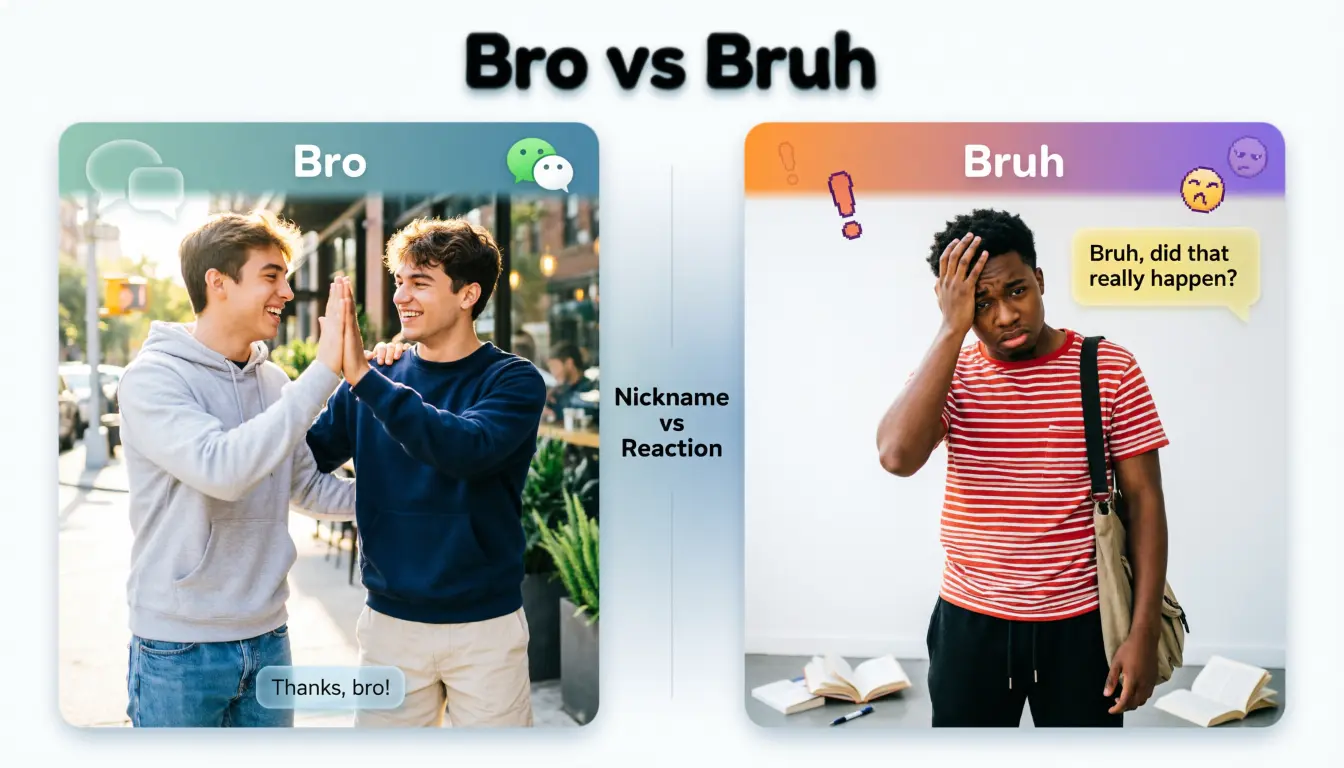
“Bro” and “bruh” are both informal slang terms, but they are used differently. “Bro” is a friendly term for brother, friend, or buddy, while “bruh” is an expression often used to show surprise, disbelief, disappointment, or frustration.
Have you ever seen someone write “bro” in a text message and another person reply with “bruh”? At first glance, these words look similar. Many people even think they mean exactly the same thing. But while they are related, they are not always used in the same way.
People often search for bro vs bruh because they want to understand the difference between these popular slang terms. They may see them on social media, in memes, text messages, gaming chats, or online videos and wonder which one is correct.
The confusion comes from the fact that both words are informal and come from similar roots. However, their tone and meaning can change depending on the situation. One is usually used as a friendly nickname, while the other often shows surprise, disappointment, or disbelief.
In this guide, you’ll learn the meaning of each word, where they came from, when to use them, common mistakes, and how they appear in everyday communication. By the end, you’ll know exactly when to say bro and when to say bruh.
Bro vs Bruh – Quick Answer
Bro is a casual way to say “brother” or “friend.”
Bruh is an internet slang expression often used to show surprise, frustration, disbelief, or embarrassment.
Examples
| Word | Example | Meaning |
| Bro | “Thanks for helping me, bro.” | Friend or buddy |
| Bro | “What’s up, bro?” | Friendly greeting |
| Bruh | “You forgot your keys again? Bruh.” | Disbelief |
| Bruh | “Bruh, that was inexplicable!” | Surprise |
Quick rule: Use bro when talking to someone. Use bruh when reacting to something.
The Origin of Bro vs Bruh
Origin of Bro
The word bro is a shortened form of brother. It became popular in American English during the 20th century. Over time, it expanded beyond family relationships and became a friendly way to address friends.
Examples
- “Hey bro, how are you?”
- “My bro helped me move.”
Origin of Bruh
The word bruh developed as a spoken variation of bro. People began pronouncing “bro” in a relaxed way, which sounded more like “bruh.”
Internet culture and social media helped spread the term. Memes, reaction videos, and gaming communities made bruh a popular expression.
Why the Spelling Difference Exists
The difference comes from pronunciation and usage:
- Bro = friend or brother.
- Bruh = reaction or expression.
Although related, they now serve different purposes in modern slang.
British English vs American English Spelling
Unlike words such as “colour” and “color,” bro and bruh are not examples of British and American spelling differences.
Both forms are informal slang used across English-speaking countries.
Comparison Table
| Feature | Bro | Bruh |
| Meaning | Friend, brother | Reaction expression |
| Formal? | No | No |
| Common in US | Yes | Yes |
| Common in UK | Yes | Yes |
| Used as greeting | Yes | Rarely |
| Used as reaction | Sometimes | Mostly |
Examples
| Country | Preferred Use |
| United States | Bro and Bruh |
| United Kingdom | Bro and Bruh |
| Canada | Bro and Bruh |
| Australia | Bro and Bruh |
| New Zealand | Bro and Bruh |
Which Spelling Should You Use?
Your choice depends on meaning.
Use “Bro” When:
- Talking to a friend
- Greeting someone
- Showing friendship
- Referring to a brother
Examples:
- “Thanks, bro.”
- “Come here, bro.”
Use “Bruh” When:
- Showing disbelief
- Reacting to something silly
- Expressing surprise
- Posting memes online
Examples:
- “Bruh, are you serious?”
- “Bruh, that was unexpected.”
Global Advice
For most situations:
- Use bro for people.
- Use bruh for reactions.
Common Mistakes with Bro vs Bruh
Mistake 1: Using Bruh as a Formal Greeting
❌ Bruh, nice to meet you.
✅ Bro, nice to meet you.
Mistake 2: Using Bro as a Reaction
❌ Bro! I can’t believe that happened.
✅ Bruh! I can’t believe that happened.
Mistake 3: Using Either Word in Professional Writing
❌ Dear Bro,
✅ Dear Mr. Smith,
Both words are slang and should be avoided in formal communication.
Bro vs Bruh in Everyday Examples
In Text Messages
Bro
“Bro, let’s meet after work.”
Bruh
“Bruh, I missed the bus again.”
On Social Media
Bro
“Happy birthday, bro!”
Bruh
“Bruh, this meme is hilarious.”
In Gaming Chats
Bro
“Good game, bro.”
Bruh
“Bruh, how did we lose that match?”
In Emails
Informal:
“Thanks, bro.”
Professional:
“Thank you for your assistance.”
Avoid both bro and bruh in business emails.
In News Writing
Professional journalists rarely use either word except when quoting someone.
Example:
The article quoted a teenager saying, “Bruh, that was unbelievable.”
Bro vs Bruh – Google Trends & Usage Data
Google search behavior shows that both terms are highly popular among younger internet users.
Bro
Most commonly searched in contexts involving:
- Friendship
- Slang meanings
- Text messages
- Social communication
Bruh
Often searched alongside:
- Memes
- TikTok
- Gaming
- Internet culture
Popular Countries
Both terms are widely used in:
- United States
- United Kingdom
- Canada
- Australia
- New Zealand
Usage Context Comparison
| Context | Bro | Bruh |
| Friendship | High | Low |
| Memes | Medium | Very High |
| Gaming | High | High |
| Texting | High | High |
| Professional Writing | Very Low | Very Low |
Bro vs Bruh Comparison Table
| Feature | Bro | Bruh |
| Part of Speech | Noun/Vocative | Interjection |
| Meaning | Friend, brother | Reaction |
| Tone | Friendly | Emotional |
| Formality | Informal | Informal |
| Social Media Use | High | Very High |
| Greeting Use | Yes | Rare |
| Meme Use | Medium | Very High |
Bro vs Bruh in Academic Writing
Neither bro nor bruh is appropriate in academic writing.
Academic writing values:
- Clarity
- Formality
- Professional tone
Example
❌ The participants said, “Bro, that’s interesting.”
✅ The participants expressed agreement with the statement.
Use these terms only when directly quoting a source.
Bro vs Bruh in Business English
Business communication should remain professional.
Avoid
- Bro
- Bruh
- Dude
- Yo
Prefer
- Colleague
- Team member
- Customer
- Client
Examples:
❌ Thanks, bro.
✅ Thank you for your support.
Common Style Guide Recommendations
Major style guides recommend avoiding slang in formal writing.
| Style Guide | Recommendation |
| APA | Avoid slang unless quoted |
| MLA | Use only when relevant |
| Chicago | Prefer formal language |
| AP Style | Avoid unnecessary slang |
For professional content, use standard English instead.
Real Examples from Published Sources
Example of Bro
“Bro” often appears in interviews, entertainment content, and sports coverage where speakers use casual language.
Example of Bruh
“Bruh” commonly appears in social media reports, internet culture articles, and discussions of online trends.
Most newspapers place these words inside quotation marks because they are slang.
Quiz: Bro or Bruh?
Choose the correct word.
1.
“____, thanks for helping me move.”
A. Bro
B. Bruh
Answer: A
2.
“____, I can’t believe that happened.”
A. Bro
B. Bruh
Answer: B
3.
“What’s up, ____?”
A. Bro
B. Bruh
Answer: A
4.
“____, that was embarrassing.”
A. Bro
B. Bruh
Answer: B
Fill in the Blanks Exercise
Complete the sentences.
- Thanks for the ride, ______.
- ______, I forgot my homework again.
- What’s happening, ______?
- ______, that movie ending shocked me.
- My ______ always supports me.
Answers
- Bro
- Bruh
- Bro
- Bruh
- Bro
FAQs About Bro vs Bruh
Is bruh just another spelling of bro?
No. While they share the same origin, they are often used differently today.
Which is more popular online?
Bruh is extremely popular in memes and reaction content.
Is bro a real word?
Yes. It is a recognized informal shortening of “brother.”
Can I use bruh in professional writing?
No. It is considered slang.
Is bro rude?
Usually not. It is generally friendly and informal.
Why do gamers say bruh?
They often use it to react to surprising or frustrating moments.
Can women use bro or bruh?
Yes. Both words are commonly used by people of all genders.
Which word is older?
Bro is older because it comes directly from the word “brother.”
Should I use bro or bruh in school assignments?
Neither is recommended unless quoting someone.
Conclusion
Understanding bro vs bruh is simple once you know their purpose. Both words come from the same root, but they play different roles in modern English. Bro is mainly used to address a friend, buddy, or brother. It creates a friendly and casual tone in conversations, text messages, and social interactions. Bruh, on the other hand, is usually a reaction word. People use it to express surprise, disbelief, frustration, or amusement, especially online.
The key difference is function. If you are speaking directly to someone, bro is usually the better choice. If you are reacting to a situation, bruh is often more natural. Neither term is appropriate for formal writing, academic work, or professional business communication. In those settings, standard English should always be used.
As internet culture continues to shape language, both words remain popular across social media, gaming communities, and everyday conversations. Knowing when to use each one will help you communicate more clearly and sound natural in modern English.

I am an Emily Carter Brooks U.S.A based linguistics writer known for my clear, reader-friendly explanations of English grammar and vocabulary differences. I have contributed to multiple online language resources and specializes in spelling variations, pronunciation confusion, and British vs American English comparisons. I’m passionate about helping learners improve their English through practical, everyday communication. engaging, and stress-free.