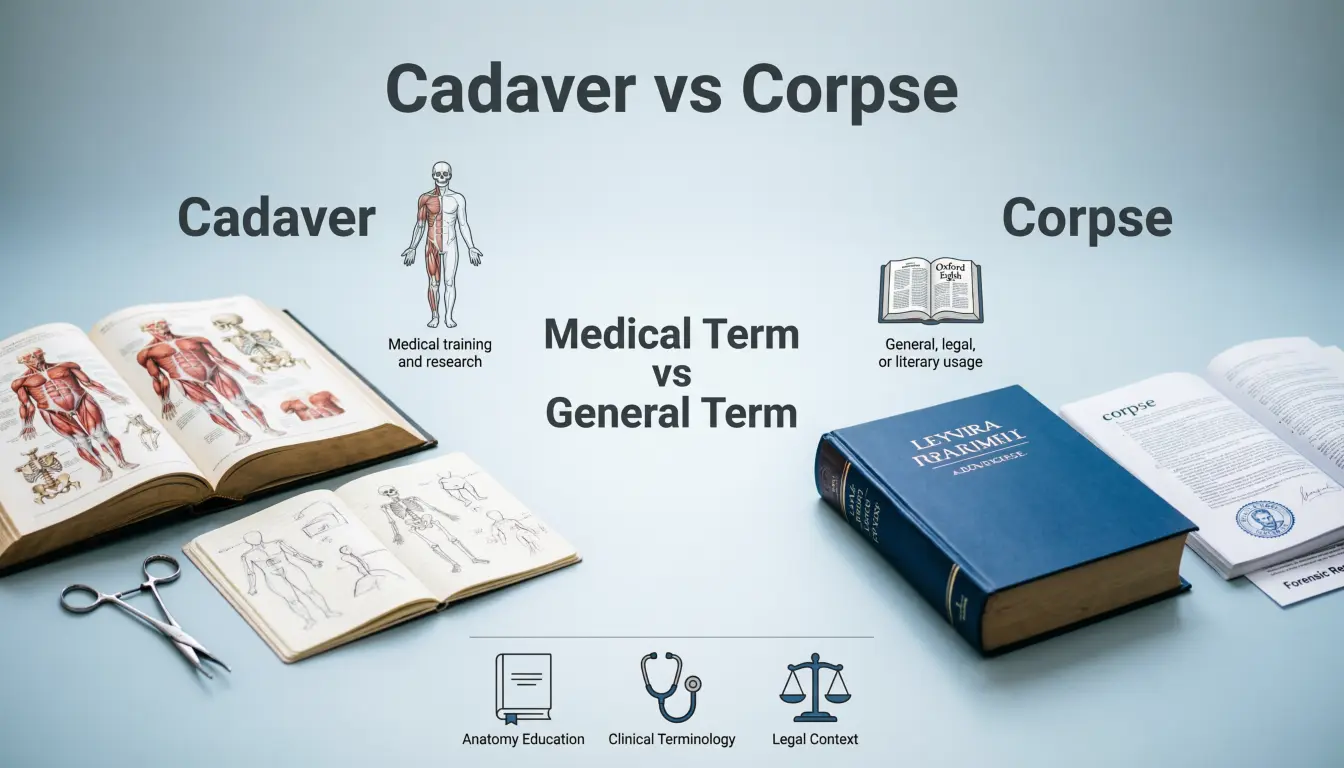
“Cadaver” and “corpse” are both correct words, but they are used in different contexts. “Cadaver” is a formal medical or scientific term for a dead human body, especially one used for research or education, while “corpse” is a more general term for a dead human body, often used in everyday, literary, or legal contexts.
Have you ever read a news report, watched a crime show, or studied a medical article and noticed the words cadaver and corpse? Many people assume they mean exactly the same thing. While both words refer to a dead human body, they are often used in different situations.
People search for cadaver vs corpse because they want to know which word is correct, more formal, or appropriate in a specific context. Writers, students, healthcare workers, and English learners frequently encounter these terms and wonder whether they can be used interchangeably.
The confusion comes from their similar meanings. However, there are important differences in tone, usage, and professional context. A doctor may talk about a cadaver, while a journalist may report the discovery of a corpse. Understanding these differences helps you communicate more accurately and professionally.
In this guide, you’ll learn the meaning, origin, usage, examples, common mistakes, trends, and practical advice for choosing between cadaver and corpse.
Cadaver vs Corpse – Quick Answer
The main difference is context and tone.
| Word | Meaning | Common Usage |
| Cadaver | A dead human body used for medical study or scientific research | Medicine, anatomy, education |
| Corpse | A dead human body, especially in legal, criminal, or general contexts | News, crime reports, literature |
Examples
- Medical students practiced surgery on a cadaver.
- Police discovered a corpse near the river.
Both words refer to a dead body, but cadaver is more scientific, while corpse is more general.
The Origin of Cadaver vs Corpse
Understanding the history of these words helps explain why they are used differently today.
Cadaver
The word cadaver comes from the Latin word cadaver, meaning “dead body.”
It entered English in the 15th century and became strongly associated with medicine, anatomy, and scientific study.
Corpse
The word corpse comes from the Old French word cors, which originated from the Latin corpus, meaning “body.”
It entered English much earlier and became the standard general word for a dead body.
Why the Difference Exists
Over time, medical professionals adopted cadaver for educational and research purposes. Meanwhile, corpse remained the everyday and legal term.
British English vs American English Spelling
Unlike many English word comparisons, cadaver and corpse do not have different British and American spellings.
The spelling remains identical in both varieties of English.
Comparison Table
| Term | American English | British English |
| Cadaver | Cadaver | Cadaver |
| Corpse | Corpse | Corpse |
Examples
American English
- Researchers examined the cadaver.
- The police found a corpse.
British English
- Medical students studied the cadaver.
- Investigators identified the corpse.
The spelling does not change based on location.
Which Spelling Should You Use?
Since the spelling is the same worldwide, your choice depends on context rather than country.
Use “Cadaver” When:
- Writing medical documents
- Discussing anatomy classes
- Referring to scientific research
- Talking about body donation programs
Examples
“The university received several cadavers for anatomical study.”
Use “Corpse” When:
- Writing news articles
- Reporting crimes
- Discussing investigations
- Writing fiction or historical accounts
Examples:
“The corpse was discovered early in the morning.”
Global Advice
For international audiences:
- Use cadaver in scientific contexts.
- Use corpse in general contexts.
Common Mistakes with Cadaver vs Corpse
Many writers misuse these terms because their meanings overlap.
Mistake 1: Using Cadaver in Casual Conversation
❌ The police found a cadaver in the park.
✔ The police found a corpse in the park.
Why? News and police reports usually use corpse.
Mistake 2: Using Corpse in Medical Education
❌ Students learned anatomy using a corpse.
✔ Students learned anatomy using a cadaver.
Why? Medical institutions prefer cadaver.
Mistake 3: Assuming They Have Different Spellings
❌ Cadavour
❌ Corpes
✔ Cadaver
✔ Corpse
Mistake 4: Thinking They Mean Different Types of Bodies
Some people believe a cadaver is an animal body.
✔ A cadaver refers specifically to a human body used for study.
Cadaver vs Corpse in Everyday Examples
In Emails
Cadaver
“Our anatomy department received a donated cadaver for educational purposes.”
Corpse
“The report discusses procedures for identifying a corpse.”
In News Reports
- Authorities discovered a corpse near the highway.
- Investigators examined the corpse at the scene.
In Medical Writing
- The cadaver was used for surgical training.
- Students practiced procedures on the cadaver.
On Social Media
- Medical students often learn from cadavers.
- Detectives found a corpse during the investigation.
In Formal Reports
- Researchers documented findings from the cadaver.
- Officials confirmed the identity of the corpse.
Cadaver vs Corpse – Google Trends & Usage Data
Search behavior shows that corpse is generally more common in everyday English.
Where “Corpse” Is Popular
- United States
- United Kingdom
- Canada
- Australia
People often encounter this word in:
- Crime stories
- News reports
- Television shows
- Fiction
Where “Cadaver” Is Popular
The word appears more frequently in:
- Medical schools
- Universities
- Research institutions
- Scientific publications
Usage Context Comparison
| Context | Preferred Word |
| Medical school | Cadaver |
| Anatomy class | Cadaver |
| Crime report | Corpse |
| Newspaper article | Corpse |
| Scientific research | Cadaver |
| Detective novel | Corpse |
Overall, corpse is more common in everyday language, while cadaver is more specialized.
Comparison Table: Cadaver vs Corpse
| Feature | Cadaver | Corpse |
| Meaning | Dead human body used for study | Dead human body |
| Tone | Scientific | General |
| Medical Usage | Very common | Rare |
| News Usage | Rare | Common |
| Legal Usage | Sometimes | Common |
| Educational Context | Common | Rare |
| Everyday Conversation | Less common | More common |
| British Spelling | Cadaver | Corpse |
| American Spelling | Cadaver | Corpse |
Quick Quiz: Cadaver vs Corpse
Choose the correct word.
1. Medical students practiced surgery on a ______.
A. Corpse
B. Cadaver
Answer: B. Cadaver
2. Police discovered a ______ near the river.
A. Corpse
B. Cadaver
Answer: A. Corpse
3. Researchers studied the donated ______.
A. Cadaver
B. Corpse
Answer: A. Cadaver
4. Detectives examined the ______.
A. Cadaver
B. Corpse
Answer: B. Corpse
5. Anatomy classes often use a ______.
A. Cadaver
B. Corpse
Answer: A. Cadaver
Fill in the Blanks
Complete the sentences with cadaver or corpse.
- The anatomy lab received a donated __________.
- Police recovered the __________ from the scene.
- Students learned surgical techniques using a __________.
- Detectives worked to identify the __________.
- The university uses each __________ for educational purposes.
Answers
- cadaver
- corpse
- cadaver
- corpse
- cadaver
FAQs About Cadaver vs Corpse
1. Is a cadaver the same as a corpse?
Both refer to a dead human body, but a cadaver is usually used for medical study.
2. Which word is more formal?
Cadaver is generally considered more formal and scientific.
3. Do doctors use the word corpse?
Doctors usually prefer the word cadaver in educational and research settings.
4. Which word appears more in news reports?
Corpse is much more common in journalism and crime reporting.
5. Is cadaver only used in medicine?
Mostly yes, although it can occasionally appear in scientific discussions outside medicine.
6. Is corpse offensive?
No. It is a standard English word, though it may sound blunt because it refers to death.
7. Do British and American English spell these words differently?
No. Both use the same spellings: cadaver and corpse.
8. Can I use corpse in a medical paper?
You can, but cadaver is usually preferred because it sounds more professional.
9. Which word should English learners use?
Use corpse for general situations and cadaver for medical or scientific contexts.
Conclusion
The debate over cadaver vs corpse is not about spelling differences but about usage and context. Both words describe a dead human body, yet they serve different purposes in modern English. A cadaver is typically associated with medical education, anatomical research, and scientific study. The word carries a professional and academic tone that makes it suitable for healthcare and educational environments.
A corpse, on the other hand, is the more general term. It commonly appears in news reports, police investigations, legal documents, literature, and everyday discussions about death. Because it is widely understood, it remains the preferred choice outside medical settings.
The good news is that British English and American English use the same spelling for both words. There is no regional variation to remember. Instead, focus on the audience and purpose of your writing. If you are discussing anatomy or research, choose cadaver. If you are writing for the general public or describing a crime scene, choose corpse.
Knowing this distinction will make your writing clearer, more professional, and more accurate.

I hold a degree in English Literature and Linguistics and have worked extensively on educational blogs, comparison websites, and digital learning platforms. My writing focuses on simplifying complex language rules, highlighting British vs American English differences, and providing practical examples for everyday usage.