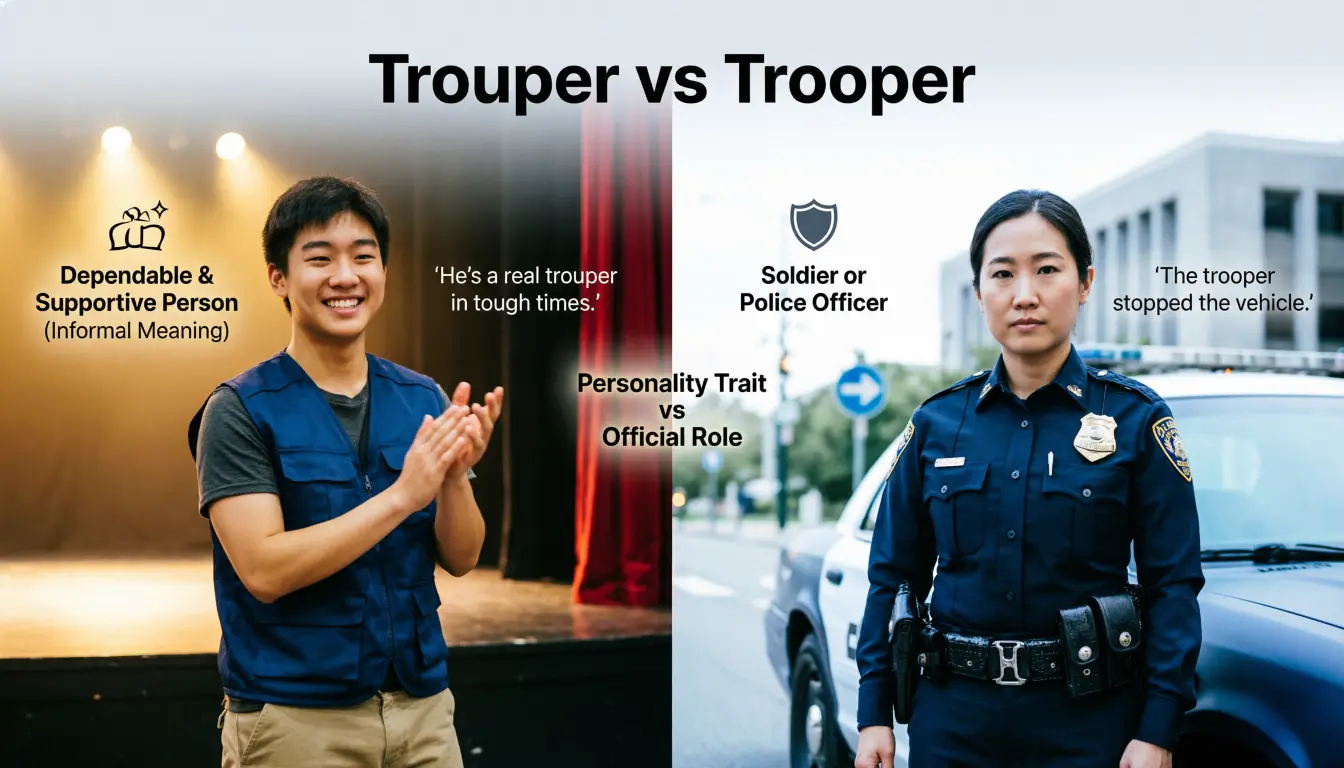
“Trouper” and “trooper” are both correct words, but they have different meanings. “Trouper” refers to a dependable performer or someone who shows great professionalism and resilience, especially in difficult situations, while “trooper” refers to a soldier (especially in cavalry or police units) or someone who keeps going bravely despite difficulty.
Have you ever seen someone praised as a “real trooper” and wondered whether it should actually be “trouper”? You are not alone. The confusion between trouper vs trooper is common because the two words look similar and sound almost identical. Yet they have different meanings and are used in different situations.
Many writers, students, bloggers, and professionals mix up these terms when writing emails, articles, social media posts, or formal documents. The mistake often happens because both words are linked to ideas of dedication, hard work, and perseverance.
Understanding the difference can help you avoid embarrassing errors and improve your writing. In this guide, you will learn the meaning of each word, where they came from, how they are used today, and which one is right for your audience. We will also look at examples, common mistakes, style guide recommendations, and real-world usage.
By the end, you will know exactly when to use trouper and when to use trooper.
Trouper vs Trooper – Quick Answer
The difference is simple:
- Trouper = A reliable performer or someone who works hard and stays positive.
- Trooper = A soldier, police officer, or member of a troop.
Examples
✅ She was a real trouper during the long theater tour.
✅ The state trooper directed traffic after the accident.
Quick Comparison
| Word | Meaning | Example |
| Trouper | Dedicated performer or dependable person | She is a real trouper. |
| Trooper | Soldier or police officer | The trooper issued a warning. |
The Origin of Trouper vs Trooper
Although these words look alike, they developed from different meanings.
Origin of Trooper
The word trooper dates back several centuries. It comes from the word troop, meaning a group of soldiers. A trooper was originally a cavalry soldier serving in a military troop.
Over time, the word expanded to include police officers, especially highway patrol officers.
Origin of Trouper
The word trouper comes from theatrical troupes. A troupe is a group of performers who travel and perform together.
A trouper was a member of a performing troupe. Because actors often worked under difficult conditions, the word gradually came to describe anyone who remains cheerful, dependable, and hardworking.
Why the Confusion Exists
The confusion exists because:
- The words sound nearly identical.
- Both can describe people who show dedication.
- Many people mistakenly use “trooper” when they mean “trouper.”
British English vs American English Spelling
Unlike words such as “analysed” and “analyzed,” trouper and trooper are not British and American spelling variations.
Both British and American English use the same spellings.
Comparison Table
| Usage | British English | American English |
| Performer | Trouper | Trouper |
| Soldier | Trooper | Trooper |
| Dependable person | Trouper | Trouper |
| Police officer | Trooper | Trooper |
British English
- The actress was a real trouper during rehearsals.
- The trooper arrived at the scene quickly.
American English
- He was a trouper despite the delays.
- The state trooper stopped the vehicle.
Which Spelling Should You Use?
The correct choice depends on meaning, not location.
Use “Trouper” If:
- You mean a performer.
- You mean a dependable person.
- You want to praise someone’s positive attitude.
Examples:
Maria was a true trouper and finished the project despite being ill.
Use “Trooper” If:
- You mean a soldier.
- You mean a police officer.
- You mean a member of a troop.
Examples:
The state trooper responded within minutes.
For Global Audiences
Focus on the meaning:
- Dependable person = Trouper
- Soldier or officer = Trooper
Common Mistakes with Trouper vs Trooper
Many writers use the wrong word when praising someone’s dedication.
Incorrect
❌ Thanks for being such a trooper during the event.
Correct
✅ Thanks for being such a trouper during the event.
Incorrect
❌ The trouper pulled over the speeding driver.
Correct
✅ The trooper pulled over the speeding driver.
Memory Tip
Think of:
- Trouper = Troupe = Performers
- Trooper = Troop = Soldiers
This trick makes the difference easy to remember.
Trouper vs Trooper in Everyday Examples
In Emails
Trouper
Thank you for being a real trouper during the busy season.
Trooper
The trooper completed the incident report.
In News Writing
Trouper
The veteran actor proved to be a trouper throughout filming.
Trooper
A state trooper rescued the stranded family.
On Social Media
Trouper
My friend was a total trouper today!
Trooper
Shout-out to the trooper who helped us on the highway.
In Formal Writing
Trouper
She remained a trouper despite difficult circumstances.
Trooper
The trooper testified during the hearing.
Trouper vs Trooper – Google Trends & Usage Data
Search data shows that trooper is generally searched more often than trouper.
Why Trooper Is More Popular
- Military references
- Law enforcement references
- News coverage
- Popular culture usage
Why Trouper Gets Searches
People often search:
- “real trouper meaning”
- “trooper vs trouper”
- “is it trouper or trooper?”
Usage by Context
| Context | Common Word |
| Military | Trooper |
| Police | Trooper |
| Theater | Trouper |
| Praise and encouragement | Trouper |
| News reports | Trooper |
Trouper vs Trooper Comparison Table
| Feature | Trouper | Trooper |
| Part of Speech | Noun | Noun |
| Main Meaning | Dependable person or performer | Soldier or officer |
| Related Word | Troupe | Troop |
| Common Context | Theater, praise | Military, law enforcement |
| Used Figuratively | Yes | Rarely |
| Correct Phrase | Real trouper | State trooper |
Trouper vs Trooper in Academic Writing
Academic writing requires precision.
Use Trouper
When discussing:
- Theater history
- Performing arts
- Human behavior
- Dedication and perseverance
Example:
The actress became known as a trouper throughout the production.
Use Trooper
When discussing:
- Military studies
- Police organizations
- Historical troop movements
Example:
The trooper served in the cavalry unit.
Trouper vs Trooper in Business English
Business communication often uses trouper figuratively.
Business Examples
✅ Sarah was a real trouper during the product launch.
✅ The team remained troupers despite the tight deadline.
Use trooper only when discussing military or police topics.
Common Style Guide Recommendations
Most major style guides and dictionaries agree:
| Meaning | Recommended Word |
| Dependable person | Trouper |
| Performer | Trouper |
| Soldier | Trooper |
| Police officer | Trooper |
When editing documents, always check whether the sentence refers to dedication or military service.
Real Examples from Published Sources
Trouper
- Entertainment publications often describe hardworking actors as “real troupers.”
- Theater reviews regularly use “trouper” for dedicated performers.
Trooper
- News reports frequently mention state troopers and highway troopers.
- Military history books use trooper for cavalry soldiers.
These examples show that professional writers keep the distinction clear.
Quick Quiz
Choose the correct word.
1.
The actor was a real _____ during filming.
A. Trouper
B. Trooper
Answer: A. Trouper
2.
A state _____ arrived at the accident scene.
A. Trouper
B. Trooper
Answer: B. Trooper
3.
She stayed cheerful and worked hard like a true _____.
A. Trouper
B. Trooper
Answer: A. Trouper
4.
The _____ conducted a traffic stop.
A. Trouper
B. Trooper
Answer: B. Trooper
Fill in the Blanks Exercise
Fill each blank with trouper or trooper.
- The actress was a real ______ during rehearsals.
- The highway ______ assisted stranded drivers.
- He remained a ______ despite the difficult conditions.
- The ______ issued a speeding ticket.
- The performer became known as a dedicated ______.
Answers
- Trouper
- Trooper
- Trouper
- Trooper
- Trouper
FAQs
1. Is it real trouper or real trooper?
The correct phrase is real trouper when praising someone’s dedication and positive attitude.
2. What does trouper mean?
A trouper is a dependable person or a performer who works hard despite challenges.
3. What does trooper mean?
A trooper is a soldier, police officer, or member of a troop.
4. Why do people confuse trouper and trooper?
They sound alike and are spelled similarly.
5. Is trouper used in American English?
Yes. Both American and British English use the word trouper.
6. Can trooper mean a hardworking person?
People sometimes use it that way informally, but many editors prefer trouper.
7. Which word is correct for police officers?
Trooper.
8. Which word is correct for actors?
Trouper.
9. Are trouper and trooper interchangeable?
No. They have different meanings and should be used carefully.
Conclusion
The debate over trouper vs trooper is not about regional spelling differences. Instead, it is about meaning. A trouper is a dependable person or performer who remains positive and hardworking even when conditions are difficult. A trooper, on the other hand, is a soldier, police officer, or member of a troop.
The easiest way to remember the distinction is to connect trouper with troupe, which refers to performers, and trooper with troop, which refers to soldiers. This simple memory trick can help you avoid mistakes in writing.
In professional, academic, and everyday communication, choosing the correct word shows attention to detail and improves clarity. When praising someone’s determination, use trouper. When referring to military personnel or law enforcement officers, use trooper.
Now that you know the difference, you can use both words confidently and correctly in any context.

I am an Emily Carter Brooks U.S.A based linguistics writer known for my clear, reader-friendly explanations of English grammar and vocabulary differences. I have contributed to multiple online language resources and specializes in spelling variations, pronunciation confusion, and British vs American English comparisons. I’m passionate about helping learners improve their English through practical, everyday communication. engaging, and stress-free.