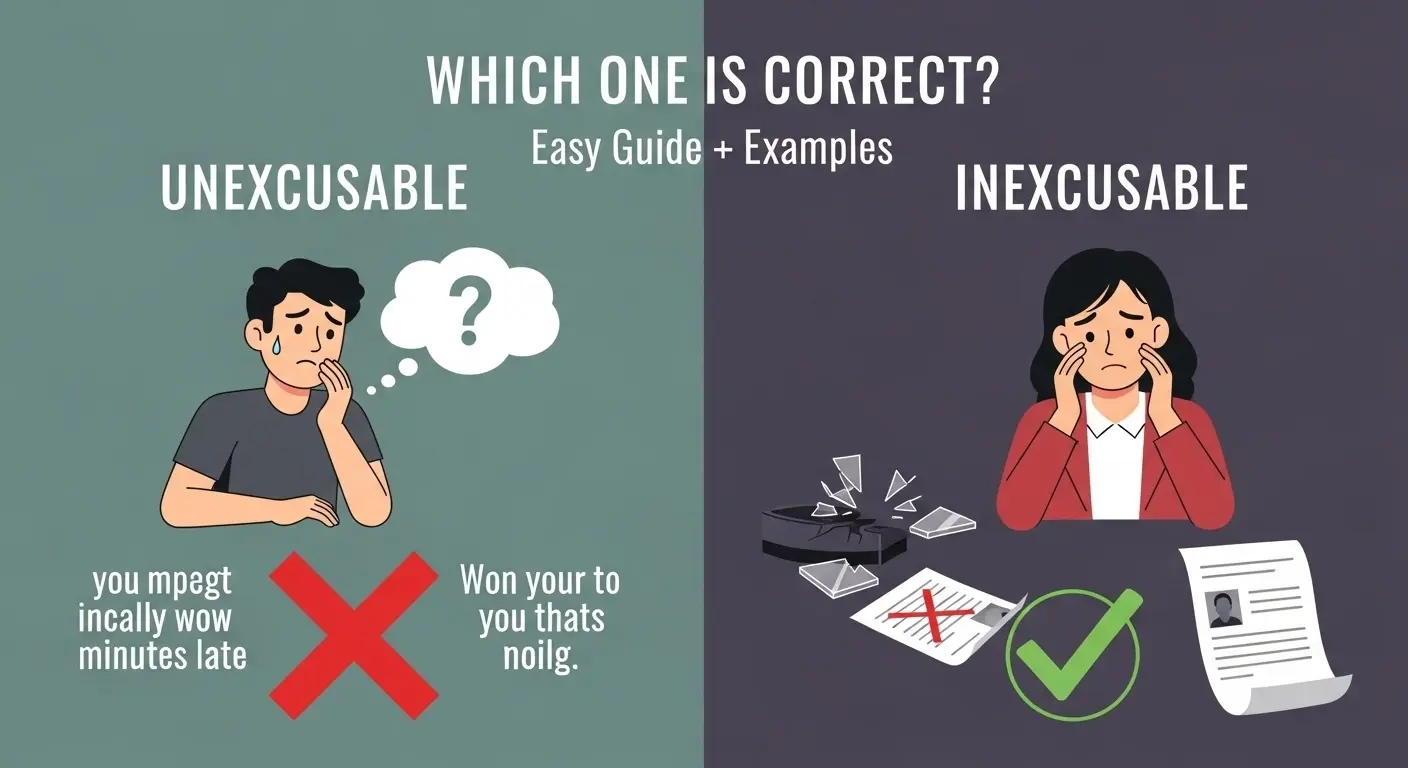
“Inexcusable” is an adjective meaning something that cannot be justified or forgiven, whereas “unexcusable” is generally avoided in formal writing.
Have you ever typed “unexcusable” and wondered if it is correct? Or maybe you saw “inexcusable” and felt confused. You are not alone. Many students and writers search for “unexcusable or inexcusable” because both words look right. But in English, small changes can make a big difference.
This confusion happens because English uses prefixes like “un-” and “in-” to make words negative. Sometimes both forms exist, but often only one is correct and commonly used. That is the case here.
Understanding the right word helps you write better emails, essays, and social posts. It also makes your English sound more natural and professional.
In this guide, you will learn:
- The correct spelling and meaning
- Why the confusion happens
- Which word you should use
- Real-life examples and tips
Let’s clear it up in a simple way.
Unexcusable or Inexcusable – Quick Answer
The correct and widely accepted word is “inexcusable.”
- Inexcusable = Something so bad that it cannot be forgiven
- Unexcusable = Rare and not commonly used (often considered incorrect)
Examples:
- His rude behavior was inexcusable. ✅
- Missing the deadline without reason is inexcusable. ✅
- His actions were unexcusable. ❌ (not standard)
Quick tip: Always use inexcusable in formal and everyday English.
The Origin of Unexcusable or Inexcusable
The word “inexcusable” comes from Latin roots:
- “excuse” = to forgive or justify
- “in-” = not
So, inexcusable means “not able to be excused.”
Why not “unexcusable”?
English uses both “un-” and “in-” as negative prefixes. But they are not always interchangeable.
- “In-” is often used with formal or Latin-based words
- “Un-” is more common with simple, everyday words
Because “excuse” comes from Latin, “inexcusable” became the correct and standard form.
“Unexcusable” may appear sometimes, but it is rare and not preferred.
British English vs American English Spelling
Good news: There is no difference between British and American English here.
Both use “inexcusable” as the correct spelling.
Comparison Table
| Feature | British English | American English |
| Correct spelling | Inexcusable | Inexcusable |
| Usage | Common | Common |
| “Unexcusable” usage | Rare | Rare |
Unlike words like “colour/color,” this word stays the same in both styles.
Which Spelling Should You Use?
Use “Inexcusable” if:
- You write for school or exams
- You write emails or reports
- You create blog or SEO content
- You speak in formal settings
Avoid “Unexcusable” because:
- It is not standard
- It may look incorrect
- It can confuse readers
Audience Advice:
- US audience → Use inexcusable
- UK/Commonwealth audience → Use inexcusable
- Global audience → Use inexcusable
Simple rule: Always choose “inexcusable.”
Common Mistakes with Unexcusable or Inexcusable
Here are common errors people make:
❌ Wrong vs ✅ Right
- ❌ Unexcusable behavior → ✅ Inexcusable behavior
- ❌ That was unexcusable → ✅ That was inexcusable
- ❌ Very unexcusable mistake → ✅ Very inexcusable mistake
Other Mistakes:
- Mixing prefixes randomly
- Thinking both words are equal
- Using “unexcusable” in formal writing
Fix: Stick to inexcusable every time.
Unexcusable or Inexcusable in Everyday Examples
- “Your delay in response is inexcusable.”
News
- “The official called the error inexcusable.”
Social Media
- “This service is just inexcusable!”
Formal Writing
- “The lack of safety measures is inexcusable.”
Daily Conversation
- “Being late without reason is inexcusable.”
You will notice: only inexcusable is used in real life.
Unexcusable or Inexcusable – Google Trends & Usage Data
Search data shows a clear pattern:
- “Inexcusable” is widely used worldwide
- “Unexcusable” has very low search volume
Popularity by Region:
- 🇺🇸 United States → “Inexcusable” dominates
- 🇬🇧 United Kingdom → Same usage
- 🌍 Global → “Inexcusable” is standard
Contexts where “inexcusable” is used:
- News articles
- Academic writing
- Social media
- Professional communication
Conclusion: “Inexcusable” is the trusted and popular choice.
Comparison Table (Side-by-Side)
| Word | Correct? | Meaning | Usage Level |
| Inexcusable | ✅ Yes | Cannot be forgiven | Very common |
| Unexcusable | ❌ No (rare) | Same meaning | Very rare |
FAQs:
1. Is “unexcusable” a real word?
It exists, but it is rare and not standard. Most people avoid it.
2. Which is correct: unexcusable or inexcusable?
Inexcusable is correct.
3. Why do people use “unexcusable”?
Because they think “un-” works with all words, which is not true.
4. Is “inexcusable” formal or informal?
It works in both formal and informal writing.
5. Can I use “unexcusable” in essays?
No. Use inexcusable to stay correct.
6. Do British and American English differ here?
No. Both use inexcusable.
7. What is an easy way to remember?
Think: Important words use “in-” → inexcusable
8. Is “inexcusable” negative?
Yes. It shows strong disapproval.
Conclusion:
The confusion between “unexcusable” and “inexcusable” is common, but the answer is simple. The correct and widely accepted word is inexcusable. It means something so wrong that it cannot be forgiven.
“Unexcusable” may appear sometimes, but it is rare and not standard. Using it can make your writing look incorrect or less professional. That is why students, writers, and professionals should always choose inexcusable.
There is also no difference between British and American English in this case. Both follow the same rule. This makes it easy to remember and use worldwide.
If you want clear and strong English, use inexcusable in emails, essays, and daily speech. Avoid guessing or mixing prefixes like “un-” and “in-.”

I hold a degree in English Literature and Linguistics and have worked extensively on educational blogs, comparison websites, and digital learning platforms. My writing focuses on simplifying complex language rules, highlighting British vs American English differences, and providing practical examples for everyday usage.