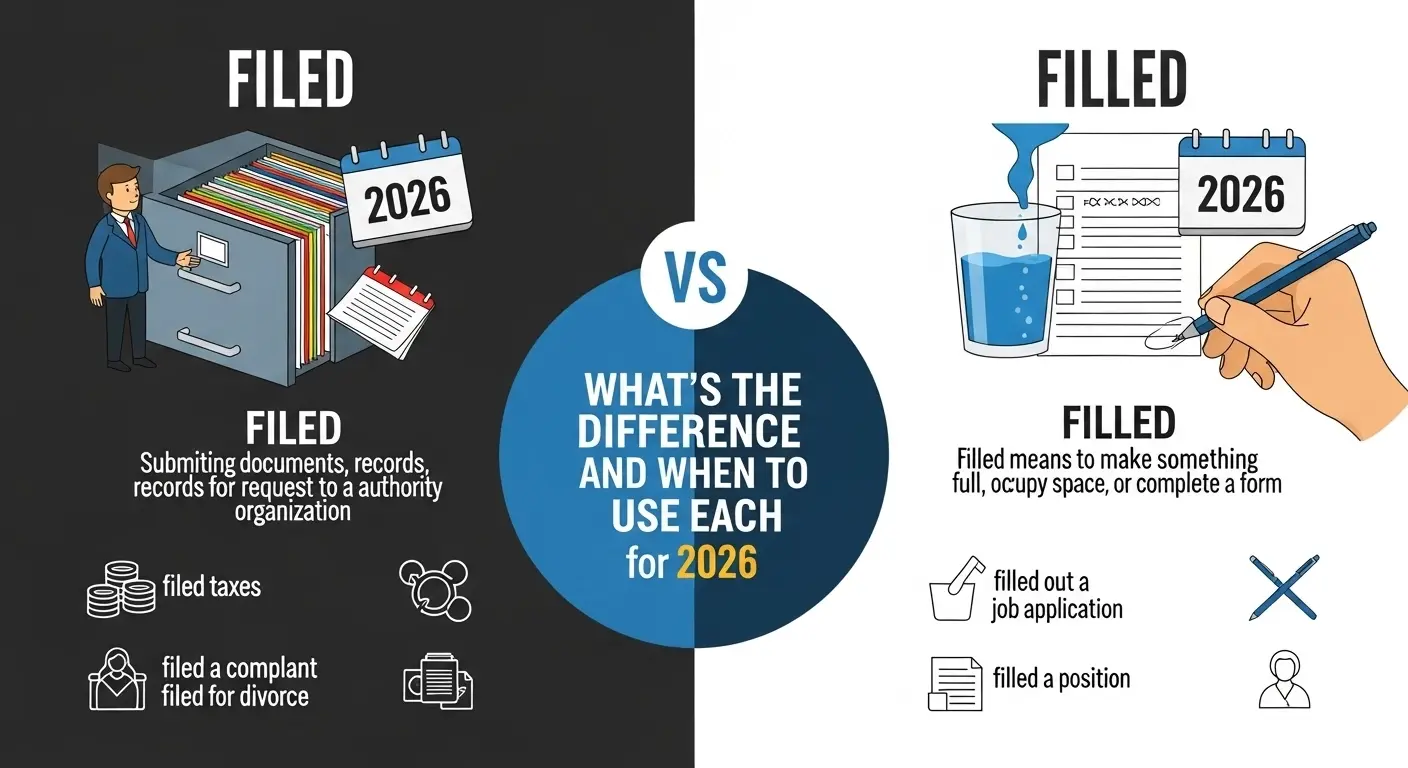
“Filed” is the past tense of file, meaning to submit, organize, or store documents, while “filled” is the past tense of fill, meaning to make something full.
Many people get confused between “filed” and “filled.” At first glance, both words look almost the same. They sound similar too. But their meanings are very different. This is why so many writers, students, and professionals search for “filed or filled” online.
The confusion usually happens in writing emails, legal documents, or everyday sentences. For example, should you say “I filed the form” or “I filled the form”? One small mistake can change the meaning of your sentence completely.
This article will help you understand the clear difference between “filed” and “filled.” You will learn their meanings, origins, and how to use them correctly. We will also look at common mistakes, real-life examples, and usage trends. By the end, you will feel confident using both words in the right way.
Let’s clear the confusion once and for all.
Filed or Filled – Quick Answer
Filed means to submit, organize, or store documents.
Filled means to make something full.
Examples:
- I filed the report yesterday. ✅ (submitted or stored)
- I filled the glass with water. ✅ (made it full)
❌ Incorrect:
- I filed the glass with water.
- I filled the report to the office.
Simple rule:
- Use filed for documents or paperwork.
- Use filled for space, containers, or amounts.
The Origin of Filed or Filled
Understanding the origin makes it easier to remember.
Filed
The word filed comes from the word “file.”
A file was originally a tool or a place where papers were stored in order. Over time, it became a verb meaning to submit or organize documents.
Example:
- File a complaint
- File taxes
Filled
The word filled comes from “fill.”
This word has old English roots and means to make something full.
Example:
- Fill a cup
- Fill a form (add information)
Why the Confusion?
The confusion happens because:
- Both words sound similar
- Both are used in formal writing
- Both can appear in office-related sentences
But their meanings are completely different.
British English vs American English Spelling
Good news: There is no spelling difference between British and American English for these words.
Both use:
- Filed ✅
- Filled ✅
However, usage context may differ slightly.
Comparison Table
| Word | Meaning | Example (UK & US) |
| Filed | Submitted or organized | She filed the complaint. |
| Filled | Made full | He filled the bottle with water. |
The spelling stays the same worldwide. Only the usage matters.
Which Spelling Should You Use?
It’s not about US vs UK. It’s about meaning.
Use “Filed” when:
- Talking about documents
- Submitting forms
- Legal or office work
Example:
- I filed my tax return.
Use “Filled” when:
- Talking about space or quantity
- Completing a form with details
Example:
- I filled the form with correct data.
Simple Tip:
- Filed = Paperwork action
- Filled = Making something full
For global writing, just focus on meaning. That’s all you need.
Common Mistakes with Filed or Filled
Here are some common errors people make:
1. Mixing meanings
❌ I filed the bottle with water
✅ I filled the bottle with water
2. Wrong word in office context
❌ I filled a complaint
✅ I filed a complaint
3. Confusion with forms
❌ I filed the form with my details
✅ I filled the form with my details
✅ I filed the form to the office
Remember:
- Fill a form (add info)
- File a form (submit it)
Filed or Filled in Everyday Examples
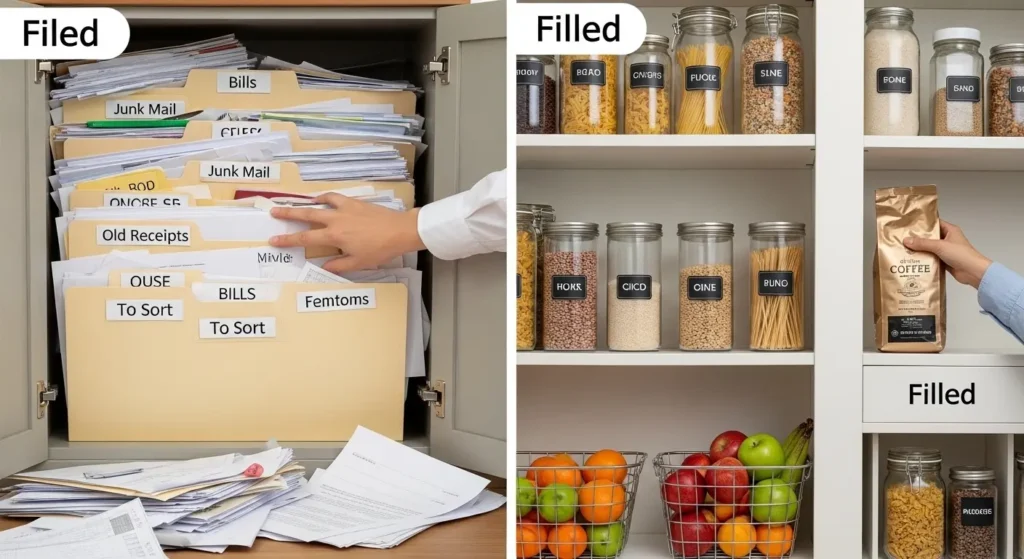
In Emails
- I have filed the report.
- Please check the filled form attached.
In News
- The company filed a lawsuit.
- The stadium was filled with fans.
On Social Media
- Just filed my taxes!
- My heart is filled with joy
In Formal Writing
- The lawyer filed the case in court.
- The tank was filled with fuel.
Filed or Filled – Google Trends & Usage Data
Search data shows that people often search “filed or filled” because:
- Both words are used in offices
- They appear in forms and legal tasks
- Non-native speakers find them confusing
Popular Usage by Context
| Context | Common Word |
| Legal/Office | Filed |
| Daily Life | Filled |
| Education | Both |
By Country
- USA & UK: High use of both words
- India & Pakistan: High confusion in searches
- Global: “Filled” is more common in daily use
“Filed” is more formal.
“Filled” is more general and widely used.
Comparison Table – Filed vs Filled
| Feature | Filed | Filled |
| Meaning | Submit or organize documents | Make something full |
| Usage | Legal, office, paperwork | Daily life, objects |
| Example | Filed a report | Filled a glass |
| Verb Type | Action (submit/store) | Action (add to make full) |
| Common Context | Taxes, complaints | Water, forms, emotions |
FAQs About Filed or Filled
1. Is it “filed a form” or “filled a form”?
Both are correct but different:
- Filled a form = wrote information
- Filed a form = submitted it
2. Can I say “filled a complaint”?
No.
Correct: Filed a complaint
3. Which is more common: filed or filled?
Filled is more common in daily use.
Filed is common in legal and office use.
4. Do filed and filled sound the same?
They sound similar, but not exactly the same.
5. Is there a spelling difference in British English?
No. Both spellings are the same in UK and US English.
6. Can “filled” be used for emotions?
Yes.
Example: I am filled with happiness.
7. Can “filed” be used outside office work?
Rarely. It is mostly used for documents.
8. How can I remember the difference?
- Filed → File → Papers
- Filled → Full → Space
Conclusion
The difference between filed and filled is simple once you understand their meanings. Even though they look and sound similar, they are used in very different situations.
Use filed when you are talking about documents, reports, or legal actions. It means you submitted or organized something. On the other hand, use filled when you are talking about making something full. This could be a glass, a form, or even emotions.
One key area where people get confused is with forms. Remember this clearly: you fill out a form when writing information, and you file a form when submitting it. This small difference can improve your writing a lot.
There is no difference in British and American spelling, so you don’t need to worry about location. Just focus on the meaning and context.
By practicing with real examples and remembering simple rules, you can avoid mistakes and use both words with confidence in daily and professional writing.

I am an Emily Carter Brooks U.S.A based linguistics writer known for my clear, reader-friendly explanations of English grammar and vocabulary differences. I have contributed to multiple online language resources and specializes in spelling variations, pronunciation confusion, and British vs American English comparisons. I’m passionate about helping learners improve their English through practical, everyday communication. engaging, and stress-free.