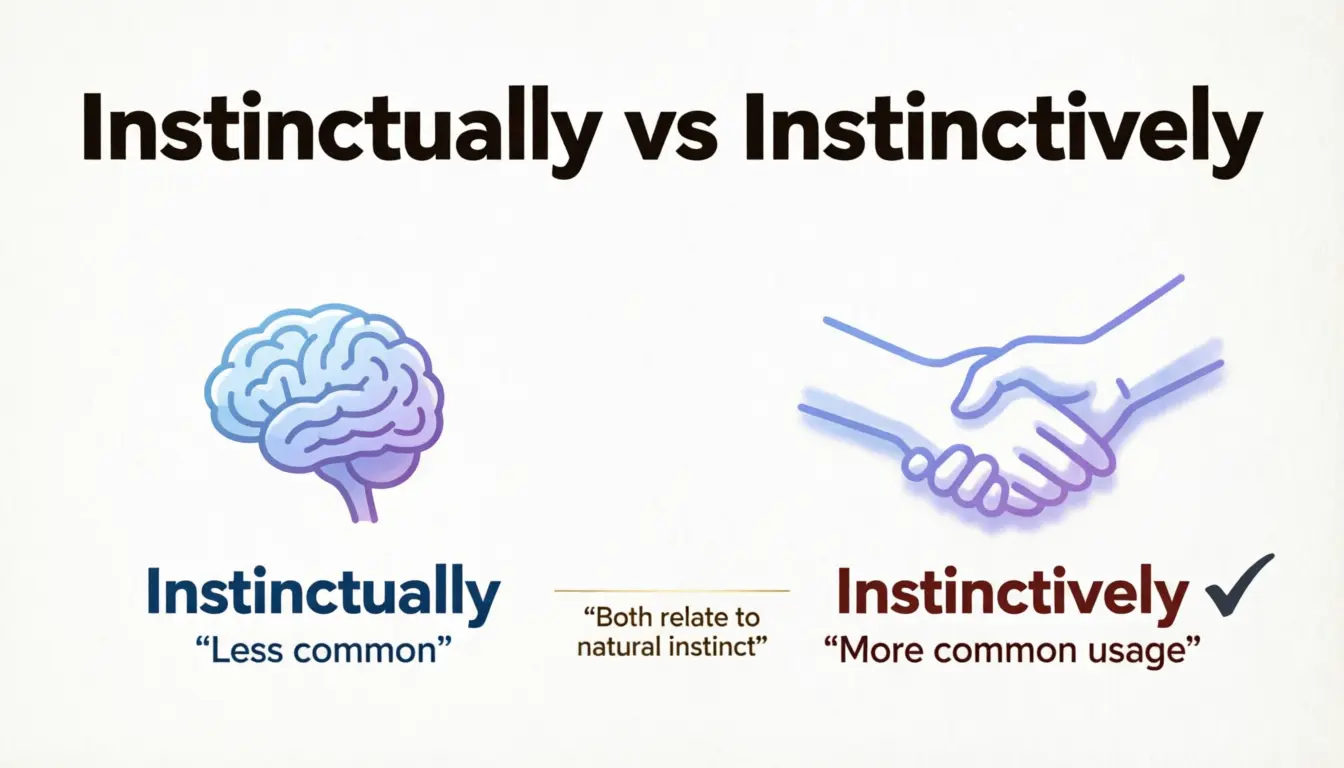
Both words are adverbs meaning to act based on instinct rather than conscious thought, but “instinctively” is preferred in most formal and everyday writing.
Have you ever typed “instinctually” and wondered if it was correct? Or maybe your spell checker changed it to “instinctively”? Many people search for “instinctually vs instinctively” because both words sound similar and seem to mean the same thing.
The confusion happens because both words come from the noun “instinct.” They are both used to describe actions done naturally, without thinking too much. But in modern English, one word is far more common and widely accepted than the other.
Writers, students, bloggers, and professionals often ask which version sounds more natural in emails, articles, and formal writing. Some people think “instinctually” is wrong. Others believe it is simply less common. This article clears up that confusion in simple English.
In this guide, you will learn the meaning of both words, their origins, spelling differences, common mistakes, and when to use each one. You will also see real-life examples, usage trends, and practical advice for both American and British English users.
By the end, you will know exactly which word fits best in your writing.
Instinctually vs Instinctively – Quick Answer
Both “instinctually” and “instinctively” are real English words. They both describe doing something naturally or by instinct.
However:
- Instinctively is the standard and more common word.
- Instinctually is rare and sounds awkward to many readers.
Examples
✅ Correct and natural:
- She instinctively moved away from danger.
- He instinctively knew the answer.
Less common:
- She instinctually moved away from danger.
- He instinctually knew the answer.
Most dictionaries accept both words, but professional writers usually prefer instinctively because it sounds smoother and more natural.
The Origin of Instinctually vs Instinctively
The two words come from the noun instinct, which means a natural feeling or behavior.
Origin of “Instinct”
The word comes from Latin:
- instinctus = impulse or inspiration
Over time, English speakers created adverbs from “instinct.”
How “Instinctively” Formed
“Instinctive” became a common adjective first.
- instinctive → instinctively
This follows a normal English pattern:
- active → actively
- creative → creatively
- instinctive → instinctively
That is why “instinctively” sounds more natural to native speakers.
How “Instinctually” Formed
“Instinctually” formed directly from:
- instinct → instinctual → instinctually
The adjective “instinctual” is valid, but it is less common than “instinctive.”
Because of this, “instinctually” also became less popular.
Why the Confusion Exists
People often assume:
- instinctual → instinctually
- instinctive → instinctively
Since both forms are grammatically possible, both entered English usage. But one became dominant over time.
British English vs American English Spelling
Unlike words such as “color” and “colour,” this is not mainly a British vs American spelling issue.
Both American and British English strongly prefer instinctively.
Comparison Table
| Word | American English | British English | Commonness |
| Instinctively | Very common | Very common | Standard choice |
| Instinctually | Rare | Rare | Less preferred |
Example in American English
- Americans instinctively check their phones.
Example in British English
- Drivers instinctively slowed down in the rain.
In both regions, “instinctively” sounds more natural.
Which Spelling Should You Use?
The best choice depends on your audience and writing style.
Use “Instinctively” For:
- Blogs
- School writing
- News articles
- Emails
- Business writing
- Academic work
- Social media
- International audiences
It is the safer and more professional option.
Use “Instinctually” Only If:
- You prefer its sound
- You are matching a specific style
- You want a more unusual tone
Even then, some readers may think it sounds incorrect.
Quick Advice by Audience
| Audience | Best Choice |
| United States | Instinctively |
| United Kingdom | Instinctively |
| Canada | Instinctively |
| Australia | Instinctively |
| Global readers | Instinctively |
Professional Recommendation
If you are unsure, always choose instinctively.
Common Mistakes with Instinctually vs Instinctively
Many writers mix the words or use awkward grammar.
Mistake #1: Thinking “Instinctually” Is Wrong
❌ “Instinctually is not a real word.”
✅ Truth:
It is a real word, but it is uncommon.
Mistake #2: Using Both in the Same Piece
❌
- The dog instinctively barked.
- It instinctually protected its owner.
✅ Better:
Choose one style and stay consistent.
Mistake #3: Using the Wrong Form
❌
- She acted instinctive.
✅ Correct:
- She acted instinctively.
Mistake #4: Overusing Rare Words
Some writers use “instinctually” because it sounds more advanced.
But simple writing is often stronger.
✅ Better:
- He instinctively reacted.
❌ Less natural:
- He instinctually reacted.
Instinctually vs Instinctively in Everyday Examples
Here is how people use these words in daily writing.
Emails
✅
- I instinctively reached out after hearing the news.
- I instinctually reached out after hearing the news.
News Writing
✅
- Residents instinctively ran for safety.
Journalists almost always use “instinctively.”
Social Media
✅
- I instinctively knew this would happen.
People online strongly prefer “instinctively.”
In Formal Writing
✅
- Humans instinctively avoid danger.
Formal and academic writing usually avoids “instinctually.”
In Conversation
Both may appear in speech, but “instinctively” sounds smoother.
Instinctually vs Instinctively – Google Trends & Usage Data
Search and writing data show a clear winner.
Popularity
- Instinctively is searched and used far more often.
- Instinctually appears much less frequently.
Why “Instinctively” Wins
- It sounds more natural.
- It follows a common English pattern.
- Major publications prefer it.
- Readers recognize it immediately.
Countries Where “Instinctively” Dominates
- United States
- United Kingdom
- Canada
- Australia
- India
Contexts Where It Appears Most
| Context | Preferred Word |
| Journalism | Instinctively |
| Academic writing | Instinctively |
| Blogs | Instinctively |
| Speech | Instinctively |
| Creative writing | Both possible |
Comparison Table: Instinctually vs Instinctively
| Feature | Instinctually | Instinctively |
| Is it a real word? | Yes | Yes |
| Common in English? | Rare | Very common |
| Sounds natural? | Less natural | More natural |
| Preferred in formal writing? | No | Yes |
| Used in journalism? | Rarely | Frequently |
| Good for global audiences? | Not ideal | Yes |
| Easier to read? | No | Yes |
FAQs About Instinctually vs Instinctively
Is “instinctually” grammatically correct?
Yes. It is a real English word, but it is uncommon.
Which is more correct: instinctually or instinctively?
Both are correct, but “instinctively” is the standard and preferred form.
Why does “instinctually” sound strange?
It is less common in modern English, so many readers are unfamiliar with it.
Do dictionaries accept “instinctually”?
Yes. Many dictionaries list it as a valid word.
Is “instinctively” more professional?
Yes. It is the better choice for formal and professional writing.
Do Americans use “instinctually”?
Some do, but “instinctively” is much more common in American English.
Is this a British vs American spelling issue?
No. Both British and American English prefer “instinctively.”
Can I use “instinctually” in creative writing?
Yes. Creative writers sometimes use it for style or rhythm.
Which word should students use?
Students should usually use “instinctively.”
Conclusion
The debate around “instinctually vs instinctively” is mostly about common usage, not grammar. Both words are valid English terms that describe actions done naturally or by instinct. However, modern English strongly favors “instinctively.”
It appears more often in books, newspapers, blogs, schools, and professional writing. Readers recognize it quickly, and it sounds smoother in sentences. While “instinctually” is not wrong, it can feel awkward or overly formal to many people.
For most situations, especially business, academic, and online writing, “instinctively” is the safest and clearest choice. It works well for both American and British audiences and helps your writing sound natural and polished.
You can still use “instinctually” in creative writing or personal style if you prefer it. But if your goal is clarity and professionalism, “instinctively” is usually the better option.
When in doubt, keep it simple. Most readers instinctively understand “instinctively” faster.

I hold a degree in English Literature and Linguistics and have worked extensively on educational blogs, comparison websites, and digital learning platforms. My writing focuses on simplifying complex language rules, highlighting British vs American English differences, and providing practical examples for everyday usage.