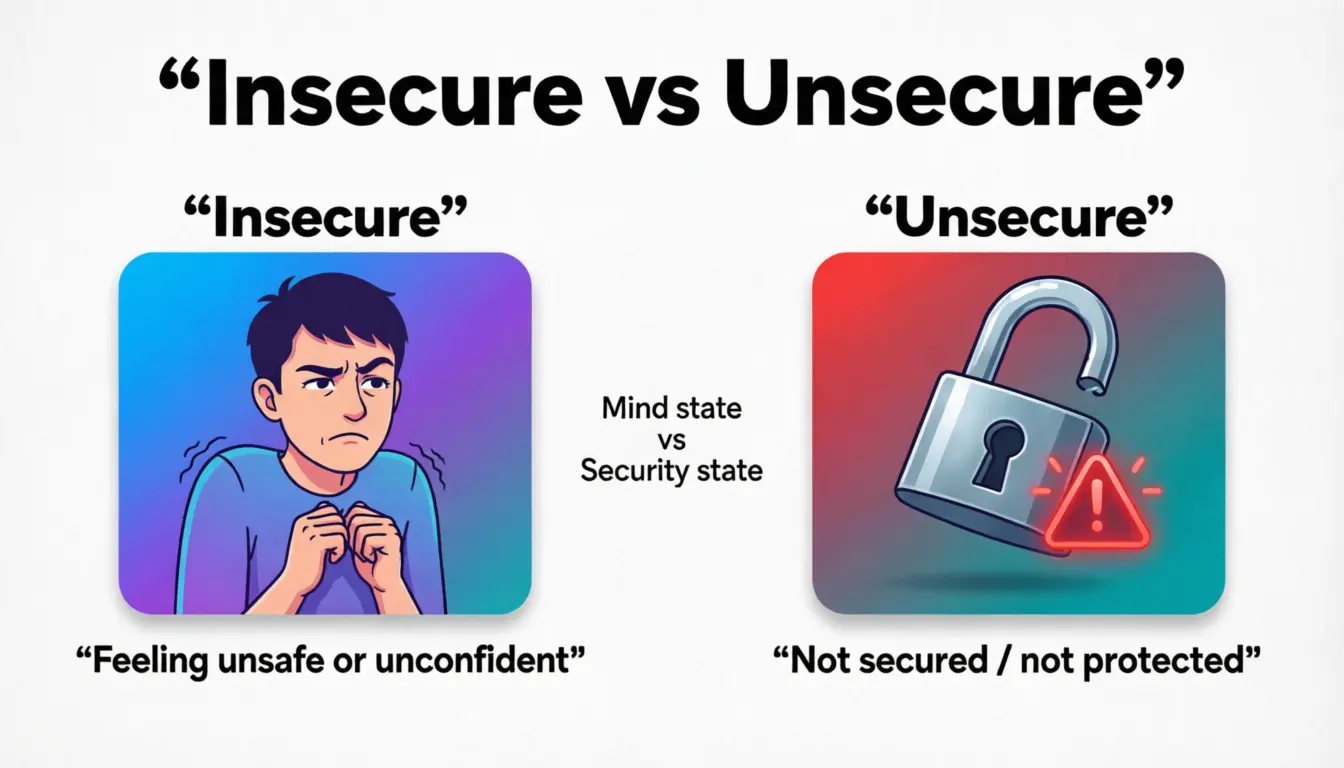
“Insecure” is the standard and widely accepted word meaning not safe, confident, or stable, while “unsecure” is less common and usually used in technical contexts to describe something not secured.
Many English learners and writers get confused by “insecure vs unsecure.” Both words look similar. Both relate to safety, confidence, or protection. But they are not always used in the same way.
People often search this keyword because they want to know:
- Which spelling is correct
- If both words are real English words
- Which one sounds more natural
- When to use each word in writing
The confusion becomes bigger in technology, psychology, and everyday speech. For example, should you say:
- “The website is insecure”
or - “The website is unsecure”?
Should a person feel “insecure” or “unsecure”?
The answer depends on context. In modern English, “insecure” is far more common and works in most situations. “Unsecure” exists too, but it is rare and usually used in technical or physical security contexts.
This guide explains the difference in very simple English. You will learn the meanings, origins, spelling rules, common mistakes, examples, trends, and expert advice for choosing the right word.
Insecure vs Unsecure – Quick Answer
Insecure means:
- not confident
- not safe
- not stable
- lacking protection
Unsecure means:
- not secured
- not locked or protected
Simple Examples
| Word | Meaning | Example |
| Insecure | lacking confidence or safety | She feels insecure about her job. |
| Unsecure | not physically secured | The gate was left unsecure. |
Quick Rule
- Use insecure in most cases.
- Use unsecure only when talking about something not secured physically or technically.
Correct Examples
- The connection is insecure.
- He feels insecure in social situations.
- The package was left unsecure in the truck.
The Origin of Insecure vs Unsecure
Both words come from the Latin root “secure,” which means safe or free from danger.
Insecure
The prefix “in-” means “not.”
So insecure literally means “not secure.”
This word became common in English many centuries ago. Over time, it gained emotional and psychological meanings too.
Today, “insecure” can describe:
- people
- systems
- buildings
- feelings
- finances
Unsecure
The prefix “un-” also means “not.”
“Unsecure” developed later and stayed less popular. It is mostly used when talking about something not properly fastened, locked, or protected.
Why Do Both Exist?
English often allows multiple negative prefixes:
- unhappy
- inactive
- unsafe
- insecure
But language usage decides which form becomes more popular. In this case, “insecure” became the standard word in everyday English.
British English vs American English Spelling
Unlike words such as “colour/color” or “favour/favor,” this is not mainly a British vs American spelling issue.
Both British and American English strongly prefer “insecure.”
“Unsecure” is accepted in some dictionaries, but it is much less common in both regions.
Comparison Table
| Usage | British English | American English |
| Insecure | Very common | Very common |
| Unsecure | Rare | Rare |
| Emotional meaning | Insecure | Insecure |
| Technical meaning | Mostly insecure | Mostly insecure |
Examples in British English
- The country feels insecure about trade.
- Her password is insecure.
Examples in American English
- He is insecure about his appearance.
- The network is insecure.
Important Note
Even in cybersecurity, many professionals still prefer “insecure” over “unsecure.”
Which Spelling Should You Use?
The best choice depends on your audience and purpose.
Use “Insecure” If:
- you are writing for a global audience
- you want natural English
- you are talking about emotions
- you are discussing safety or technology
- you are writing formal content
Use “Unsecure” If:
- you mean “not physically secured”
- you are describing something left unlocked
- your industry commonly uses it
Audience-Based Advice
| Audience | Recommended Word |
| United States | Insecure |
| United Kingdom | Insecure |
| Canada | Insecure |
| Australia | Insecure |
| Global readers | Insecure |
| Technical locking context | Sometimes unsecure |
Professional Advice
If you are unsure, choose “insecure.” It sounds more natural and professional in modern English.
Common Mistakes with Insecure vs Unsecure
Many writers misuse these words because they appear similar.
Mistake 1: Using “unsecure” for emotions
❌ She feels unsecure.
✅ She feels insecure.
Mistake 2: Using “unsecure” in formal writing
❌ The website is unsecure.
✅ The website is insecure.
Mistake 3: Thinking one word is incorrect
Some people believe “unsecure” is not a real word. It is real, but it is uncommon.
Mistake 4: Mixing meanings
❌ The child feels unsecure at school.
✅ The child feels insecure at school.
Quick Correction Table
| Wrong | Correct |
| I feel unsecure. | I feel insecure. |
| The app is unsecure. | The app is insecure. |
| The bike was insecure to the wall. | The bike was unsecured to the wall. |
Insecure vs Unsecure in Everyday Examples
Here are simple real-world examples.
Emails
- Your account may be insecure without two-factor authentication.
- The file was left unsecure on the shared drive.
News Articles
- Experts warned about insecure networks.
- Police found several unsecure entrances in the building.
Social Media
- He seems insecure about criticism.
- Don’t leave your profile insecure online.
In Formal Writing
- The company used insecure software systems.
- The equipment remained unsecure during transport.
In Daily Conversation
- I feel insecure speaking in public.
- The door was unsecure all night.
Insecure vs Unsecure – Google Trends & Usage Data
Search and usage data show a very clear winner: “insecure.”
Global Popularity
“Insecure” is searched far more often than “unsecure” in:
- the United States
- the United Kingdom
- Canada
- Australia
- India
Why “Insecure” Is More Popular
The word works in many situations:
- emotions
- cybersecurity
- finance
- relationships
- politics
“Unsecure” has a much narrower meaning.
Usage by Context
| Context | Common Word |
| Psychology | Insecure |
| Relationships | Insecure |
| Cybersecurity | Insecure |
| Physical locking | Unsecure or unsecured |
| Academic writing | Insecure |
Important Trend
Many style guides now prefer “unsecured” instead of “unsecure.”
Example:
- unsecured loan
- unsecured building access
This makes “unsecure” even less common today.
Comparison Table: Insecure or Unsecure
| Feature | Insecure | Unsecure |
| Common in English | Yes | Rare |
| Emotional meaning | Yes | No |
| Technology usage | Very common | Rare |
| Formal writing | Preferred | Less preferred |
| Physical security meaning | Yes | Sometimes |
| Sounds natural | Yes | Less natural |
| Global acceptance | High | Limited |
FAQs About Insecure vs Unsecure
Is “unsecure” a real word?
Yes. “Unsecure” is a real English word, but it is uncommon.
Which is more correct: insecure or unsecure?
“Insecure” is more standard and widely accepted.
Can “unsecure” describe feelings?
No. Use “insecure” for emotions and confidence issues.
Is “unsecure” wrong in cybersecurity?
Not exactly, but “insecure” is more common and sounds more natural.
Why is “insecure” more popular?
It developed broader meanings over time and became standard in modern English.
Should I use “unsecured” instead of “unsecure”?
Often yes. “Unsecured” is more common in professional writing.
Do British and American English use different versions?
No. Both mainly use “insecure.”
What is an insecure connection?
It means the connection is unsafe or not properly protected.
What does insecure mean in relationships?
It describes a lack of confidence, trust, or emotional stability.
Conclusion
The debate around “insecure vs unsecure” is mostly about usage, not spelling rules. Both words exist in English, but they are not equally common.
“Insecure” is the standard choice in modern writing. It works for emotions, safety, technology, finance, and everyday communication. Native speakers use it far more often in both British and American English.
“Unsecure” is much rarer. It usually appears when something is not physically secured or locked. Even then, many writers now prefer the word “unsecured.”
If you want your English to sound natural, clear, and professional, use “insecure” in most situations. It is safer for academic writing, business communication, content, and global audiences.
Remember this simple rule:
- People feel insecure
- Objects may be unsecured
- “Unsecure” is uncommon and limited
By understanding the difference, you can avoid mistakes and choose the correct word with confidence in every situation.

I hold a degree in English Literature and Linguistics and have worked extensively on educational blogs, comparison websites, and digital learning platforms. My writing focuses on simplifying complex language rules, highlighting British vs American English differences, and providing practical examples for everyday usage.