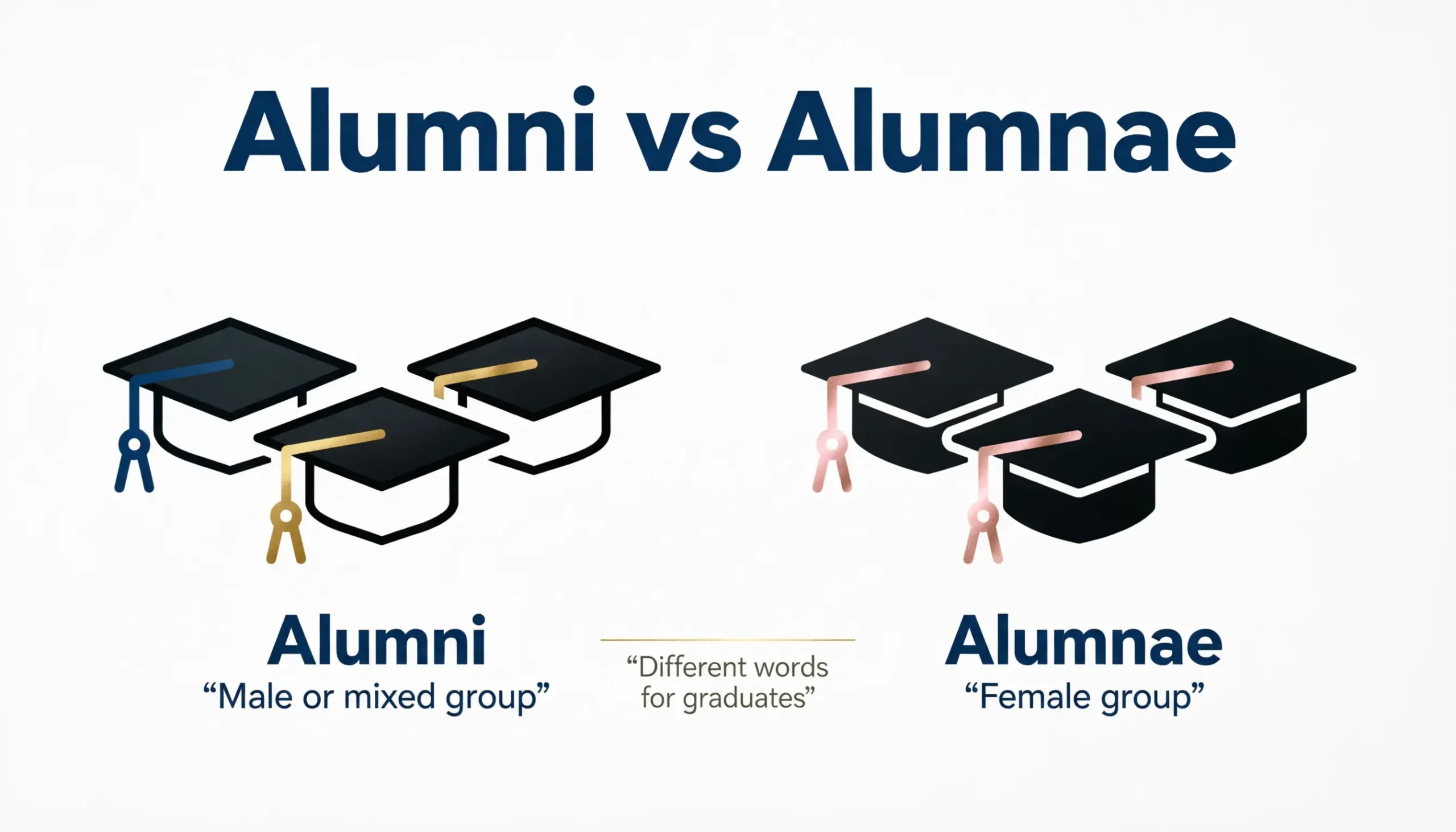
“Alumni” refers to a group of male graduates or a mixed group of individuals, while “alumnae” refers specifically to a group of female graduates.
Many people search for “alumni or alumnae” because these words often appear in school, college, and university contexts but their meanings are confusing. You might see them on graduation invitations, university websites, LinkedIn profiles, or reunion events and wonder: What is the correct word? Are they the same? Or do they refer to different people?
This confusion is very common because both words come from Latin and are used in slightly different ways depending on gender and grammar rules. In modern English, however, usage has become more flexible, and many institutions use “alumni” for everyone.
People also struggle with when to use singular vs plural forms, or whether “alumni” is male-only. These uncertainties lead to frequent spelling and usage mistakes in academic writing, professional communication, and social media posts.
In this article, you will learn the exact meaning of alumni and alumnae, their origin, correct usage in British and American English, common mistakes, and real-life examples. By the end, you will know exactly which word to use in any situation clearly and confidently.
Alumni or Alumnae – Quick Answer
Alumni = plural term for graduates of a school, college, or university (traditionally male or mixed gender group).
Alumnae = plural term for female graduates only.
Simple Examples:
- The alumni of Harvard include doctors, engineers, and artists.
- The alumnae of the women’s college gathered for a reunion.
Singular Forms:
- Alumnus = male graduate
- Alumna = female graduate
Quick Rule:
- Mixed group → alumni
- Only women → alumnae
The Origin of Alumni or Alumnae
The words alumni and alumnae come from Latin.
- Alumnus = “foster son” or “pupil”
- Alumna = “foster daughter” or “pupil”
- Alumni = plural masculine form
- Alumnae = plural feminine form
Originally, Latin grammar required gender-based plural endings. That’s why we have different versions.
Over time, English adopted these words for education systems, especially universities in Europe and the United States. As universities expanded and became co-educational (accepting both individuals), the usage of “alumni” began to shift toward a gender-neutral plural term in many places.
Today, most English speakers use “alumni” for any group of graduates unless they specifically want to emphasize female graduates.
British English vs American English Spelling
The difference between British and American English is not about spelling only—it also affects usage style.
Key Differences:
- American English: “alumni” is commonly used for all graduates (gender-neutral usage)
- British English: more likely to preserve the traditional distinction between alumni and alumnae, especially in formal writing
Example:
- US: The university celebrated its alumni.
- UK: The university invited its alumni and alumnae separately in formal contexts.
Comparison Table
| Term | Singular | Plural (Male / Mixed) | Plural (Female) | Usage Region |
| Alumnus | Yes | Alumni | No | Formal Latin-based usage |
| Alumna | Yes | Alumnae | Yes | Formal female-specific |
| Alumni | No | Yes (mixed/male) | Sometimes used | US + Global common usage |
| Alumnae | No | No | Yes | Formal female-only usage |
Which Spelling Should You Use?
Your choice depends on audience and context.
1. US English Usage
- Use alumni for all graduates
- Gender distinction is usually ignored
2. UK and Commonwealth Usage
- Prefer traditional forms in formal writing
- Use alumni and alumnae when gender clarity matters
3. Global / Modern Usage
- “Alumni” is widely accepted everywhere
- Most universities and brands use “alumni” as a general term
Simple Rule:
If you are unsure, use alumni it is widely understood and accepted.
Common Mistakes with Alumni or Alumnae
1. Using “alumni” for a single person
❌ She is an alumni of Oxford
✔ She is an alumna of Oxford
2. Using “alumnae” for mixed groups
❌ The alumnae attended the event (mixed group)
✔ The alumni attended the event
3. Confusing singular and plural
❌ He is an alumni
✔ He is an alumnus
4. Overusing gender distinction
Many modern institutions ignore gender distinction, so using all forms unnecessarily can sound outdated.
Alumni or Alumnae in Everyday Examples
Email Example:
“Dear alumni, we are excited to invite you to our annual reunion event.”
News Example:
“The university’s alumni have donated millions to research programs.”
Social Media Example:
“Proud to be part of this amazing alumnae community!”
Formal Writing Example:
“The alumnae of the institution continue to lead in science, education, and business fields.”
Alumni or Alumnae – Google Trends & Usage Data
Search behavior shows interesting patterns:
- “Alumni” is far more popular globally
- “Alumnae” is used less frequently and mostly in academic or formal contexts
- Countries like the United States, India, and Canada prefer “alumni”
- European academic institutions still sometimes use both forms
Key Insight:
Most people searching online are trying to confirm:
- Which word is correct
- Whether “alumni” includes women
- How to use it in writing
This shows that the main intent is clarity and correctness in academic or professional communication.
Comparison Table: Alumni vs Alumnae vs Other Forms
| Word | Gender | Singular/Plural | Meaning | Usage Style |
| Alumnus | Male | Singular | Male graduate | Formal |
| Alumna | Female | Singular | Female graduate | Formal |
| Alumni | Mixed/Male | Plural | Graduates (general) | Common |
| Alumnae | Female | Plural | Female graduates | Formal |
FAQs About Alumni or Alumnae
1. What is the difference between alumni and alumnae?
Alumni refers to male or mixed graduates, while alumnae refers only to female graduates.
2. Can I use alumni for women?
Yes, in modern English, “alumni” is commonly used for all genders.
3. Is alumnus male or female?
Alumnus refers to a male graduate.
4. What is the singular of alumnae?
The singular form is “alumna.”
5. Is alumnae still used today?
Yes, but mostly in formal or traditional academic writing.
6. Which is more correct: alumni or alumnae?
Both are correct, but “alumni” is more widely used today.
7. Can a woman be called an alumni?
Informally yes, but grammatically the correct term is “alumna.”
8. Why do universities use alumni instead of alumnae?
Because “alumni” is simpler and gender-neutral in modern usage.
9. What is the plural of alumnus?
The plural is “alumni.”
Conclusion
The difference between alumni and alumnae comes from Latin grammar, but modern English has simplified their usage. Traditionally, “alumni” refers to male or mixed groups of graduates, while “alumnae” refers to female graduates only. However, in today’s global English, “alumni” is widely used for all graduates, making communication easier and more inclusive.
If you are writing for academic, professional, or global audiences, using “alumni” is usually safe and widely accepted. Only use “alumnae” when you specifically want to refer to female graduates in a formal or traditional context.
Understanding these words helps you write more clearly in emails, essays, resumes, and professional profiles. It also avoids common grammar mistakes that can confuse readers.
In short, both words are correct, but context decides the best choice. When in doubt, “alumni” is your safest option for modern English communication.

I hold a degree in English Literature and Linguistics and have worked extensively on educational blogs, comparison websites, and digital learning platforms. My writing focuses on simplifying complex language rules, highlighting British vs American English differences, and providing practical examples for everyday usage.