“Discard” is a verb meaning to throw something away or get rid of it, whereas “disgard” has no accepted meaning in English.
Have you ever typed “disgard” and felt unsure if it was right? You’re not alone. Many people confuse “discard” and “disgard” because they sound similar. This small spelling mistake is very common in emails, social media, and even professional writing.
People search for this keyword to find the correct spelling and avoid errors. In English, some words look tricky because of silent letters or unusual patterns. That’s exactly what happens here. One version is correct, and the other is simply a mistake.
If you are a student, writer, or professional, using the correct spelling matters. It helps you look clear, confident, and credible. Even a small error can change how others see your writing.
In this article, you’ll get a quick answer, learn the origin of the word, see examples, and understand when and how to use it correctly. By the end, you will never confuse “discard” and “disgard” again.
Discard or Disgard – Quick Answer
The correct spelling is “discard.”
“Disgard” is incorrect and not a real English word.
Examples:
- ✅ Please discard the old files.
- ✅ He decided to discard the broken chair.
- ❌ Please disgard this message. (Wrong)
Tip: If you mean “to throw away” or “get rid of something,” always use discard.
The Origin of Discard or Disgard
The word “discard” comes from old European languages.
- It comes from Old French: descarter
- “Des” means “away”
- “Carte” means “card”
It was first used in card games, meaning “to throw away a card you don’t want.” Over time, the meaning grew. Now, it means to get rid of anything.
Why “disgard” exists
“Disgard” is not a real word. It likely appears because:
- People confuse it with words like “guard”
- They try to spell by sound
- They are not familiar with the correct form
So, “disgard” is just a spelling error, not a variant.
British English vs American English Spelling
Good news: there is no difference here.
Both British English and American English use the same spelling: discard.
Comparison Table
| Feature | British English | American English |
| Correct spelling | discard | discard |
| Incorrect spelling | disgard ❌ | disgard ❌ |
| Usage meaning | Same | Same |
Unlike words like colour/color, this word stays the same everywhere.
Which Spelling Should You Use?
The answer is simple: always use “discard.”
Based on audience:
- USA audience: Use discard
- UK & Commonwealth: Use discard
- Global audience: Use discard
There is no situation where “disgard” is correct.
Professional advice:
If you are writing:
- Emails
- Blogs
- Reports
- Social media
Always double-check and use discard.
Using the wrong spelling can:
- Hurt your credibility
- Confuse readers
- Look unprofessional
Common Mistakes with Discard or Disgard
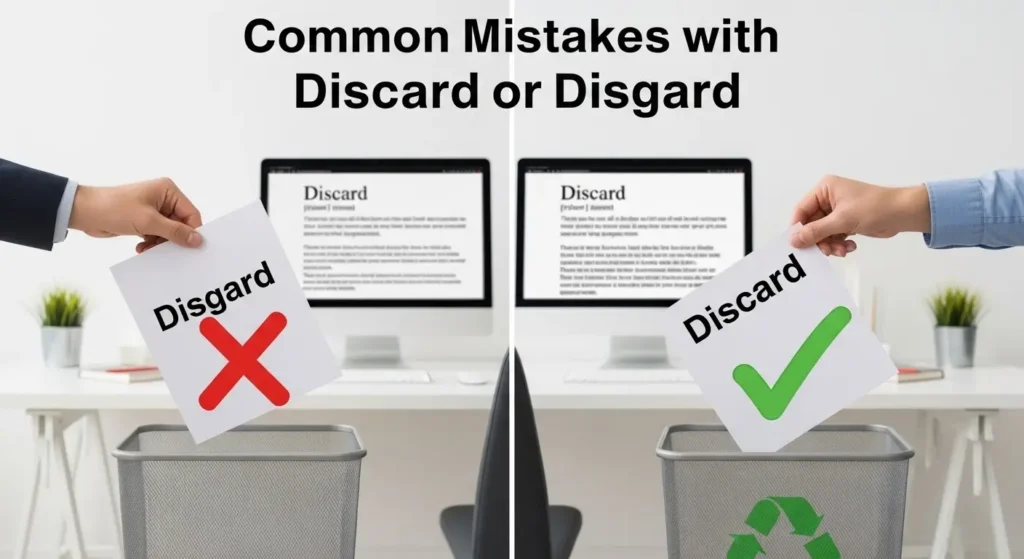
Here are common errors people make:
1. Writing “disgard” instead of “discard”
- ❌ Disgard the old data
- ✅ Discard the old data
2. Mixing with similar words
- “Guard” is correct in other contexts, but not here
- ❌ Disguard the item
- ✅ Discard the item
3. Auto-correct issues
Sometimes typing fast leads to wrong spelling.
4. Pronunciation confusion
People hear “dis-gard” and write it that way.
Discard or Disgard in Everyday Examples
1. Emails
- Please discard the previous version of the file.
- Kindly discard outdated records.
2. News
- The company will discard unsafe products.
- Officials asked people to discard expired food.
3. Social Media
- Time to discard bad habits!
- Just discard negativity and move on.
4. Formal Writing
- Researchers discarded invalid data.
- The system will automatically discard duplicates.
Discard or Disgard /Google Trends & Usage Data
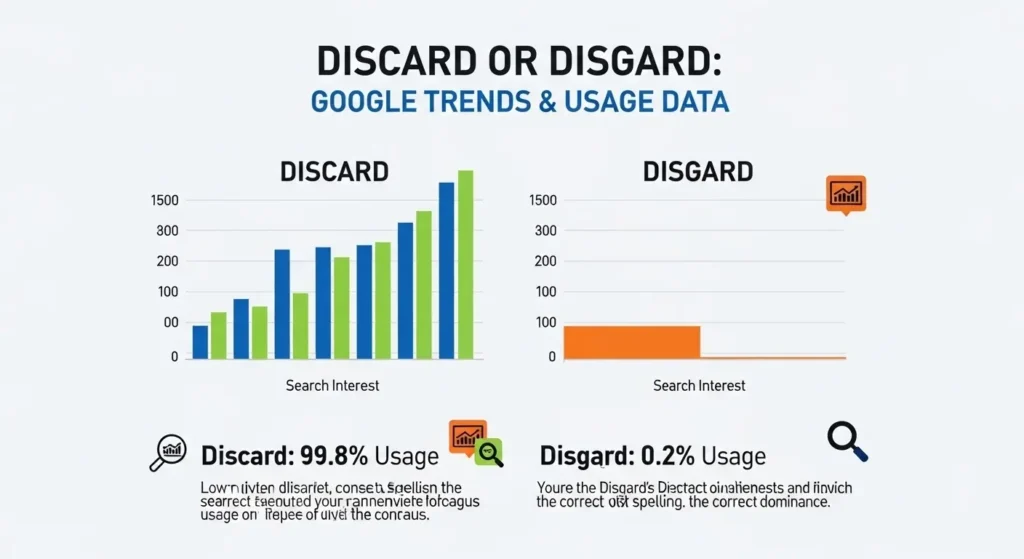
When we look at usage data:
- “Discard” is widely used worldwide
- “Disgard” appears rarely and mostly as a typo
Popularity by region:
- USA: “discard” is standard
- UK: “discard” is standard
- India & Pakistan: mostly “discard,” but “disgard” appears as a mistake
Context of usage:
- Technology (delete or remove files)
- Everyday language (throw away items)
- Business (remove invalid data)
Key insight:
Search engines recognize “disgard” as an error and often suggest “discard.”
Keyword Comparison Table
| Word | Correct? | Meaning | Usage |
| discard | ✅ Yes | To throw away | Correct in all contexts |
| disgard | ❌ No | No meaning | Spelling mistake |
FAQs
1. Is “disgard” a real word?
No, “disgard” is not a real English word. It is a spelling mistake.
2. What does “discard” mean?
It means to throw away or get rid of something.
3. Why do people write “disgard”?
Because of pronunciation confusion and similarity to words like “guard.”
4. Is “discard” used in British English?
Yes, “discard” is correct in both British and American English.
5. Can “disgard” ever be correct?
No, it is always incorrect.
6. How can I remember the correct spelling?
Think of “card” inside “discard” like throwing away a card.
7. Is “discarded” the past form?
Yes. Example: He discarded the paper.
8. Is “discard” formal or informal?
It works in both formal and informal writing.
Conclusion
The confusion between “discard” and “disgard” is very common, but the answer is simple. “Discard” is the correct spelling, and “disgard” is just a mistake. This word comes from old French and originally meant throwing away cards. Today, it is used in many situations, from daily life to professional work.
There is no difference between British and American English for this word. Both use the same spelling: discard. That makes it easier to remember and apply.
Using the correct spelling is important. It helps your writing look clear and professional. Even small mistakes can affect how others understand your message. So, always double-check your spelling, especially for commonly confused words like this.
To avoid errors, remember the simple tip: “discard” contains “card.” Once you learn this, you won’t make the mistake again.
Keep practicing and stay consistent. Good spelling builds strong communication skills.

I am an Emily Carter Brooks U.S.A based linguistics writer known for my clear, reader-friendly explanations of English grammar and vocabulary differences. I have contributed to multiple online language resources and specializes in spelling variations, pronunciation confusion, and British vs American English comparisons. I’m passionate about helping learners improve their English through practical, everyday communication. engaging, and stress-free.