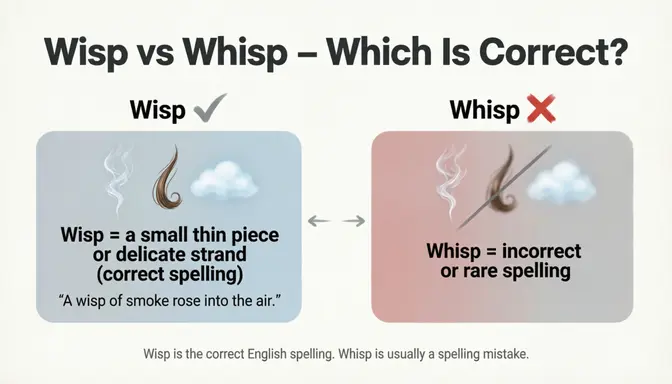
“Wisp” is a noun meaning a small thin strand or a faint trace of something (like smoke, hair, or mist), whereas “whisp” has no accepted meaning in English.
English spelling can be tricky. Some words look right even when they are wrong. One common example is wisp or whisp. Many people type “whisp” when writing about smoke, hair, clouds, or soft sounds. But is “whisp” a real word, or just a spelling mistake?
This confusion happens because English has many words starting with wh, like whisper, whistle, and whirl. So it feels natural to write “whisp.” But the correct word in most cases is wisp.
If you are writing an email, article, social media post, or school paper, using the right spelling matters. Wrong spelling can confuse readers and make writing look less professional.
In this guide, you will learn the difference between wisp and whisp, where the word came from, how British and American English use it, and which spelling you should choose. By the end, you will know the correct form and avoid this common mistake.
Wisp or Whisp – Quick Answer
The correct spelling is wisp.
Whisp is usually a misspelling.
A wisp means a small thin piece or amount of something.
Examples:
- A wisp of smoke rose into the sky.
- She had a wisp of hair on her face.
- There was a wisp of cloud above the hill.
Quick comparison:
| Word | Correct? | Meaning |
| Wisp | Yes | A small thin piece or amount |
| Whisp | No | Misspelling of wisp |
So, if you are unsure, choose wisp.
The Origin of Wisp or Whisp
The word wisp is very old. It comes from Old English wisps or related Germanic roots. Long ago, it meant a bundle of straw or grass.
Over time, the meaning changed.
People started using wisp for anything thin, light, or small.
For example:
- a wisp of smoke
- a wisp of fog
- a wisp of hair
But where did whisp come from?
The answer is simple: confusion.
Many people connect it with words like:
- whisper
- whistle
- whisk
These words begin with wh, so some writers wrongly add “h” to wisp.
But standard dictionaries use only wisp.
British English vs American English Spelling
Good news: there is no spelling difference here.
Both British English and American English use wisp.
Unlike words such as colour/color or organise/organize, this word stays the same.
Examples in British English
- A wisp of fog covered the road.
- A wisp of smoke came from the fire.
Examples in American English
- A wisp of cloud moved across the sky.
- She brushed away a wisp of hair.
Comparison Table
| English Type | Correct Spelling | Example |
| British English | Wisp | A wisp of smoke |
| American English | Wisp | A wisp of hair |
| Canadian English | Wisp | A wisp of fog |
| Australian English | Wisp | A wisp of cloud |
Whisp is incorrect in all major English forms.
Which Spelling Should You Use?
Always use wisp.
Your audience does not matter here.
If your readers are in the US
Use wisp
Example:
A wisp of steam rose from the cup.
If your readers are in the UK
Use wisp
Example:
A wisp of smoke drifted away.
If your readers are global
Still use wisp
It is the accepted spelling everywhere.
Simple advice:
Think of it this way:
Wisp = right
Whisp = wrong
That makes it easy.
Common Mistakes with Wisp or Whisp
Many writers make small mistakes with this word.
Here are common ones:
| Wrong | Right |
| Whisp of smoke | Wisp of smoke |
| Whisp of hair | Wisp of hair |
| Whisp of fog | Wisp of fog |
| A little whisp | A little wisp |
Why do people make this mistake?
1. Mixing with “whisper”
People see whisp and think of whisper.
Wrong:
She saw a whisp of smoke.
Right:
She saw a wisp of smoke.
2. Adding extra letters
Some writers add letters by habit.
Wrong:
Wisph
Right:
Wisp
3. Using it as a verb wrongly
Wrong:
The smoke whisped away.
Right:
The smoke drifted away in a wisp.
Wisp or Whisp in Everyday Examples
Here is how wisp appears in daily writing.
Emails
There was a wisp of confusion in your message.
News writing
A wisp of smoke was seen near the building.
Social media
Just saw a wisp of cloud shaped like a bird.
Formal writing
The artist painted a wisp of mist over the valley.
In stories
A wisp of hair fell across her eyes.
Wisp or Whisp – Google Trends & Usage Data
Search data shows many people type whisp because they are unsure.
But wisp is far more common in books, websites, and articles.
Where “wisp” is popular
- United States
- United Kingdom
- Canada
- Australia
Why people search “whisp”
Usually because:
- they hear the word and guess the spelling
- they confuse it with whisper
- they want to check the correct form
Usage by context
| Context | Common Form |
| Books | Wisp |
| News | Wisp |
| Blogs | Wisp |
| Social Media | Wisp |
| Search Mistakes | Whisp |
The real word in use is wisp.
Wisp vs Whisp Comparison Table
| Feature | Wisp | Whisp |
| Correct spelling | Yes | No |
| Dictionary word | Yes | No |
| Used in UK | Yes | No |
| Used in US | Yes | No |
| Formal writing | Yes | No |
| Common typo | No | Yes |
FAQs About Wisp or Whisp
1. Is whisp a real word?
No. It is usually a misspelling of wisp.
2. What does wisp mean?
It means a small thin piece of something.
Example: a wisp of smoke.
3. Is wisp used in British English?
Yes. British English uses wisp.
4. Is whisp ever correct?
Not in standard modern English.
5. Why do people spell it whisp?
Because of words like whisper and whisk.
6. Can wisp mean hair?
Yes.
Example: a wisp of hair.
7. Can wisp mean smoke?
Yes.
Example: a wisp of smoke.
8. Is wisp formal or informal?
It can be both.
It works in all writing styles.
Conclusion
The choice between wisp or whisp is simple once you know the rule. The correct spelling is wisp, and it is the only accepted form in standard English. The word means a small, thin, light piece of something, like smoke, hair, fog, or cloud. While whisp may look correct because it matches words like whisper or whistle, it is not the right spelling.
This makes the answer easy for writers, students, and professionals. Whether you write for the United States, the United Kingdom, or anywhere else, wisp is the spelling to use. It works in emails, stories, formal papers, and social media.
The best way to remember it is simple: wisp has no “h.” If you see “whisp,” treat it as a typo and correct it.
Using the right spelling makes your writing cleaner, clearer, and stronger. Next time you write about smoke, hair, or fog, choose wisp with confidence.

I am an Emily Carter Brooks U.S.A based linguistics writer known for my clear, reader-friendly explanations of English grammar and vocabulary differences. I have contributed to multiple online language resources and specializes in spelling variations, pronunciation confusion, and British vs American English comparisons. I’m passionate about helping learners improve their English through practical, everyday communication. engaging, and stress-free.