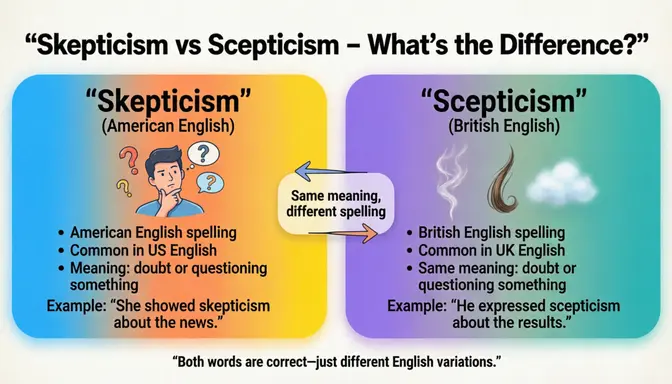
“Skepticism” is the American English spelling, while “scepticism” is the British English spelling, and both refer to a doubtful or questioning attitude toward something.
Is it skepticism or scepticism? If you have seen both spellings, you are not alone. Many writers, students, and professionals search this term because the two words look different but seem to mean the same thing.
The confusion comes from regional spelling rules. In some places, skepticism is the normal form. In others, scepticism is preferred. This creates problems in essays, emails, blogs, and formal writing. People often wonder which spelling is correct and if using the “wrong” one will look like a mistake.
The good news is simple: both spellings are correct. The real difference is where you are writing and who your audience is.
In this guide, you will learn the meaning, history, spelling differences, and the best way to choose between skepticism and scepticism. You will also see examples, common mistakes, and usage trends to help you write with confidence.
Skepticism or Scepticism – Quick Answer
Skepticism and scepticism mean the same thing.
They both describe doubt or questioning beliefs before accepting them as true.
The only difference is spelling:
- Skepticism = American English
- Scepticism = British English
Example:
- Her skepticism about the plan was clear.
- His scepticism about the news was understandable.
Both sentences are correct.
Quick rule:
If writing for the US, use skepticism.
If writing for the UK or Commonwealth countries, use scepticism.
The Origin of Skepticism or Scepticism
The word comes from the ancient Greek word skeptikos, meaning “thoughtful” or “inquiring.”
It later moved into Latin and then French before entering English.
In early English, the spelling was closer to scepticism because of French influence.
Over time, American English changed many spellings to make them simpler or closer to pronunciation. That is why skepticism became the preferred American form.
British English kept the older spelling pattern.
That is why both spellings still exist today.
Why do spelling differences exist?
English changed differently in different countries.
American English often simplified words:
| British | American |
| centre | center |
| colour | color |
| scepticism | skepticism |
This is part of normal language evolution.
British English vs American English Spelling
The main difference between skepticism and scepticism is the letter choice:
| British English | American English |
| Scepticism | Skepticism |
| Sceptic | Skeptic |
| Sceptical | Skeptical |
British English examples:
- There is growing scepticism about the policy.
- She remained sceptical of the promise.
American English examples:
- Public skepticism is increasing.
- He was skeptical about the results.
Simple spelling rule
British English often keeps sc in words from Greek or French.
American English often uses sk for clearer sound.
Comparison Table: Skepticism vs Scepticism
| Word | Meaning | Region | Correct? |
| Skepticism | Doubt or questioning | US | Yes |
| Scepticism | Doubt or questioning | UK/Commonwealth | Yes |
| Skeptic | A doubting person | US | Yes |
| Sceptic | A doubting person | UK/Commonwealth | Yes |
| Skeptical | Showing doubt | US | Yes |
| Sceptical | Showing doubt | UK/Commonwealth | Yes |
Which Spelling Should You Use?
Choosing the right spelling depends on your audience.
Use skepticism if:
- Your readers are in the US
- You write for American websites
- Your style guide follows American English
Example:
“The article faced public skepticism.”
Use scepticism if:
- Your readers are in the UK
- Your audience is in Australia, New Zealand, or Canada
- Your publisher uses British English
Example:
“The report was met with scepticism.”
For global audiences
Pick one spelling and stay consistent.
Do not mix both in one article.
Consistency builds trust.
Common Mistakes with Skepticism or Scepticism
Writers often make small errors.
Here are common mistakes:
1. Mixing spellings
❌ The report caused skepticism and scepticism.
✅ The report caused skepticism.
2. Using the wrong regional form
❌ UK newspaper using skepticism
✅ UK newspaper using scepticism
3. Wrong adjective form
❌ She is very skeptic.
✅ She is very skeptical.
✅ She is very sceptical.
4. Wrong noun form
❌ He showed skeptical.
✅ He showed skepticism.
Quick correction tip
Noun = skepticism / scepticism
Adjective = skeptical / sceptical
Person = skeptic / sceptic
Skepticism or Scepticism in Everyday Examples
Here is how the word appears in real life.
Emails
“I understand your skepticism about the new system.”
“I appreciate your scepticism and questions.”
News
“The public showed skepticism toward the survey.”
“There is rising scepticism over the decision.”
Social media
“My skepticism is growing.”
“A lot of scepticism online today.”
In formal writing
“Scientific skepticism helps test ideas.”
“Healthy scepticism improves critical thinking.”
Skepticism or Scepticism – Google Trends & Usage Data
Search interest for skepticism is higher in the United States because American English dominates online content.
The spelling scepticism is more common in:
- United Kingdom
- Australia
- New Zealand
- South Africa
Usage by country
| Country | Common Form |
| United States | Skepticism |
| United Kingdom | Scepticism |
| Australia | Scepticism |
| Canada | Both |
| India | Both (British leaning) |
Why does skepticism appear more online?
American websites produce a large amount of English content.
That makes skepticism more visible in search results.
But scepticism remains strong in British publishing.
When Does Skepticism Matter?
Spelling matters in:
- Academic papers
- News articles
- Business writing
- SEO content
- Books
Wrong regional spelling can look less natural to readers.
For example:
A UK audience may expect scepticism.
A US audience may expect skepticism.
This small choice improves readability.
FAQs About Skepticism or Scepticism
1. Is skepticism correct?
Yes. It is the standard American spelling.
2. Is scepticism correct?
Yes. It is the standard British spelling.
3. Do they have different meanings?
No. They mean exactly the same thing.
4. Which spelling is older?
Scepticism is older in English history.
5. Which spelling is more popular?
Skepticism is more common online because of American usage.
6. Can I use both in one article?
No. Choose one and stay consistent.
7. Is skeptic or sceptic correct?
Both are correct. It depends on region.
8. Which form should students use?
Use the spelling your school or style guide requires.
Conclusion
The choice between skepticism and scepticism is simple once you know the rule. Both spellings are correct, and both carry the same meaning: doubt, questioning, or careful thinking before accepting something as true.
The difference is regional. Skepticism is the standard form in American English, while scepticism is the preferred spelling in British English and many Commonwealth countries. This pattern also applies to related words like skeptic/sceptic and skeptical/sceptical.
The best choice depends on your audience. If you write for US readers, use skepticism. If your readers are in the UK or other British-English regions, use scepticism. For international audiences, pick one style and keep it consistent throughout your writing.
In the end, the goal is clarity. Using the right regional spelling makes your writing look polished, professional, and easier for your readers to trust.

I hold a degree in English Literature and Linguistics and have worked extensively on educational blogs, comparison websites, and digital learning platforms. My writing focuses on simplifying complex language rules, highlighting British vs American English differences, and providing practical examples for everyday usage.