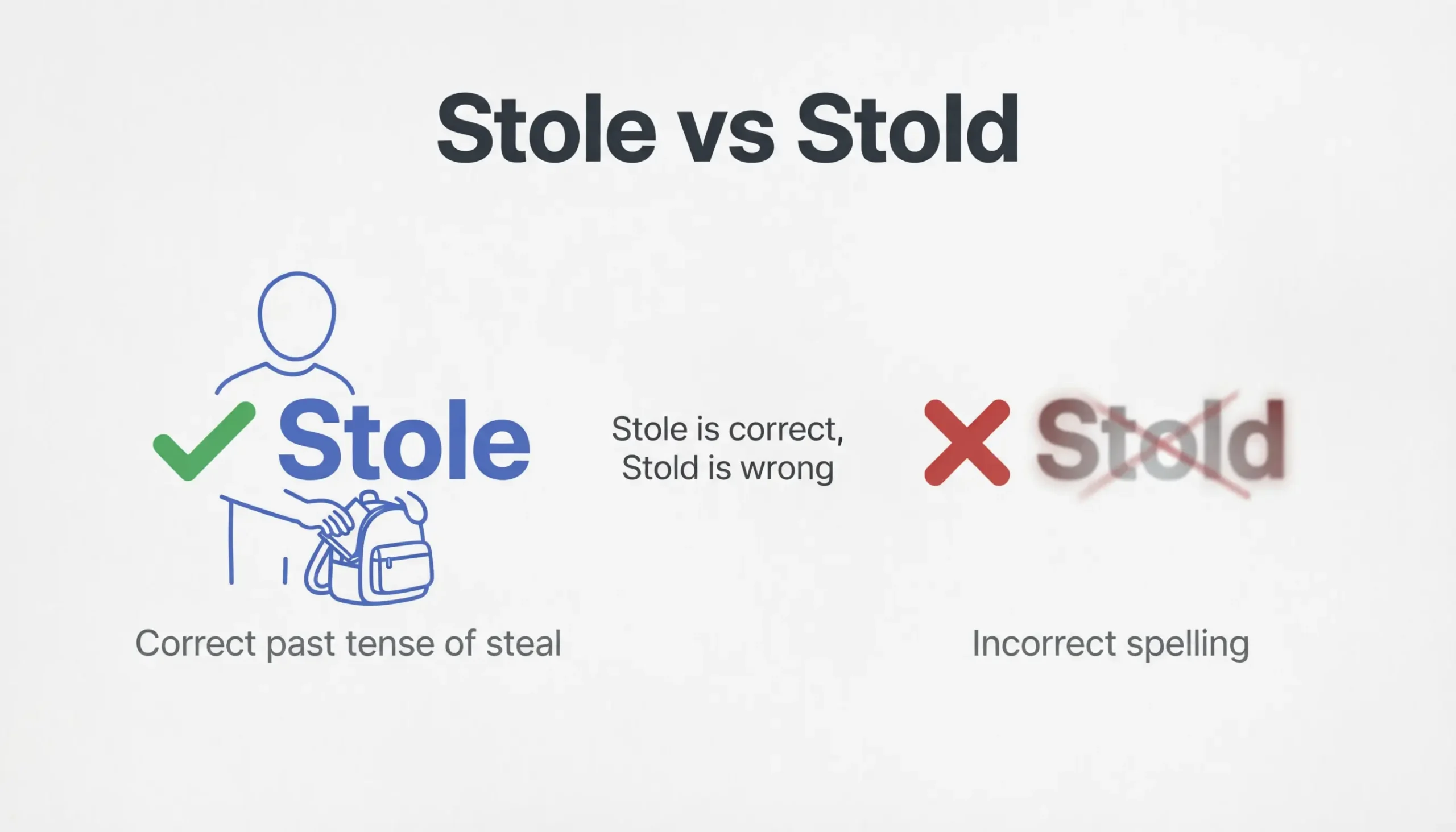
“Stole” is the simple past form meaning to take something without permission, whereas “stold” has no accepted meaning in English.
Have you ever typed “stold” and wondered if it was right? You are not alone. Many English learners and even native speakers get confused between stole and stold because English verb forms can be tricky.
This confusion often happens when people try to use the past tense of “steal.” Since many English verbs change in unusual ways, it is easy to guess the wrong form. For example, words like tell → told make some people think steal → stold. But English does not work that way.
The good news is that the answer is simple: stole is correct, and stold is wrong.
In this guide, you will learn the correct spelling, the history of the word, the difference between verb forms, and how to use stole in real-life writing. We will also look at common mistakes, examples, and trends so you can use the right word with confidence.
If you have ever searched “stole or stold,” this article will clear up the confusion for good.
Stole or Stold – Quick Answer
The correct word is stole.
Stold is not a correct English word.
Steal is the base verb.
Verb forms:
| Verb Form | Correct Word |
| Base Form | Steal |
| Past Tense | Stole |
| Past Participle | Stolen |
Examples:
- He stole my wallet yesterday.
- Someone stole the car last night.
- The thief had stolen the money before police arrived.
Wrong:
- He stold my wallet. ❌
Right:
- He stole my wallet.
So, if you are talking about the past, always use stole.
The Origin of Stole or Stold
The word stole comes from the old English verb “stelan,” which meant “to take secretly.”
Over time, English changed:
- Old English: stelan
- Middle English: stelen
- Modern English: steal
The past tense became stole.
This follows the pattern of strong verbs in English:
- break → broke
- speak → spoke
- steal → stole
So why do people say stold?
It happens because English has many verbs ending in -old:
- tell → told
- sell → sold
People copy that pattern and create stold by mistake.
But grammar rules do not accept it.
British English vs American English Spelling
There is no spelling difference between British and American English for this word.
Both use:
- steal
- stole
- stolen
This makes it simple.
Examples in American English:
- Someone stole my bike.
Examples in British English:
- Someone stole my bicycle.
The verb form stays the same.
Comparison Table
| English Type | Present | Past | Past Participle |
| American English | Steal | Stole | Stolen |
| British English | Steal | Stole | Stolen |
So, unlike words like color/colour, there is no regional spelling change here.
Which Spelling Should You Use?
Use stole in all English-speaking countries.
If your audience is in the US
Use stole.
Example:
- The man stole cash from the bank.
If your audience is in the UK
Use stole.
Example:
- Someone stole her purse.
If your audience is global
Use stole.
It is the standard form everywhere.
Simple rule:
- Past action = stole
- Perfect tense = stolen
- Never use stold
Common Mistakes with Stole or Stold
Here are common mistakes people make:
1. Using stold instead of stole
Wrong:
- He stold my pen.
Correct:
- He stole my pen.
2. Using stole instead of stolen
Wrong:
- He has stole my bag.
Correct:
- He has stolen my bag.
3. Mixing verb forms
Wrong:
- She steal my phone yesterday.
Correct:
- She stole my phone yesterday.
Quick Fix Table
| Wrong | Correct |
| Stold | Stole |
| Has stole | Has stolen |
| Steal yesterday | Stole yesterday |
Remember:
Yesterday = stole
Has/have = stolen
Stole or Stold in Everyday Examples
Here is how people use stole in daily life.
Emails
- Someone stole my package from the porch.
News
- Police said the suspect stole jewelry from the shop.
Social media
- My brother stole my fries again!
Formal writing
- The employee stole company data.
In casual talk
- Who stole my charger?
These examples show that stole works in every type of writing.
Stole or Stold – Google Trends & Usage Data
Search data shows that stole is used far more than stold.
Why?
Because stole is the correct past tense.
People search stold mostly because they are unsure.
Common countries searching this:
- United States
- United Kingdom
- Canada
- Australia
Usage context:
| Word | Usage Type |
| Stole | Correct grammar |
| Stold | Misspelling |
In books, news, and schools, stole is the accepted form.
Stole vs Stold Comparison Table
| Word | Correct? | Meaning | Example |
| Stole | Yes | Past tense of steal | He stole money |
| Stold | No | Not a real word | Incorrect usage |
| Stolen | Yes | Past participle of steal | It was stolen |
This table makes it easy to remember.
FAQs
Is stold a real word?
No. Stold is not a correct English word.
Why do people say stold?
People mix it up with words like “told” and “sold.”
What is the past tense of steal?
The past tense is stole.
What is the past participle of steal?
The past participle is stolen.
Is stole used in British English?
Yes. British and American English both use stole.
Can I use stold in informal writing?
No. It is still wrong.
Is “has stole” correct?
No. Use has stolen.
Why is English so confusing with verbs?
English has irregular verbs, and they do not follow one simple rule.
Conclusion
The choice between stole or stold is easy once you know the rule. The correct past tense of steal is always stole. The word stold is a mistake and should not be used in speaking or writing.
This confusion happens because English has irregular verbs. Some verbs change to -old, like tell → told and sell → sold. That makes people think steal → stold should work too. But it does not.
A simple way to remember it is this:
- Today I steal
- Yesterday I stole
- I have stolen
This pattern works in American English, British English, and everywhere else.
If you want clear and correct writing, stick with stole for past tense and stolen for perfect tense. Avoid stold every time.
Now the next time you write about theft, loss, or taking something, you will know the right word without doubt.

I hold a degree in English Literature and Linguistics and have worked extensively on educational blogs, comparison websites, and digital learning platforms. My writing focuses on simplifying complex language rules, highlighting British vs American English differences, and providing practical examples for everyday usage.