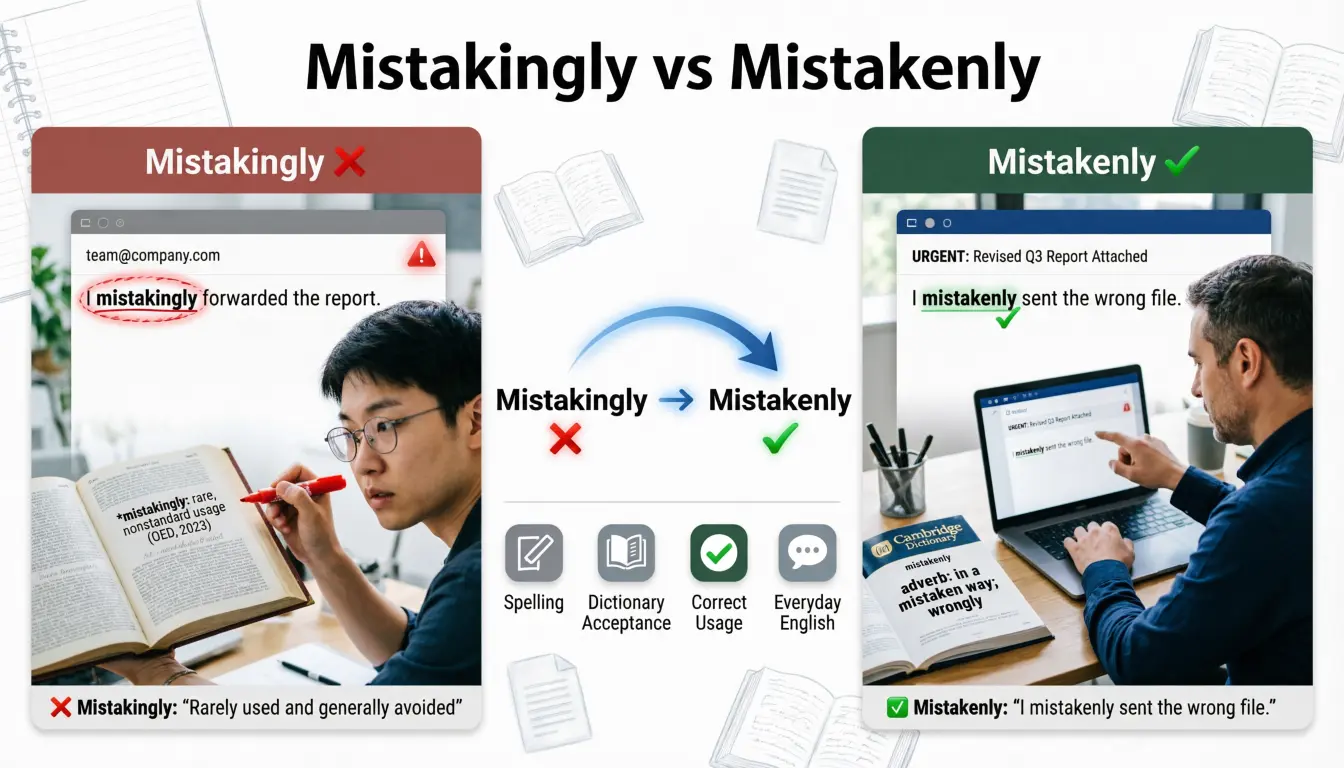
“Mistakenly” is the preferred and standard word, while “mistakingly” is a less common variant that many style guides discourage. “Mistakenly” means by error, incorrectly, or unintentionally, whereas “mistakingly” is rarely used in modern English and may sound awkward to many readers
Have you ever typed a sentence and paused at the word mistakingly? You may have wondered, Is this correct, or should it be mistakenly? You are not alone.
Thousands of people search for “mistakingly or mistakenly” every month because both words look right, sound right, and even appear in real writing.
This creates confusion for students, bloggers, professionals, and non-native English learnersis mistakenly a word.
The problem is simple but important. Using the wrong word can make your writing look unpolished. In exams, emails, news articles, or content, small mistakes matter.
Many people want a quick answer, but they also want to know why one form is preferred and when the other might still appear.
This guide solves that confusion. You will learn which spelling is correct, where both words came from, how British and American English treat them, and how to use the right form in daily writing.
By the end, you will never hesitate again when choosing between mistakingly or mistakenly.
Mistakingly or Mistakenly – Quick Answer
Mistakenly is the correct and widely accepted word in modern English.
Mistakingly is considered nonstandard and is rarely used in professional writing.
Simple examples
✅ Correct:
- I mistakenly sent the email to the wrong person.
- She was mistakenly accused of cheating.
❌ Incorrect or discouraged:
- I mistakingly sent the email to the wrong person.
Most dictionaries, style guides, and grammar experts recommend mistakenly. While mistakingly exists, it is uncommon and often marked as incorrect or informal.
The Origin of Mistakingly or Mistakenly
To understand why this confusion exists, we need to look at word history.
Root word: Mistake
Both mistakenly and mistakingly come from the verb mistake, which entered English from Old Norse mistaka, meaning “to take in error.”
How adverbs are formed
In English, adverbs are often formed by adding -ly to adjectives.
- Mistaken (adjective) → mistakenly (adverb)
- He was mistaken. → He was mistakenly (in his belief)
This pattern is natural and common.
Why “mistakingly” appeared
Mistakingly is formed from the verb mistaking, not the adjective mistaken.
- Mistake → mistaking → mistakingly
This structure is less natural in English. Over time, writers preferred mistakenly because it sounds smoother and fits normal grammar rules.
Historical usage
- Mistakenly has been common since the 16th century.
- Mistakingly appeared later and never gained wide acceptance.
That is why modern English favors mistakenly almost everywhere.
British English vs American English Spelling

Many spelling debates exist because of British and American differences. However, this is not one of them.
Key point
Both British English and American English prefer mistakenly.
Comparison table
| Feature | British English | American English |
| Preferred form | Mistakenly | Mistakenly |
| “Mistakingly” usage | Rare, discouraged | Rare, discouraged |
| Dictionary support | Strong | Strong |
Examples
🇬🇧 British English:
- The letter was mistakenly delivered to the wrong house.
🇺🇸 American English:
- He was mistakenly identified as the suspect.
There is no regional difference here. The same rule applies worldwide.
Which Spelling Should You Use?
The answer depends on your audience, but the result is the same.
If your audience is American
✔ Always use mistakenly
It is the only form accepted in schools, offices, and media.
If your audience is British or Commonwealth
✔ Use mistakenly
It matches British grammar standards and dictionaries.
If your audience is global or ESL
✔ Use mistakenly
It is clearer, safer, and universally understood.
Content and professional writing advice
For blogs, websites, and academic content:
- Use mistakenly
- Avoid mistakingly to prevent grammar flags and trust issues
Mistakenly is the safest and smartest choice.
Common Mistakes with Mistakingly or Mistakenly
Even when writers know the correct word, they still make errors.
1. Using “mistakingly” to sound formal
❌ I mistakingly believed the deadline was Friday.
✅ I mistakenly believed the deadline was Friday.
“Mistakingly” does not sound more formal. It sounds wrong.
2. Confusing verb and adverb forms
❌ I was mistake in my answer.
✅ I was mistaken in my answer.
✅ I answered mistakenly.
3. Overthinking grammar rules
Some writers assume:
- verb + ing + ly = correct adverb
This works sometimes, but not here.
English prefers:
- adjective + ly → adverb
That is why mistakenly wins.
4. Copying incorrect online usage
Some blogs and social posts use mistakingly, but popularity does not equal correctness.
Always trust dictionaries and style guides.
Mistakingly or Mistakenly in Everyday Examples
Let’s see how mistakenly works in real life.
Emails
- I mistakenly attached the wrong file.
- This email was mistakenly sent to you.
News writing
- The report was mistakenly published before approval.
- The suspect was mistakenly identified.
Social media
- Sorry, I mistakenly tagged the wrong person.
- I mistakenly shared outdated news.
Formal writing
- The data was mistakenly interpreted.
- Funds were mistakenly allocated.
In all these cases, mistakenly sounds natural and correct.
Mistakingly or Mistakenly in Academic Writing
In academic writing, mistakenly is the correct and widely accepted word. It is commonly used in research papers, essays, reports, and scholarly articles to describe an error or incorrect action. On the other hand, mistakingly is considered a nonstandard or less common variant and is rarely used in formal academic contexts.
Examples:
- The researcher mistakenly recorded the data in the wrong column.
- The student mistakenly cited an outdated source in the literature review.
- The results were mistakenly interpreted as evidence of causation.
To maintain professionalism and credibility in academic writing, always choose mistakenly over mistakingly.
Mistakingly or Mistakenly in Business
In business communication, accuracy and clarity are essential. Therefore, mistakenly is the preferred term in emails, reports, contracts, and workplace conversations. Using the standard form helps ensure your writing appears professional and polished.
Examples:
- We mistakenly sent your order to the wrong address.
- The invoice was mistakenly processed twice.
- The employee mistakenly attached the incorrect file to the email.
Although some people may occasionally use mistakingly, most business style guides and professional writers recommend using mistakenly.
Business Tip: If you’re writing a formal email or report, always use mistakenly to avoid appearing careless or unfamiliar with standard English usage.
Mistakingly or Mistakenly Quiz
Test your understanding of mistakingly vs mistakenly with this quick quiz.
1. Which word is considered standard English?
a) Mistakingly
b) Mistakenly
✅ Answer: b) Mistakenly
2. Choose the correct sentence:
a) She mistakingly submitted the wrong document.
b) She mistakenly submitted the wrong document.
✅ Answer: b) She mistakenly submitted the wrong document.
3. Which word is preferred in academic and business writing?
a) Mistakenly
b) Mistakingly
✅ Answer: a) Mistakenly
4. Fill in the blank:
The manager __________ approved the outdated proposal.
a) mistakingly
b) mistakenly
✅ Answer: b) mistakenly
5. True or False:
“mistakingly” is more commonly used than “mistakenly.”
✅ Answer: False
Quiz Result Guide
- 5/5 Correct: Excellent! You fully understand the difference.
- 3–4 Correct: Good job! Just remember that mistakenly is the preferred standard form.
- 0–2 Correct: Review the examples again and focus on using mistakenly in formal writing.
Mistakingly or Mistakenly – Google Trends & Usage Data
Search data tells a clear story.
Popularity
- Mistakenly is searched and used far more often.
- Mistakingly shows very low usage.
By country
- 🇺🇸 United States: Strong preference for mistakenly
- 🇬🇧 United Kingdom: Strong preference for mistakenly
- 🇨🇦 🇦🇺 🇮🇳: Same pattern
Context
- Academic writing: Mistakenly
- News articles: Mistakenly
- Legal documents: Mistakenly
Search trends confirm what grammar rules say: mistakenly dominates.
Comparison Table: Mistakingly vs Mistakenly
| Feature | Mistakenly | Mistakingly |
| Correctness | ✅ Correct | ❌ Nonstandard |
| Dictionary support | Yes | Limited |
| Professional use | High | Very low |
| British English | Accepted | Rare |
| American English | Accepted | Rare |
| Content safe | Yes | No |
FAQs
1. Is “mistakingly” a real word?
Yes, but it is rare and considered nonstandard. Most experts advise against using it.
2. Which is grammatically correct: mistakingly or mistakenly?
Mistakenly is grammatically correct and preferred.
3. Can I ever use “mistakingly”?
You can, but you should not. It may confuse readers or appear incorrect.
4. Do dictionaries accept “mistakingly”?
Some list it, but they label it as uncommon or less preferred.
5. is by mistakenly a correct word?
No. Both British and American English use mistakenly.
6. Which word should I use in exams or formal writing?
Always use mistakenly.
7. Which spelling is better for content?
Mistakenly. It is trusted, common, and user-friendly.
8.is mistakenly a correct word
Conclusion
The confusion between mistakingly or mistakenly is common, but the solution is simple. Mistakenly is the correct, accepted, and recommended word in modern English.
It follows natural grammar rules, appears in trusted dictionaries, and is used across British and American English alike.
While mistakingly exists, it is rare and discouraged. Using it can make your writing look informal or incorrect, especially in professional, academic, or online content.
If your goal is clarity, credibility, and correctness, mistakenly is the clear winner.
For emails, exams, blogs, news articles, and content writing, always choose mistakenly. Once you remember this rule, you will never pause again when typing this word. People also interested in the words mistakely or mistakenly which is correct,
Simple choices like this can greatly improve the quality of your English writing.
Related Topics:
Mistakingly or Mistakenly Meaning
The words mistakingly and mistakenly are often used to describe an action done because of an error or misunderstanding. However, mistakenly is the correct and widely accepted form in modern English. It means “by mistake” or “incorrectly,” while mistakingly is considered nonstandard and rarely appears in formal writing.
Mistakingly or Mistakenly in a Sentence
Understanding the difference becomes easier when you see the words in context. For example, “She mistakenly sent the email to the wrong person” is correct and natural English. Although some people may write “mistakingly,” most dictionaries and style guides recommend using mistakenly in both speech and writing.
Mistaking Meaning
The word mistaking is the present participle of the verb mistake. It refers to the act of incorrectly identifying, understanding, or judging something. For example, “He is mistaking confidence for arrogance” means he is wrongly interpreting one thing as another.
By Mistakenly Meaning
“We use the phrase ‘by mistakenly’ to describe an action that happens because of an error. For instance, ‘I deleted the file by mistakenly clicking the wrong button’ explains that an unintended mistake caused the deletion.”
Is Mistakenly a Word?
“Major dictionaries recognize ‘mistakenly’ as a valid English word, and people commonly use it to mean ‘in error’ or ‘by mistake.’”
While some people use mistakingly, mistakenly is the preferred and grammatically accepted choice in standard English.
Mistakenly Synonyms
“We can use several words as synonyms for ‘mistakenly,’ depending on the context.”
Common alternatives include incorrectly, erroneously, inaccurately, wrongly, and accidentally. These words all suggest that something happened because of a mistake or misunderstanding.
Mistakenly or Accidentally
Although mistakenly and accidentally are similar, they are not always interchangeable. Mistakenly emphasizes an error in judgment or understanding, while accidentally focuses on something happening without intention. For example, you might mistakenly identify a person, but accidentally drop a glass.
Mistakenly Pronunciation
The correct pronunciation of mistakenly is:
mistakenly (mis-TAY-kən-lee)
“People commonly pronounce it as ‘mis-TAY-kən-lee,’ placing the stress on the second syllable.”
. Practicing the word aloud can help improve both pronunciation and confidence in everyday communication.
Read more about;

I hold a degree in English Literature and Linguistics and have worked extensively on educational blogs, comparison websites, and digital learning platforms. My writing focuses on simplifying complex language rules, highlighting British vs American English differences, and providing practical examples for everyday usage.