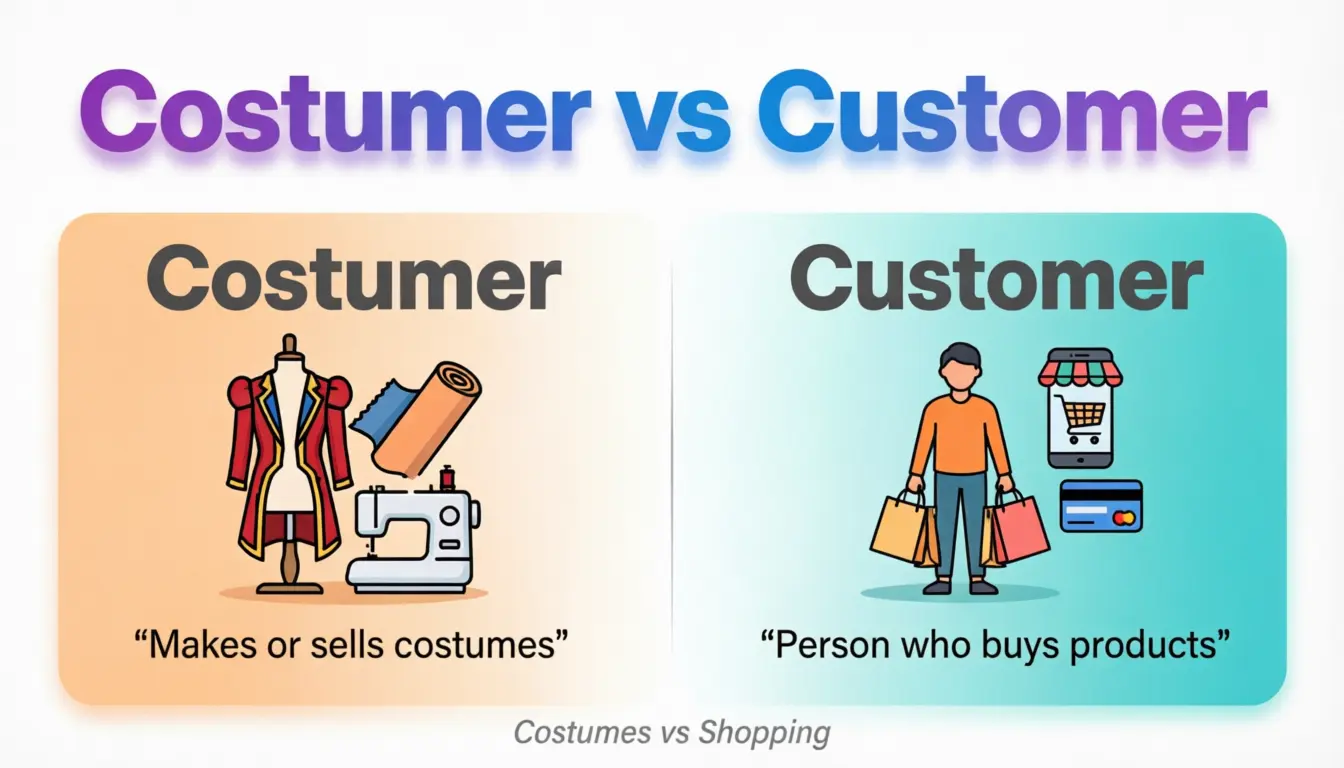
“Costumer” is a noun referring to a person or company that makes or supplies costumes, while “customer” is a noun meaning a person who buys goods or services from a business.
Many people confuse costumer and customer because the two words look almost the same. A single missing letter can change the meaning completely. This spelling mix-up is common in emails, business writing, social media posts, and even job ads. If you have ever wondered if to write costumer or customer, you are not alone.
The confusion happens because both words come from related English roots and sound very similar when spoken quickly. However, they describe two very different people. One word relates to clothing and costumes, while the other relates to buying goods or services.
Understanding the difference matters. Using the wrong spelling in professional writing can make your message look careless. For businesses, it may even affect trust and credibility. Search engines also treat the words differently, so correct spelling helps with content and online visibility.
This guide explains the meanings, origins, spelling differences, and correct usage of costumer vs customer in simple language. You will also see examples, comparison tables, common mistakes, FAQs, and practical writing tips for everyday use.
Costumer vs Customer – Quick Answer
| Word | Meaning | Example |
| Costumer | A person who makes, sells, or designs costumes | The movie hired a talented costumer. |
| Customer | A person who buys products or services | The customer ordered coffee online. |
Simple Explanation
- A costumer works with costumes or theatrical clothing.
- A customer buys something from a shop, company, or service provider.
Easy Examples
- The theater costumer designed outfits for the actors.
- Every customer received a discount coupon.
A quick memory trick:
Customer = buys
Costumer = costumes
The Origin of Costumer vs Customer
The two words developed from different English roots, even though they look alike today.
Origin of “Customer”
The word customer comes from the Old French word custume, meaning “habit” or “custom.” Over time, it described a person who regularly visited a merchant or business. By the 16th century, English speakers used customer for buyers and clients.
Origin of “Costumer”
The word costumer comes from costume, which entered English through French and Italian influences. It originally referred to clothing styles or theatrical dress. Later, costumer became the term for someone who designs or supplies costumes for theater, film, or fashion events.
Why People Confuse Them
The confusion happens because:
- Both words start with “cost-”
- They sound similar
- Spellcheck may not always catch the mistake
- Fast typing often drops or changes letters
Still, their meanings are completely different.
British English vs American English Spelling
Unlike many English words, costumer and customer are spelled the same in both British and American English.
The difference is not regional spelling. The difference is meaning.
Comparison Table
| Term | British English | American English | Meaning |
| Costumer | Costumer | Costumer | Costume designer or supplier |
| Customer | Customer | Customer | Buyer or client |
Example Sentences
| Region | Sentence |
| UK English | The customer complained about late delivery. |
| US English | The customer requested a refund. |
| UK English | The theater hired a skilled costumer. |
| US English | The film studio needed an experienced costumer. |
Key Point
There is no spelling change between British and American English for these words. The important thing is choosing the correct word for the correct meaning.
Which Spelling Should You Use?
The right spelling depends on what you want to say.
Use “Customer” When Talking About Buyers
Choose customer if you mean:
- A shopper
- A client
- A buyer
- A service user
Examples
- Our customers love fast delivery.
- The customer asked for support.
This is the far more common word in daily English.
Use “Costumer” When Talking About Costumes
Choose costumer if you mean:
- A costume designer
- A costume supplier
- A person working in theater wardrobe
Examples
- The Broadway costumer prepared every outfit.
- The movie hired a famous Hollywood costumer.
Audience-Based Advice
| Audience | Best Choice |
| US business writing | Customer |
| UK business writing | Customer |
| Fashion and theater industry | Costumer |
| Global audience | Customer for buyers, Costumer for costume work |
For most people, customer is the correct word.
Common Mistakes with Costumer vs Customer
People often mix these words in professional writing.
Mistake #1: Using “Costumer” in Business Emails
❌ Dear Costumer, thank you for your order.
✅ Dear Customer, thank you for your order.
Mistake #2: Using “Customer” for Costume Design
❌ The movie customer created beautiful outfits.
✅ The movie costumer created beautiful outfits.
Mistake #3: Assuming It Is a Regional Difference
Some people think:
- Customer = American spelling
- Costumer = British spelling
This is incorrect.
Both countries use the same spellings and meanings.
Mistake #4: Auto-Correct Errors
Spellcheck tools sometimes miss the mistake because both words are valid English terms.
Always check the context carefully.
Costumer vs Customer in Everyday Examples
In Emails
- Our customer service team will reply soon.
- The theater costumer finished the actor’s outfit.
In News Articles
- Customers complained about rising prices.
- The award-winning costumer worked on the new film.
On Social Media
- Happy customers shared positive reviews online.
- The cosplay costumer posted new costume designs.
In Formal Writing
- Customer satisfaction is important for every business.
- The museum hired a historical costumer for the exhibit.
In Marketing
- Customer loyalty helps companies grow.
- A professional costumer can improve film production quality.
Costumer vs Customer – Google Trends & Usage Data
Search data shows that customer is much more popular than costumer worldwide.
Why “Customer” Is More Common
The word appears often in:
- Business
- Retail
- Marketing
- Banking
- E-commerce
- Customer service
Millions of companies use the term daily.
Why “Costumer” Has Lower Search Volume
The word is more specialized. It mainly appears in:
- Theater
- Film production
- Fashion
- Costume design
- Cosplay communities
Popularity by Country
| Country | More Common Word |
| United States | Customer |
| United Kingdom | Customer |
| Canada | Customer |
| Australia | Customer |
| India | Customer |
Context-Based Usage
| Context | Correct Word |
| Online shopping | Customer |
| Retail stores | Customer |
| Costume design | Costumer |
| Film wardrobe | Costumer |
Costumer vs Customer Comparison Table
| Feature | Costumer | Customer |
| Main Meaning | Costume designer or supplier | Buyer or client |
| Industry | Theater, film, fashion | Business, retail, services |
| Frequency | Rare | Very common |
| Part of Speech | Noun | Noun |
| Related Word | Costume | Custom |
| Example | The costumer designed masks. | The customer bought shoes. |
FAQs About Costumer vs Customer
Is “costumer” a real word?
Yes. A costumer is someone who designs, sells, or provides costumes.
Which word is more common?
Customer is much more common in everyday English.
Is “costumer” the British spelling of “customer”?
No. They are different words with different meanings.
Can I use “costumer” for shoppers?
No. Use customer for shoppers or buyers.
What does “customer service” mean?
It means support or help provided to buyers and clients.
What does a costumer do?
A costumer creates or manages costumes for theater, film, TV, or events.
Why do people confuse these words?
They look and sound very similar.
Is “customer” correct in formal writing?
Yes. It is the standard professional spelling for buyers or clients.
How can I remember the difference?
Think of “costume” inside “costumer.”
Conclusion
The difference between costumer vs customer is simple once you understand the meanings. A customer is a buyer, client, or shopper. A costumer is someone who works with costumes, usually in theater, film, or fashion. Although the words look almost identical, they are not spelling variations of the same term.
This confusion happens often because both words sound similar and share several letters. However, using the wrong one can create problems in business writing, academic work, marketing, and professional communication. Most people searching online actually want the word customer, since it is far more common in daily life and business English.
There is also no British versus American spelling difference here. Both English versions use the same spellings and meanings. The important step is choosing the word that matches your context.
If you are talking about shopping, services, or clients, use customer. If you are discussing costumes, theater, or wardrobe design, use costumer. A quick spelling check before publishing can help your writing stay clear, professional, and easy to understand.

I am an Emily Carter Brooks U.S.A based linguistics writer known for my clear, reader-friendly explanations of English grammar and vocabulary differences. I have contributed to multiple online language resources and specializes in spelling variations, pronunciation confusion, and British vs American English comparisons. I’m passionate about helping learners improve their English through practical, everyday communication. engaging, and stress-free.