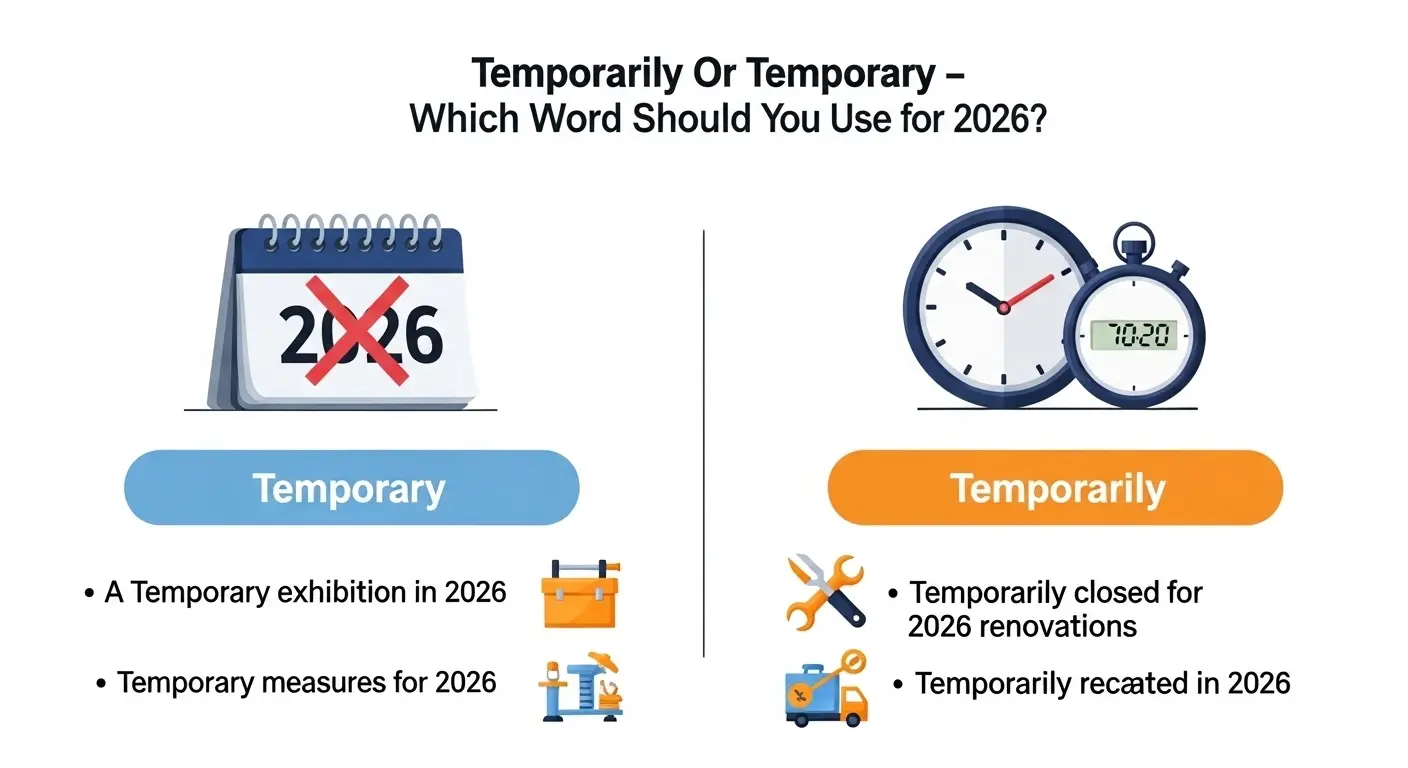
“Temporarily” is an adverb meaning for a limited period of time, while “temporary” is an adjective describing something not permanent or lasting for a short time.
Have you ever stopped while writing and wondered: Is it “temporarily” or “temporary”? You are not alone. These two words look almost the same, but they do very different jobs in a sentence.
Many people search for temporarily or temporary because they want to use the correct word in emails, school work, business writing, or social media posts. A small grammar mistake can change how your sentence sounds.
The confusion happens because both words come from the same root word: temporary. But one is an adjective, and the other is an adverb. That means they work differently.
For example:
- This office is temporary. ✅
- The office is closed temporarily. ✅
- The office is closed temporary. ❌
In this guide, you will learn the difference between temporarily and temporary, where these words came from, how British and American English use them, common mistakes to avoid, and simple examples from daily life.
By the end, you will know exactly which one to use.
Temporarily or Temporary – Quick Answer
The quick answer is simple:
- Temporary = adjective (describes a noun)
- Temporarily = adverb (describes an action or verb)
Use temporary when talking about something that will not last long.
Examples:
- We found a temporary house.
- She got a temporary job.
Use temporarily when talking about an action happening for a short time.
Examples:
- The website is temporarily down.
- He is temporarily living in London.
Quick rule:
If it describes a thing, use temporary.
If it describes an action, use temporarily.
| Word | Part of Speech | Use |
| Temporary | Adjective | Describes nouns |
| Temporarily | Adverb | Describes actions |
The Origin of Temporarily or Temporary
The word temporary comes from the Latin word temporarius. It means “lasting for a time.”
The root word is tempus, which means “time.”
Over time, English took this word and made two forms:
| Word | Meaning |
| Temporary | Lasting for a short time |
| Temporarily | For a short time |
Why do spelling differences exist?
The base word stays as temporary, but when English adds -ly, it becomes temporarily.
Example:
- Quick → Quickly
- Slow → Slowly
- Temporary → Temporarily
This is a normal English word-building rule.
British English vs American English Spelling
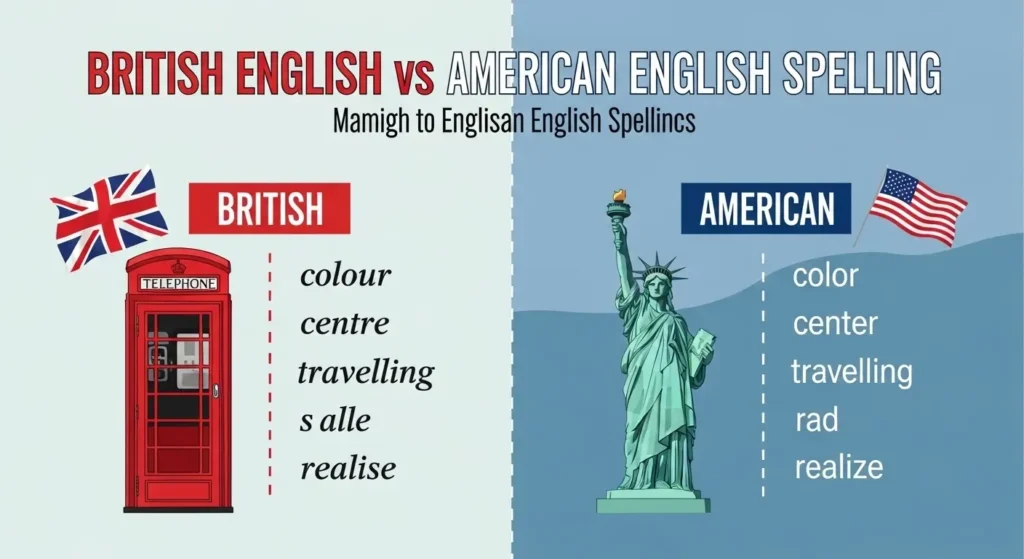
Good news: there is no spelling difference between British and American English for these words.
Both use:
- Temporary
- Temporarily
The difference is not about region. It is about grammar.
British English examples:
- The road closure is temporary.
- The road is temporarily closed.
American English examples:
- This is a temporary fix.
- The service is temporarily unavailable.
Comparison Table
| Type | British English | American English |
| Adjective | Temporary | Temporary |
| Adverb | Temporarily | Temporarily |
| Meaning | Same | Same |
So whether you write for the US, UK, Canada, or Australia, the spelling stays the same.
Which Spelling Should You Use?
Choosing between temporary and temporarily depends on your sentence.
For US audiences
Use normal grammar rules:
- Temporary job
- Temporarily closed
For UK audiences
Same rule:
- Temporary worker
- Temporarily delayed
For Commonwealth countries
Countries like Australia, New Zealand, and Canada also follow the same pattern.
For global writing
If your audience is worldwide:
Use the word based on grammar, not country.
Simple trick:
Ask yourself:
Is it a thing or an action?
Thing = temporary
Action = temporarily
Examples:
- A temporary password
- Access is temporarily blocked
Common Mistakes with Temporarily or Temporary
People often mix these words.
Here are common mistakes:
Mistake #1: Using temporary instead of temporarily
❌ The store is closed temporary.
✅ The store is closed temporarily.
Why?
“Closed” is an action state, so it needs an adverb.
Mistake #2: Using temporarily instead of temporary
❌ I need a temporarily office.
✅ I need a temporary office.
Why?
“Office” is a noun, so it needs an adjective.
Mistake #3: Thinking they mean different things
Both relate to short time, but their grammar use is different.
Mistake #4: Forgetting -ly
Many adverbs end in -ly.
Temporary → Temporarily
Quick correction chart
| Wrong | Correct |
| Temporary closed | Temporarily closed |
| Temporarily solution | Temporary solution |
| Temporary living here | Temporarily living here |
Temporarily or Temporary in Everyday Examples
Here is how people use these words in real life.
In emails
- My email account is temporarily unavailable.
- Here is your temporary login code.
In news
- The bridge is temporarily shut.
- The government made a temporary law change.
On social media
- Taking a temporary break from posting.
- My account is temporarily locked.
In school writing
- The classroom is in a temporary building.
- Classes are temporarily canceled.
In office writing
- This is a temporary contract.
- The manager is temporarily away.
Temporarily or Temporary/ Google Trends & Usage Data
Search interest for temporarily or temporary is strong because people often need grammar help.
Here is how people usually search:
| Search Phrase | Why People Search It |
| Temporary meaning | Word definition |
| Temporarily meaning | Usage help |
| Temporary vs temporarily | Grammar difference |
| Is temporary an adverb? | Part of speech confusion |
Usage by country
English-speaking countries like:
- USA
- UK
- Canada
- Australia
- India
often search these words.
Why?
Because both words are common in:
- Work emails
- Website messages
- News headlines
- School writing
Common contexts
Temporary is popular in:
- Jobs
- Housing
- IDs
- Contracts
Temporarily is popular in:
- Website notices
- Travel alerts
- Service updates
Comparison Table: Temporary vs Temporarily
| Feature | Temporary | Temporarily |
| Word type | Adjective | Adverb |
| Meaning | Not permanent | For a short time |
| Describes | Nouns | Verbs/actions |
| Example | Temporary job | Temporarily closed |
| Common use | Objects, roles, situations | Actions, states |
FAQs
1. Is it temporary or temporarily closed?
Use temporarily closed.
Because “closed” needs an adverb.
2. Is temporary an adverb?
No.
Temporary is an adjective.
3. Is temporarily an adjective?
No.
Temporarily is an adverb.
4. Can I say temporary leave?
Yes.
Example: He is on temporary leave.
5. Can I say temporarily leave?
Yes, but the meaning changes.
Example: He will temporarily leave the office.
Here, it describes the action.
6. What does temporary mean?
It means not permanent.
Example: temporary home.
7. What does temporarily mean?
It means for a short time.
Example: temporarily unavailable.
8. Are temporary and temporarily interchangeable?
No.
They have different grammar roles.
9. Which is more common?
Both are common, but used in different sentence structures.
Conclusion
The difference between temporarily or temporary is simple once you know the grammar rule. Use temporary when describing a noun. It tells us something is not permanent and will last for a short time. For example, a temporary job or a temporary home.
Use temporarily when describing an action or condition. It shows that something happens for a short time. For example, a website may be temporarily unavailable, or someone may temporarily move to another city.
The spelling does not change in British or American English. Both forms are correct, but they must be used in the right place.
A simple trick can help:
If it is a thing, choose temporary.
If it is an action, choose temporarily.
This small grammar choice makes your writing clearer, stronger, and more professional. Next time you write, you will know exactly which word fits best.

I hold a degree in English Literature and Linguistics and have worked extensively on educational blogs, comparison websites, and digital learning platforms. My writing focuses on simplifying complex language rules, highlighting British vs American English differences, and providing practical examples for everyday usage.