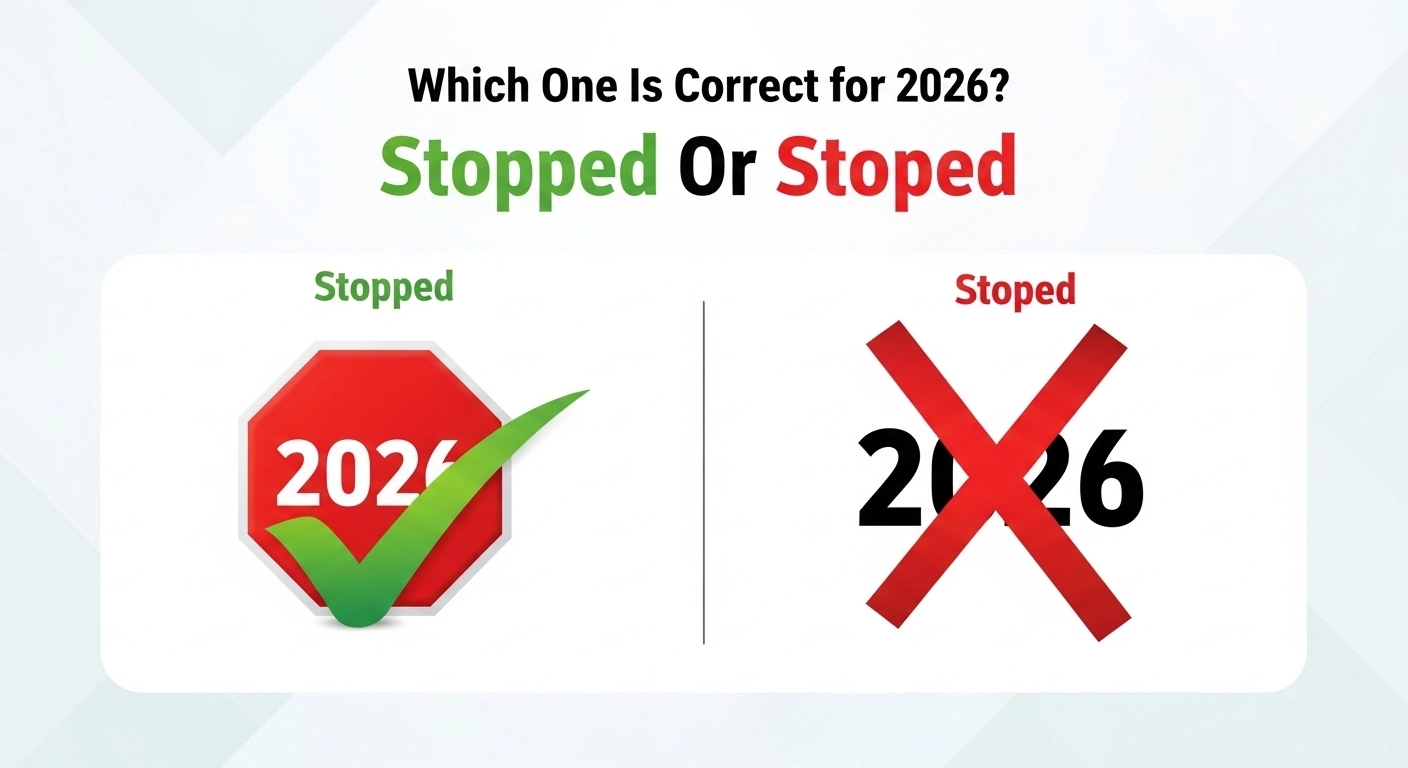
“Stopped” is the correct spelling, while “stoped” is generally a misspelling in modern English. “Stopped” is the past tense and past participle of stop, meaning to cease moving, doing, or continuing something. The final consonant is doubled because stop ends in a single vowel followed by a single consonant.
Many English learners and even native speakers get confused between “stopped” and “stoped.” You may see both versions online, in emails, or social media posts, and wonder which is correct. This confusion usually arises from the way English handles verb conjugation, especially when doubling consonants before adding -ed.
If you’ve ever typed “I stoped the car” and wondered if it looked right, you’re not alone. People search for this topic because using the wrong spelling can make writing look careless or unprofessional. Knowing the correct form is essential for academic writing, business emails, social media posts, and even casual messages.
This guide will clarify the difference between stopped and stoped, explain why one is correct, explore spelling differences between British and American English, and give practical examples for everyday use.
By the end, you’ll be confident about which spelling to use, why it matters, and how to avoid common mistakes.
Stopped or Stoped – Quick Answer
The correct past tense of stop is stopped.
- ✅ Correct: I stopped the car at the red light.
- ❌ Incorrect: I stoped the car at the red light.
The reason is simple: when a verb ends with a single vowel followed by a single consonant, English doubles the consonant before adding -ed if the stress is on the last syllable.
Example:
- stop → stopped
- hop → hopped
- plan → planned
Stoped is never correct in standard English and is considered a spelling mistake.
The Origin of Stopped
The verb stop comes from Middle English stoppen, which meant “to block or obstruct.” Over centuries, English developed specific rules for forming past tense verbs. The doubling of the consonant before adding -ed came from Old and Middle English spelling conventions to indicate a short vowel sound.
This is why we write stopped with two p’s, instead of stoped, which could mislead readers about pronunciation. The pattern is consistent across similar verbs, making it easier to remember once you understand the rule.
British English vs American English Spelling
Interestingly, British and American English sometimes differ in doubling consonants, but in this case, both agree: stopped is correct in both variants.
Rules:
- Single vowel + single consonant + stressed final syllable: double consonant → stopped.
- Final consonant not stressed: do not double → visited.
- Verbs ending in -l in British English: double consonant even in unstressed syllable → travelled (UK) vs traveled (US).
| Word | British English | American English | Correct Past Tense | Comment |
| stop | stopped | stopped | ✅ stopped | Same in UK & US |
| plan | planned | planned | ✅ planned | Same in UK & US |
| travel | travelled | traveled | ✅ travelled/US traveled | L differs |
| hop | hopped | hopped | ✅ hopped | Same rule |
So, whether writing in UK or US English, stopped is universally correct.
Which Spelling Should You Use?
- In the US: Always use stopped.
- In the UK & Commonwealth countries: Always use stopped.
- Global writing: If your audience is international, stick with stopped for clarity and professionalism.
Using stoped in any context will likely appear as a typo and may reduce the credibility of your writing.
Common Mistakes with Stopped
Many mistakes occur due to a misunderstanding of the consonant doubling rule. Here are common errors:
- Stoped → ❌ Correct: stopped
- Hoppted → ❌ Correct: hopped
- Planed (past tense of “plan”) → ❌ Correct: planned
- Forgetting doubling after short vowels → ❌ Correct: pat → patted
Tip: If the verb ends in a single vowel + single consonant and is stressed on the last syllable, always double the consonant before adding -ed.
Stopped in Everyday Examples
Here’s how stopped appears in different contexts:
- Emails:
- “I stopped by the office to drop off the documents.”
- “I stopped by the office to drop off the documents.”
- News:
- “The train stopped unexpectedly due to technical issues.”
- “The train stopped unexpectedly due to technical issues.”
- Social Media:
- “Just stopped at this amazing café!”
- “Just stopped at this amazing café!”
- Formal Writing:
- “The committee stopped all non-essential operations during the audit.”
- “The committee stopped all non-essential operations during the audit.”
In every case, stopped is correct and stoped would be seen as a mistake.
Stopped Or Stoped in Academic Writing
In academic writing, stopped is the correct spelling, while stoped is generally considered incorrect in standard English. Academic papers, research articles, and university assignments should always use stopped when referring to the past tense or past participle of stop. For example, “The experiment was stopped due to technical difficulties” is correct. Using stoped may be viewed as a spelling mistake and can reduce the professionalism of your writing.
Stopped Or Stoped in Business
In business communication, reports, emails, and official documents should always use stopped. The word follows the standard English spelling rule where the final consonant is doubled before adding -ed. For example, “Production was stopped temporarily” and “The project was stopped because of budget constraints” are correct business usages. The spelling stoped is rarely used outside specialized mining terminology and should be avoided in general business writing.
Stopped Or Stoped Quiz
Test your understanding of stopped vs stoped with these quick questions:
1. Which spelling is correct in standard English?
a) Stoped
b) Stopped ✅
2. Choose the correct sentence:
a) The meeting was stoped early.
b) The meeting was stopped early. ✅
3. Why is “stopped” spelled with two p’s?
a) Because stop ends in a consonant-vowel-consonant pattern ✅
b) Because it is a British spelling only
4. Which sentence is correct?
a) She stopped talking when the teacher arrived. ✅
b) She stoped talking when the teacher arrived.
5. True or False: “Stoped” is the standard past tense of stop.
Answer: False ✅
Quiz Result: If you answered most questions correctly, you now know that stopped is the proper spelling in everyday English, while stoped is generally incorrect except in certain technical mining contexts.
Stopped – Google Trends & Usage Data
According to Google Trends, searches for “stopped or stoped” spike among students, writers, and non-native English speakers.
- Top countries searching:
- India
- Pakistan
- UK
- USA
- India
- Context:
- English homework questions
- Grammar check searches
- Social media usage corrections
- English homework questions
This indicates that most people want a quick answer about correct spelling, confirming that stopped is overwhelmingly preferred.
Keyword Comparison Table
| Variation | Correct? | Example |
| stopped | ✅ Yes | I stopped the car. |
| stoped | ❌ No | I stoped the car. |
| stoppped | ❌ No | I stoppped the car. |
| stopp | ❌ No | I stopp the car. |
FAQs:
- Is “stoped” ever correct?
No, “stoped” is a misspelling. Always use stopped. - Why do we double the ‘p’ in stopped?
English doubles the consonant after a single vowel when the stress is on the last syllable. - Is “stopped” the same in UK and US English?
Yes, both UK and US follow the same rule for “stop.” - Can I use “stopped” in professional writing?
Absolutely, it is correct in emails, reports, and formal documents. - What verbs follow the same rule as stop?
Examples: hop → hopped, plan → planned, chat → chatted. - How do I remember the rule?
Look for verbs ending in a single vowel + consonant with stress on the last syllable. Double the consonant before -ed. - Is “stopping” spelled the same way?
Yes, when forming present participle: stop → stopping (double the p). - Why do people type “stoped”?
They often forget the doubling rule or are influenced by pronunciation patterns. - Is there a pronunciation difference?
No, “stopped” and “stoped” (if written) would sound the same, but only stopped is correct.
Conclusion:
In English writing, stopped is the only correct past tense form of stop. The doubling of the consonant is a rule rooted in centuries of English spelling conventions and applies in both British and American English. Using stoped is always a spelling error and can make your writing appear careless.
If you are composing emails, social media posts, formal reports, or casual messages, always use stopped. Remember the simple rule: single vowel + single consonant + stressed syllable = double consonant + -ed. Following this pattern will help you with many other verbs like hop → hopped, plan → planned, and chat → chatted.
By mastering this small but important rule, you ensure your writing is accurate, professional, and clear for any audience, whether local, international, or online. Always check your work for spelling mistakes, as attention to detail reflects credibility.
Overview:
People also search for terms like stopped or stoped meaning, stopped or stoped synonym, and stopped or stoped examples when trying to understand the correct spelling and usage of the word. The correct form is stopped, which is the past tense and past participle of stop, while stoped is generally considered a misspelling in modern English.
Users also look up stopped meaning, stopped pronunciation, and is stoped a word to clarify common spelling confusion. Related searches such as stop past tense and staff spelling often appear because learners want to improve their understanding of English spelling rules, verb forms, and pronunciation.
Read More Article:
- Quit or Quite? Correct Meaning, Usage, and Common Mistakes Explained
- Herd or Heard? A Complete Guide to Understanding the Difference (With Examples, History, and Usage Tips)
- Prey or Pray: The Complete Guide to Meaning, Usage, and Common Mistakes
- Mis or Miss? Correct Meaning, Usage, and Common Mistakes Explained
.

I am an Emily Carter Brooks U.S.A based linguistics writer known for my clear, reader-friendly explanations of English grammar and vocabulary differences. I have contributed to multiple online language resources and specializes in spelling variations, pronunciation confusion, and British vs American English comparisons. I’m passionate about helping learners improve their English through practical, everyday communication. engaging, and stress-free.