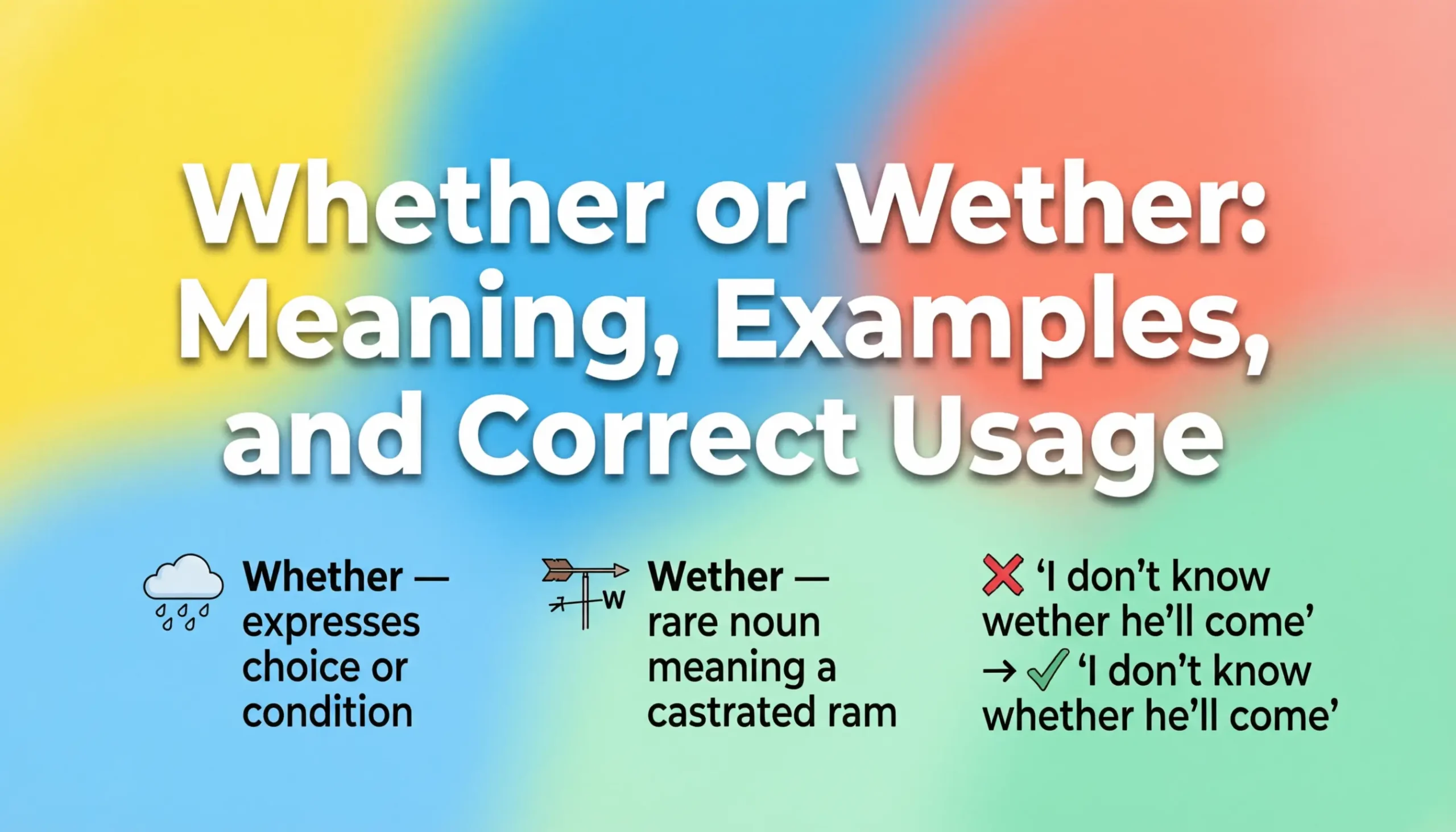
English spelling confuses even confident writers, and whether or wether is a perfect example. Many people type this phrase into Google because they are unsure which word is correct, when to use it, or if both spellings are acceptable. The confusion often happens during fast typing, exams, emails, or professional writing where accuracy matters.
At first glance, whether and wether look like simple spelling variants of the same word. That assumption leads to frequent mistakes in essays, business emails, and social media posts. However, the truth is much simpler and more important. These two words are not interchangeable, and only one of them fits most everyday sentences.
This article solves that confusion clearly and quickly. You’ll learn the correct spelling, its origin, how British and American English treat it, and which word you should use depending on context. We’ll also cover common mistakes, real-life examples, Google search trends, and practical advice for writers, students, and professionals.
If you’ve ever paused while writing a sentence like “I don’t know to go or stay”, this guide will make sure you never hesitate again.
Whether or Wether – Quick Answer
Whether is the correct word in almost all writing situations.
Wether is a completely different word and is rarely used.
Examples:
- ✅ I don’t know whether it will rain today.
- ❌ I don’t know wether it will rain today.
Wether refers to a castrated male sheep, not a spelling alternative.
The Origin of Whether or Wether
The word whether comes from Old English hwæðer, meaning “which of two.” Over time, its spelling evolved, but its meaning stayed connected to choice, doubt, or alternatives.
Wether, on the other hand, also comes from Old English but followed a completely different path. It developed as a noun used in farming and animal husbandry.
Why the confusion exists:
- Both words look similar
- They sound nearly the same
- Spellcheck doesn’t always catch context errors
But historically and linguistically, they are unrelated in meaning.
British English vs American English Spelling
There is no spelling difference between British and American English for this word.
Both varieties use whether, and neither accepts wether as an alternative spelling.
Comparison Table
| Aspect | British English | American English |
| Correct spelling | whether | whether |
| Accepted variant | None | None |
| “Wether” usage | Animal term only | Animal term only |
Key point: This is not a UK vs US issue—it’s a meaning issue.
Which Spelling Should You Use?
Use whether if you are:
- Writing for US audiences
- Writing for UK or Commonwealth audiences
- Writing globally
- Writing professionally, academically, or casually
Only use wether if you are specifically talking about sheep or farming.
Audience-based advice:
- US audience: Always use whether
- UK/Commonwealth: Always use whether
- Global readers: Use whether to avoid confusion
Common Mistakes with Whether or Wether
Here are the most frequent errors people make:
- ❌ Using wether instead of whether
✅ I’m not sure whether he’ll come. - ❌ Assuming both spellings are correct
✅ Only whether is correct in normal writing - ❌ Ignoring spellcheck suggestions
✅ Always review context, not just spelling - ❌ Using wether in exams or formal writing
✅ This can cost marks or credibility
Whether or Wether in Everyday Examples
Emails
- Please confirm whether the meeting is still scheduled.
News
- Officials are deciding whether to announce new policies.
Social Media
- Not sure whether to laugh or cry today.
Formal Writing
- The study examines whether the method improves results.
Wether example (rare):
- The farmer separated the wether from the flock.
Whether or Wether /Google Trends & Usage Data
Search data shows that “whether or wether” is commonly searched worldwide, especially in:
- South Asia
- The UK
- The US
- ESL-dominant regions
This tells us users are:
- Unsure about spelling
- Checking correctness before publishing
- Trying to avoid mistakes in exams or work
In actual written content:
- Whether appears millions of times
- Wether appears mostly in agricultural texts
Comparison Table: Whether vs Wether
| Feature | Whether | Wether |
| Part of speech | Conjunction | Noun |
| Meaning | Expresses doubt or choice | Castrated male sheep |
| Common usage | Very common | Very rare |
| Correct in questions | Yes | No |
| Accepted in exams | Yes | No |
FAQs:
1. Is wether ever correct?
Yes, but only when referring to a male sheep.
2. Is whether used in questions?
Yes. It often introduces indirect questions.
3. Can whether mean “if”?
Yes, in many cases it works similarly to if.
4. Is there a British spelling difference?
No. Both British and American English use whether.
5. Why do people confuse whether and wether?
Because they sound similar and look alike.
6. Is wether a spelling mistake?
Usually yes, unless talking about livestock.
7. Can spellcheck catch this mistake?
Not always, because wether is a real word.
8. Is whether formal or informal?
It works in both formal and informal writing.
Conclusion:
The confusion between whether or wether is common, but the solution is simple once you understand the difference. Whether is the correct and widely accepted word used to express doubt, choice, or alternatives in everyday English. It appears in emails, news articles, academic papers, and casual conversations across both British and American English.
Wether, on the other hand, is not a spelling variant. It is a specific noun used mainly in agriculture and should never replace whether in normal writing. Using the wrong word can make your writing look careless, especially in professional or academic contexts.
To avoid mistakes, remember this rule:
If you are talking about a decision, a question, or uncertainty, always use whether. If sheep are not involved, wether does not belong in your sentence.
Mastering small distinctions like this improves clarity, confidence, and credibility in your writing exactly what strong English communication requires.
Read More Article:
Present or Gift – Which One Is Correct?

I am an Emily Carter Brooks U.S.A based linguistics writer known for my clear, reader-friendly explanations of English grammar and vocabulary differences. I have contributed to multiple online language resources and specializes in spelling variations, pronunciation confusion, and British vs American English comparisons. I believes that learning English should be practical, engaging, and stress-free.