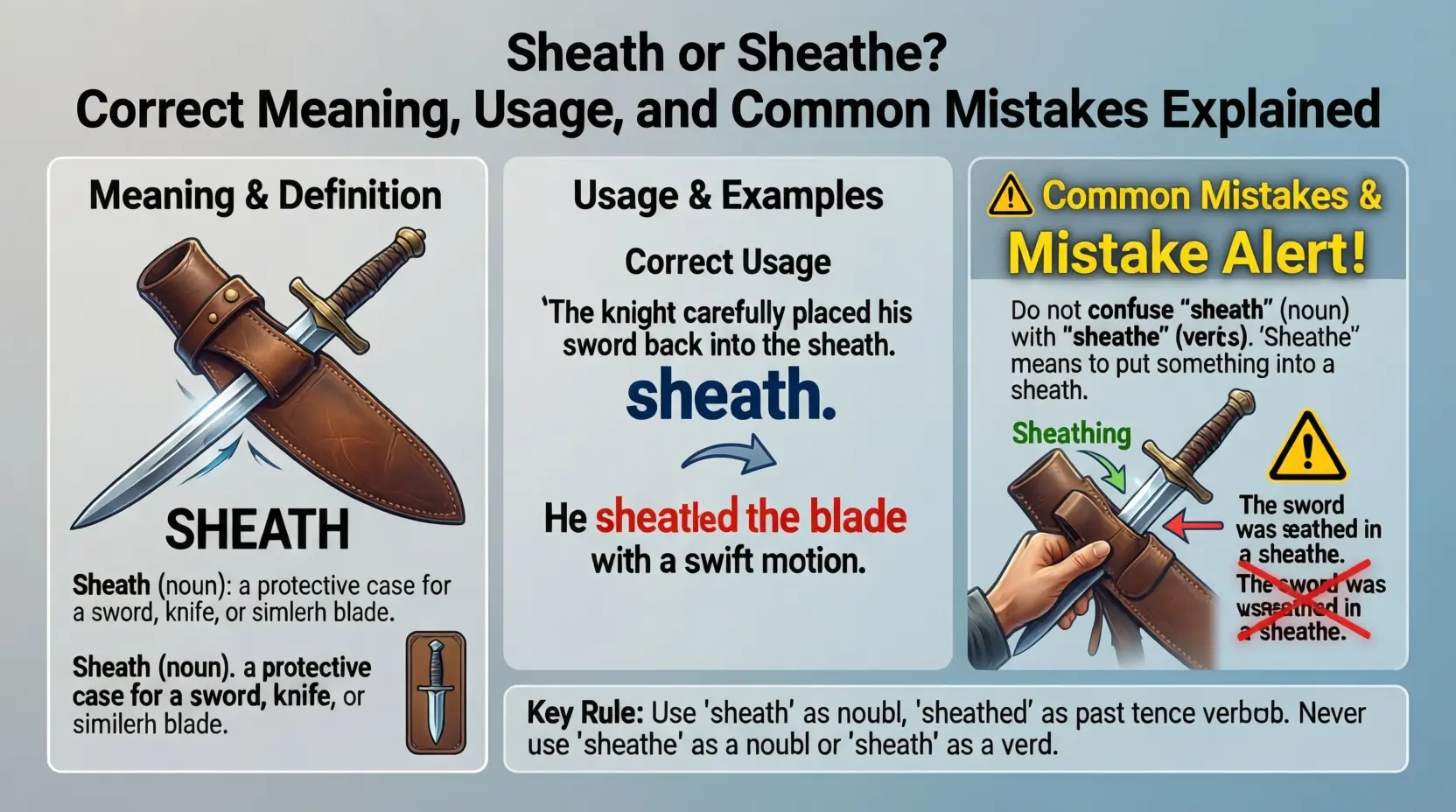
English words can be tricky, especially when they sound almost the same. One common question is “sheath or sheathe.” Both words exist, but their meanings and uses are slightly different. Many learners search for sheath or sheathe because they are unsure which spelling to use in writing or conversation.
Confusion usually appears in contexts like knives, swords, or protective coverings. For example: Did you put the sword in the sheath or did you sheathe it? Both are correct depending on the sentence, but one is a noun and the other is a verb.
This article explains sheath and sheathe in very simple English. You will learn the quick answer, word origin, British vs American usage, common mistakes, real-life examples, Google trends, comparison tables, FAQs, and expert advice.
By the end, you will know exactly when to use sheath and when to use sheathe.
Sheath or Sheathe – Quick Answer
- Sheath → noun, a cover or case for a blade
- Sheathe → verb, to put a blade into a sheath
Simple Examples
- The knife is in the sheath.
- Always sheathe your sword after use.
👉 Sheath = thing (noun)
👉 Sheathe = action (verb)
What Does “Sheath” Mean? (Simple Explanation)
Sheath is a noun. It is the protective covering for:
- swords
- knives
- daggers
- blades
Examples
- The soldier carried his sword in a leather sheath.
- The gardener kept the knife in a metal sheath.
👉 Think: Sheath = case, cover, holder
What Does “Sheathe” Mean? (Simple Explanation)
Sheathe is a verb. It means to put a blade into its sheath or cover something with a protective case.
Examples
- The knight sheathed his sword after the battle.
- Please sheathe the knife before storing it.
👉 Think: Sheathe = action of covering
Sheath vs Sheathe – Part of Speech Difference
| Word | Part of Speech | Meaning |
| Sheath | Noun | Blade cover / case |
| Sheathe | Verb | To put into a sheath / cover |
The Origin of Sheath and Sheathe
Origin of “Sheath”
- Comes from Old English sceath
- Meaning: covering or case for a blade
- Used for centuries in swords and knives
Origin of “Sheathe”
- Derived from the noun “sheath” + English verb form
- Meaning: place a blade into a sheath
👉 Both words have similar roots but differ by noun vs verb usage.
British English vs American English Usage
There is no spelling difference between British and American English for sheath or sheathe. Both are correct everywhere.
Usage Table
| Feature | British English | American English |
| Sheath | Noun | Noun |
| Sheathe | Verb | Verb |
| Meaning | Same | Same |
| Usage | Same | Same |
Examples
- UK: He sheathed the sword carefully.
- US: He sheathed the sword carefully.
- UK: The dagger is in a leather sheath.
- US: The dagger is in a leather sheath.
Which One Should You Use?
- Use Sheath → when talking about the cover
- Use Sheathe → when talking about the action
Quick Rule
Ask yourself: Am I talking about a thing or an action?
- Thing = sheath
- Action = sheathe
Common Mistakes with Sheath or Sheathe
Mistake 1
❌ Put the sword in the sheathe.
✅ Put the sword in the sheath.
Mistake 2
❌ Always sheath your knife in the sheath. (correct, but check context)
✅ Always sheathe your knife in its sheath.
Mistake 3
❌ The sheathe is leather.
✅ The sheath is leather.
Sheath or Sheathe in Everyday Life
Emails / Instructions
- Please sheathe the tool after use.
- Store the blade in a protective sheath.
Historical / Fiction Context
- The knight drew his sword from its sheath.
- He sheathed his dagger quickly.
Museums / Collections
- Ancient swords were displayed in their sheaths.
- Guards sheathed ceremonial swords carefully.
Sheath or Sheathe in Professional / Technical Writing
- Technical manuals use sheathe for actions:
- Always sheathe the blade when not in use.
- Always sheathe the blade when not in use.
- Inventory lists use sheath for items:
- Check the leather sheaths for defects.
- Check the leather sheaths for defects.
Sheath or Sheathe – Google Trends & Popularity
Search trends show:
- Sheath is more commonly searched because it is a noun and widely used in stories and manuals.
- Sheathe is searched less but is essential for writing instructions or historical contexts.
High Search Countries
- United States
- United Kingdom
- Canada
- Australia
Sheath vs Sheathe – Side-by-Side Comparison Table
| Feature | Sheath | Sheathe |
| Part of Speech | Noun | Verb |
| Meaning | Blade cover / case | Put into a sheath |
| Example | Sword in a sheath | Sheathe your sword |
| Usage | Object | Action |
| Common Context | Knives, swords, tools | Historical, instructional |
Easy Trick to Remember the Difference
👉 Sheath = think “case / cover”
👉 Sheathe = think “action of putting into cover”
Tip: “Sheathe ends with ‘e’ for ‘exercise’” → action word
Practice Sentences (Try Yourself)
Fill in the blanks:
- Always ___ your sword after battle.
- The knife is in its leather ___.
- The knight drew the dagger from its ___.
Answers
- sheathe
- sheath
- sheath
FAQs:
1. Is “sheath” a noun or verb?
Noun – a cover or case.
2. Is “sheathe” a verb or noun?
Verb – to put a blade into a sheath.
3. Can “sheathe” be used for anything else?
Yes, it can also mean covering any sharp or pointed object.
4. Is there a British vs American spelling difference?
No, both spellings are the same worldwide.
5. Which is more common in writing?
Sheath is more common, as it is used in many contexts.
6. Can I use sheath as a verb?
No, use sheathe for the action.
7. Is “sheathe” only for swords?
Mostly, but it can also refer to knives, daggers, or other sharp tools.
Conclusion
The confusion between sheath or sheathe is simple to solve. Sheath is a noun that refers to the protective cover for a blade, while sheathe is a verb that describes the action of putting the blade into its sheath. Both spellings are correct worldwide and used in the same way in American and British English.
To avoid mistakes, always ask yourself: Am I talking about a thing or an action? If it’s a thing → sheath, if it’s an action → sheathe. Once you understand this simple difference, your writing in manuals, fiction, historical stories, or instructions will be accurate, clear, and professional.
Read More Article:
Everybodies or Everybody’s: The Correct Spelling, Meaning, and Usage Explained Simply

I hold a degree in English Literature and Linguistics and have worked extensively on educational blogs, comparison websites, and digital learning platforms. My writing focuses on simplifying complex language rules, highlighting British vs American English differences, and providing practical examples for everyday usage.