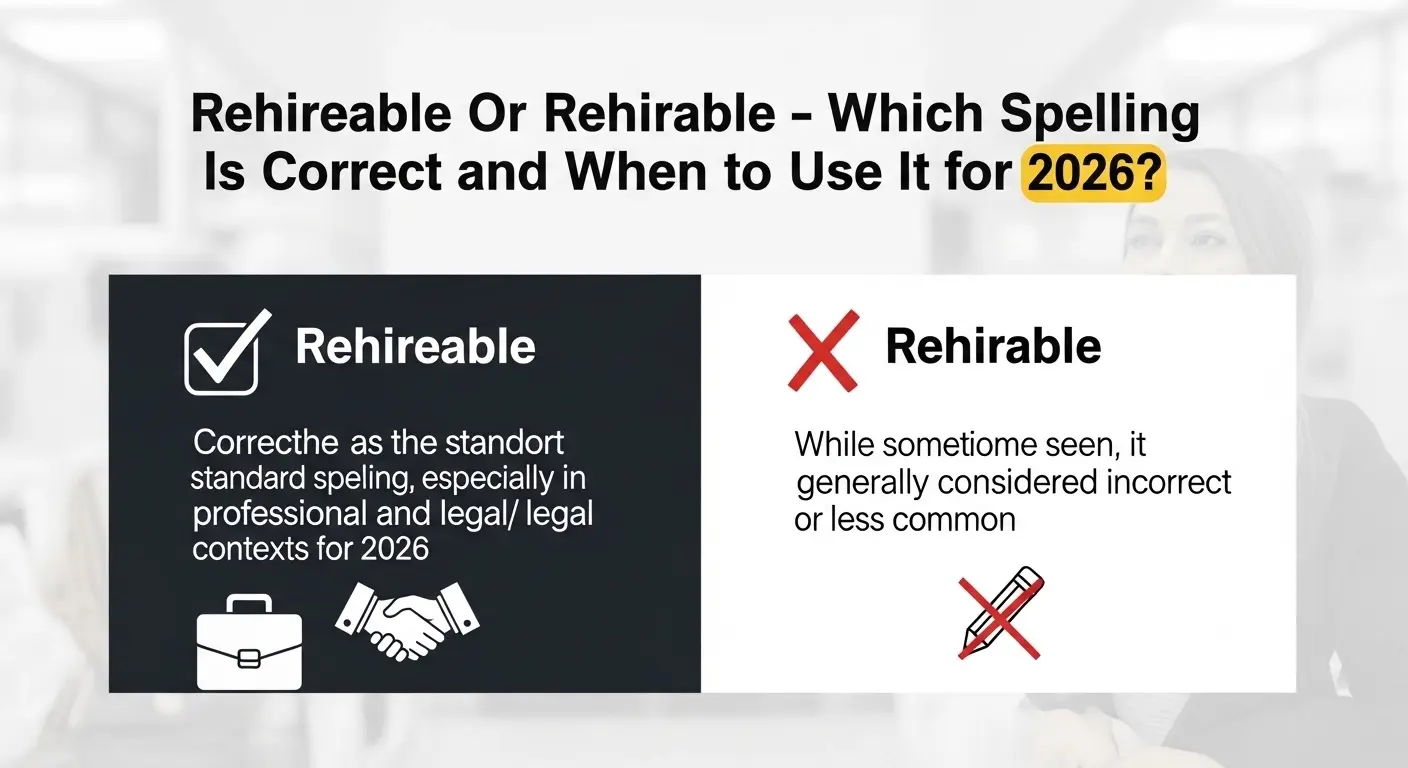
Have you ever seen the words “rehireable” and “rehirable” and wondered which one is correct? You’re not alone. Many people search for this keyword because both spellings look right at first glance. This confusion often happens when adding suffixes like “-able” to verbs such as “hire.”
The problem becomes more common in job-related contexts like HR reports, performance reviews, and exit interviews where the term “rehirable” is used to describe whether a former employee can be hired again. Using the wrong spelling in such situations can make your writing seem less professional.
In this article, we’ll clear up the confusion between “rehireable” and “rehirable.” You’ll learn the correct spelling, why the difference exists, and how to use the word properly in everyday writing.
We’ll also explore examples, common mistakes, and practical tips so you can write with confidence.
Rehireable or Rehirable – Quick Answer
The correct spelling is “rehirable.”
“Rehireable” is incorrect and not used in standard English.
Examples:
- ✅ She is rehirable after her contract ends.
- ❌ She is rehireable after her contract ends.
Why?
When adding “-able” to a word ending in “e,” the “e” is usually dropped. So:
- hire + able → rehirable
The Origin of Rehireable or Rehirable
The word “rehirable” comes from the verb “hire.”
- Hire means to employ someone.
- Adding the prefix “re-” means “again.”
- Adding the suffix “-able” means “capable of.”
So, “rehirable” means:
Capable of being hired again.
Why does the spelling change?
English spelling rules say:
- If a word ends in “e,” drop the “e” before adding “-able.”
Examples:
- move → movable
- love → lovable
- hire → hirable → rehirable
That’s why “rehireable” is not correct it keeps an extra “e” that should be removed.
British English vs American English Spelling
Good news: there is no difference between British and American English for this word. Both use the same spelling: rehirable.
Comparison Table
| Version | Correct Spelling | Usage Region | Notes |
| Rehirable | ✅ Yes | US & UK | Standard and correct |
| Rehireable | ❌ No | None | Incorrect spelling |
Unlike words like “colour” vs “color,” this keyword does not change by region.
Which Spelling Should You Use?
If you are writing for a US audience:
Use rehirable. This is the only accepted form.
If you are writing for a UK or Commonwealth audience:
Still use rehirable. No variation exists.
If your audience is global:
Always choose rehirable to stay professional and clear.
Simple rule:
Use “rehirable” everywhere no exceptions.
Common Mistakes with Rehireable or Rehirable
Here are the most common errors people make:
1. Adding an extra “e”
- ❌ rehireable
- ✅ rehirable
2. Confusing it with “hireable”
- “Hireable” (correct) means able to be hired
- “Rehirable” (correct) means able to be hired again
3. Using inconsistent spelling
- ❌ The employee is rehireable. She is rehirable later.
- ✅ The employee is rehirable. She is rehirable later.
4. Avoiding the word completely
Some people avoid using “rehirable” due to confusion. Instead, they write long phrases like:
- “Eligible to be hired again”
While correct, it’s less concise than “rehirable.”
Rehireable or Rehirable in Everyday Examples
1. Emails
- “This employee is marked as rehirable in our records.”
2. HR Reports
- “Out of 50 employees, 40 were considered rehirable.”
3. News
- “The company confirmed that laid-off workers are rehirable.”
4. Social Media
- “Left my job on good terms happy to be rehirable!”
5. Formal Writing
- “The candidate remains rehirable based on performance evaluation.”
Rehireable or Rehirable – Google Trends & Usage Data
Search data shows that many people type “rehireable” by mistake. This happens because:
- The base word “hire” ends in “e”
- People assume the “e” stays
However, professional writing, HR systems, and dictionaries consistently use “rehirable.”
Popularity by region:
- United States: “rehirable” dominates in HR and corporate use
- United Kingdom: same usage as US
- Global searches: both spellings appear, but “rehireable” is mostly incorrect usage
Key insight:
“Rehireable” is common in searches, but “rehirable” is correct in real-world writing.
Comparison Table: Keyword Variations
| Word | Correct? | Meaning | Example |
| Rehirable | ✅ Yes | Can be hired again | She is rehirable |
| Rehireable | ❌ No | Incorrect spelling | Avoid using |
| Hireable | ✅ Yes | Can be hired | He is hireable |
| Rehire | ✅ Yes | To hire again (verb) | They will rehire staff |
FAQs:
1. Is “rehireable” ever correct?
No, it is always incorrect. Use “rehirable.”
2. Why do people write “rehireable”?
Because they think the “e” in “hire” should stay. But grammar rules say to drop it.
3. Is “rehirable” a real word?
Yes, it is widely used in HR and business contexts.
4. What does “rehirable” mean?
It means someone can be hired again after leaving a job.
5. Is there a British spelling version?
No. Both British and American English use “rehirable.”
6. Can I use “eligible for rehire” instead?
Yes. It’s a longer but safe alternative.
7. Is “rehirable” formal or informal?
It is formal and commonly used in professional settings.
8. Should I avoid this word in writing?
No. It is clear and efficient when used correctly.
Conclusion:
The confusion between “rehireable” and “rehirable” is common, but the answer is simple. The correct spelling is rehirable, and it should be used in all contexts formal, informal, British, and American English. The incorrect version, “rehireable,” appears often in searches but does not follow standard spelling rules.
Understanding why “rehirable” is correct helps you avoid mistakes. English grammar rules explain that when adding “-able” to a word ending in “e,” the “e” is usually dropped. This rule applies to many words, not just “hire.”
In professional writing, especially in HR and business communication, using the correct spelling matters. It shows attention to detail and improves clarity. Whether you’re writing emails, reports, or social media posts, choosing “rehirable” ensures your message is clear and accurate.
If you’re ever unsure, remember this simple tip:
Drop the “e” before adding “-able.”
Stick with “rehirable,” and you’ll always be correct.

I hold a degree in English Literature and Linguistics and have worked extensively on educational blogs, comparison websites, and digital learning platforms. My writing focuses on simplifying complex language rules, highlighting British vs American English differences, and providing practical examples for everyday usage.