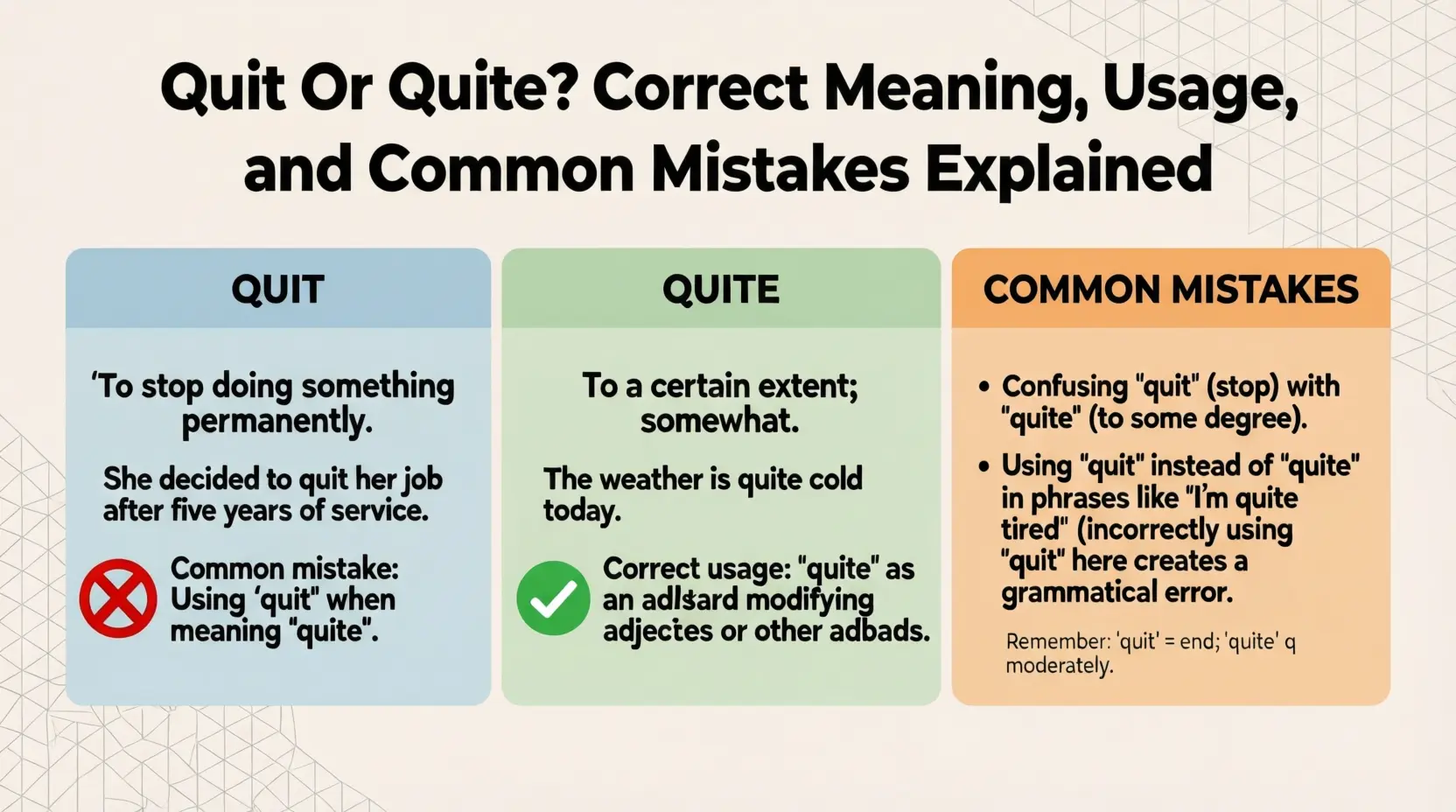
Some English words look very similar but have completely different meanings. “Quit or quite” is one of the most confusing word pairs for learners. Both words sound almost the same, but using the wrong one can change the meaning of a sentence. That is why many people search online for quit or quite.
This confusion often appears in emails, exams, social media posts, and professional writing. For example, many people write “I quite my job”, which is wrong. The correct sentence is “I quit my job.” One small letter can create a big mistake.
This article explains quit and quite in very simple English. You will learn the quick answer, meanings, word origins, British vs American usage, common mistakes, real-life examples, Google usage trends, comparison tables, FAQs, and expert tips.
By the end, you will clearly know when to use quit and when to use quite—with confidence.
Quit or Quite – Quick Answer
Quit = to stop or leave something
Quite = very / fairly / a lot
Easy Examples
- I quit my job.
- She is quite happy today.
👉 Quit = verb (action)
👉 Quite = adverb (degree or intensity)
What Does “Quit” Mean? (Simple Explanation)
Quit means to stop doing something or to leave something.
It is often used with:
- jobs
- habits
- games
- activities
Examples
- He quit smoking.
- She quit her job.
- I will quit the game.
👉 Quit always shows an action.
What Does “Quite” Mean? (Simple Explanation)
Quite means very, fairly, or a lot.
It is used to make an adjective or adverb stronger.
Examples
- The movie is quite good.
- He is quite tall.
- I am quite tired today.
👉 Quite shows degree, feeling, or intensity.
Quit vs Quite – Part of Speech Difference
This difference makes everything clear.
Quit
- Part of speech: Verb
- Shows action
Quite
- Part of speech: Adverb
- Shows intensity or degree
Quick Comparison Table
| Word | Part of Speech | Meaning |
| Quit | Verb | Stop / Leave |
| Quite | Adverb | Very / Fairly |
The Origin of Quit or Quite
Origin of “Quit”
- Comes from the French word quiter
- Meaning: to free or leave
- Later adopted into English
Origin of “Quite”
- Related to the Latin word quietus
- Meaning: completely or fully
- Over time, it came to mean “very”
👉 These words have different origins, which explains their different meanings.
British English vs American English Usage
Good news:
There is no difference between British and American English for quit and quite.
Usage Comparison Table
| Feature | British English | American English |
| Quit | Same | Same |
| Quite | Same | Same |
| Meaning | Same | Same |
Examples:
- UK: He quit his job.
- US: He quit his job.
Which One Should You Use? (Audience-Based Advice)
Use Quit when:
- You mean stop or leave
- You talk about actions
Examples:
- quit a job
- quit smoking
- quit school
Use Quite when:
- You describe degree or feeling
- You mean very or fairly
Examples:
- quite easy
- quite happy
- quite difficult
Simple Rule
👉 Stop or leave = quit
👉 Very or fairly = quite
Common Mistakes with Quit or Quite
Mistake 1
❌ I quite my job
✅ I quit my job
Mistake 2
❌ She is quit tired
✅ She is quite tired
Mistake 3
❌ He will quite smoking
✅ He will quit smoking
👉 Most mistakes happen because the words look similar.
Quit or Quite in Everyday Life
In Emails
- I have decided to quit my position.
- I am quite busy today.
In School
- He quit the team.
- The exam was quite easy.
On Social Media
- I finally quit junk food 💪
- This place is quite beautiful 😍
In News
- The minister quit his role.
- The weather is quite cold today.
Quit or Quite in Professional Writing
Business
- She quit the company last year.
- The project is quite successful.
Reports
- Many workers quit due to stress.
- The results were quite surprising.
🚫 Never replace quit with quite in formal writing.
Quit or Quite / Google Trends & Usage Data
Search data shows:
- Quit is often searched with jobs, habits, and lifestyle topics.
- Quite is often searched by learners confused about grammar.
Countries with High Searches
- United States
- United Kingdom
- India
- Pakistan
👉 This confusion is very common for ESL learners worldwide.
Quit vs Quite – Side-by-Side Comparison Table
| Feature | Quit | Quite |
| Meaning | Stop / Leave | Very / Fairly |
| Part of speech | Verb | Adverb |
| Shows action | Yes | No |
| Shows feeling | No | Yes |
| Example | Quit job | Quite happy |
Easy Trick to Remember the Difference
👉 Quit has T → Terminate (stop)
👉 Quite has E → Extra (very)
This trick helps in exams and fast writing.
Practice Sentences (Try It Yourself)
Fill in the blanks:
- He decided to ___ smoking.
- The movie was ___ interesting.
- She ___ her job last year.
Answers
- quit
- quite
- quit
FAQs:
1. Is “quit” present or past tense?
“Quit” is used for both present and past.
2. Can “quite” mean completely?
Yes, sometimes in British English.
3. Are quit and quite interchangeable?
No. They have different meanings.
4. Which word is used more?
Quit for actions, quite for description.
5. Are these common exam mistakes?
Yes, very common.
6. Can “quite” be used with verbs?
No. It modifies adjectives or adverbs.
7. Is one word more formal?
No. Both are neutral and professional.
Conclusion:
The confusion between quit or quite is very common, but the rule is simple. Quit means to stop or leave something, while quite means very or fairly. They sound similar, but their meanings and uses are completely different. Both British and American English follow the same rules, so you can use them confidently anywhere.
If your sentence talks about an action like leaving a job or stopping a habit, use quit. If your sentence describes a feeling, level, or quality, use quite. Understanding this small difference will greatly improve your writing, speaking, and exam performance.
Mastering simple word pairs like this makes your English clearer, stronger, and more professional.
Discover More Article:
Practises or Practices? The Complete Guide to Correct Spelling, Meaning, and Usage

I am an Emily Carter Brooks U.S.A based linguistics writer known for my clear, reader-friendly explanations of English grammar and vocabulary differences. I have contributed to multiple online language resources and specializes in spelling variations, pronunciation confusion, and British vs American English comparisons. I believes that learning English should be practical, engaging, and stress-free.