Small English words often create big confusion. One of the most searched grammar questions is “onto or into?” These two short prepositions look easy, but many learners and even native speakers use them incorrectly. People search for onto or into because both words describe movement, and both can sound correct in similar sentences. This makes it hard to choose the right one.
The confusion usually appears in daily writing emails, exams, social media posts, and even news articles. For example, should you say “She jumped onto the pool” or “She jumped into the pool”? One sentence makes sense, the other does not. The problem is not spelling. The problem is meaning.
This article clears that confusion in a simple way. You will learn the exact difference between onto and into, where they come from, how British and American English use them, common mistakes to avoid, and real-life examples.
You will also see usage tables, FAQs, and professional advice so you never get confused again.
Onto or Into – Quick Answer
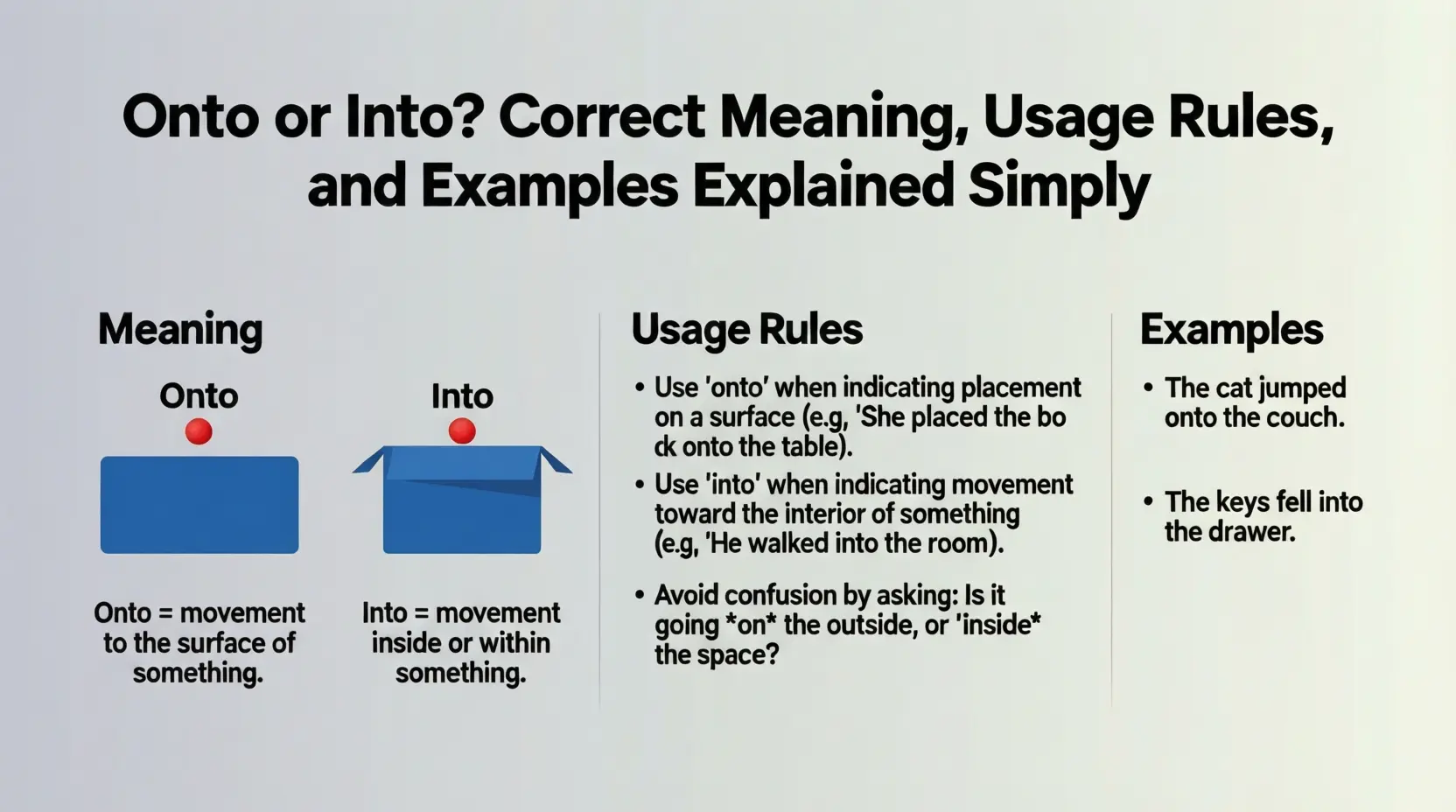
Onto means movement to a surface.
Into means movement inside something.
Easy Examples
- The book fell onto the floor.
- The book fell into the box.
Rule:
👉 On top = onto
👉 Inside = into
What Does “Onto” Mean? (Simple Explanation)
Onto shows movement from one place to a surface.
It answers the question: Where did it land?
Examples
- The child climbed onto the bed.
- The bird flew onto the tree branch.
- He poured water onto the ground.
If something ends up on top of something, onto is correct.
What Does “Into” Mean? (Simple Explanation)
Into shows movement from outside to inside something.
It answers the question: Did it go inside?
Examples
- She walked into the room.
- The keys fell into the bag.
- He jumped into the pool.
If something ends up inside, always use into.
Physical Movement vs Abstract Meaning
This is where many learners get confused.
Physical Movement
- Walked into the house
- Jumped onto the table
Abstract Meaning (Only “Into” Works)
Into is also used for ideas, feelings, and interests.
Examples:
- She is into music.
- He got into trouble.
- They went into business together.
🚫 Onto is NOT used for abstract ideas.
The Origin of Onto or Into
Both words come from Old English.
Origin of “Into”
- Comes from in + to
- Shows movement inward
- Used for over 1,000 years
Origin of “Onto”
- Comes from on + to
- Shows movement to a surface
- Became common later
There is no spelling debate here. Both are correct words with different meanings.
Onto vs On To – Important Difference
Many people confuse onto with on to.
Onto (One Word)
Used for movement to a surface.
- He jumped onto the chair.
On to (Two Words)
Used for progress or moving forward.
- Let’s move on to the next topic.
🚫 These are not the same.
British English vs American English Usage
There is no spelling difference in British or American English.
Both use:
- onto
- into
Usage Comparison Table
| Feature | British English | American English |
| Spelling | Same | Same |
| Grammar rule | Same | Same |
| Spoken style | Slightly formal | Slightly casual |
Examples:
- UK: He stepped into the lift.
- US: He stepped into the elevator.
Which One Should You Use? (Audience-Based Advice)
For US Audience
Use clear physical meaning:
- Surface → onto
- Inside → into
For UK / Commonwealth
Same rule applies. No difference.
For Global Writing
Always choose the word based on final position.
Golden Tip:
Ask yourself: Where does it end?
Common Mistakes with Onto or Into
Mistake 1
❌ She jumped onto the water
✅ She jumped into the water
Mistake 2
❌ He climbed into the roof
✅ He climbed onto the roof
Mistake 3
❌ Put the files onto the folder
✅ Put the files into the folder
Onto or Into in Daily Life
In Emails
- Please enter your details into the form.
- Place the document onto my desk.
In Schools
- The teacher walked into the class.
- The student climbed onto the chair.
On Social Media
- I’m really into fitness 💪
- He jumped onto the stage 🎤
In News
- Protesters climbed onto the building.
- The suspect ran into the tunnel.
Onto or Into in Technology & Business
Technology
- Upload the file into the system.
- Drag the image onto the screen.
Business
- He got into marketing.
- The company moved into new markets.
🚫 Never use onto for careers or fields.
Onto or Into /Google Trends & Usage Data
Search trends show “into” is searched more than “onto.”
Why?
- Into is used physically and abstractly.
- Onto is mostly physical.
High Search Countries
- United States
- United Kingdom
- India
- Pakistan
This shows learners worldwide struggle with this topic.
Onto vs Into – Side-by-Side Comparison Table
| Feature | Onto | Into |
| Final position | On a surface | Inside |
| Physical use | Yes | Yes |
| Abstract use | No | Yes |
| Common errors | Many | Fewer |
| Example | Jumped onto bed | Walked into room |
Practice Sentences (Try Yourself)
Choose the correct word:
- He threw the ball ___ the box.
- She climbed ___ the ladder.
- The cat ran ___ the house.
Answers:
- into
- onto
- into
FAQs:
1. Is “onto” always one word?
Yes. Onto is one word.
2. Can “into” mean interest?
Yes. Example: I’m into art.
3. Is “on to” the same as “onto”?
No. Different meaning and usage.
4. Which is correct: get onto the bus or into the bus?
Both are used, but onto is more common.
5. Can I use onto with emotions?
No. Only into works.
6. Are these tested in exams?
Yes. Very common grammar question.
7. Which one is more formal?
Both are neutral and correct.
Conclusion
Understanding the difference between onto or into is easier than it seems. The key is knowing where the movement ends. If something moves to a surface, use onto. If it moves inside, use into. There is no spelling difference between British and American English, which makes these rules universal.
Many mistakes happen because learners focus on the verb instead of the final position. Once you change that habit, your English becomes clearer and more confident. From emails and exams to news writing and social media, using the correct preposition improves your message and avoids confusion.
Small grammar rules like this build strong language skills. Master onto and into, and you remove one more obstacle from your English journey.

I hold a degree in English Literature and Linguistics and have worked extensively on educational blogs, comparison websites, and digital learning platforms. My writing focuses on simplifying complex language rules, highlighting British vs American English differences, and providing practical examples for everyday usage.