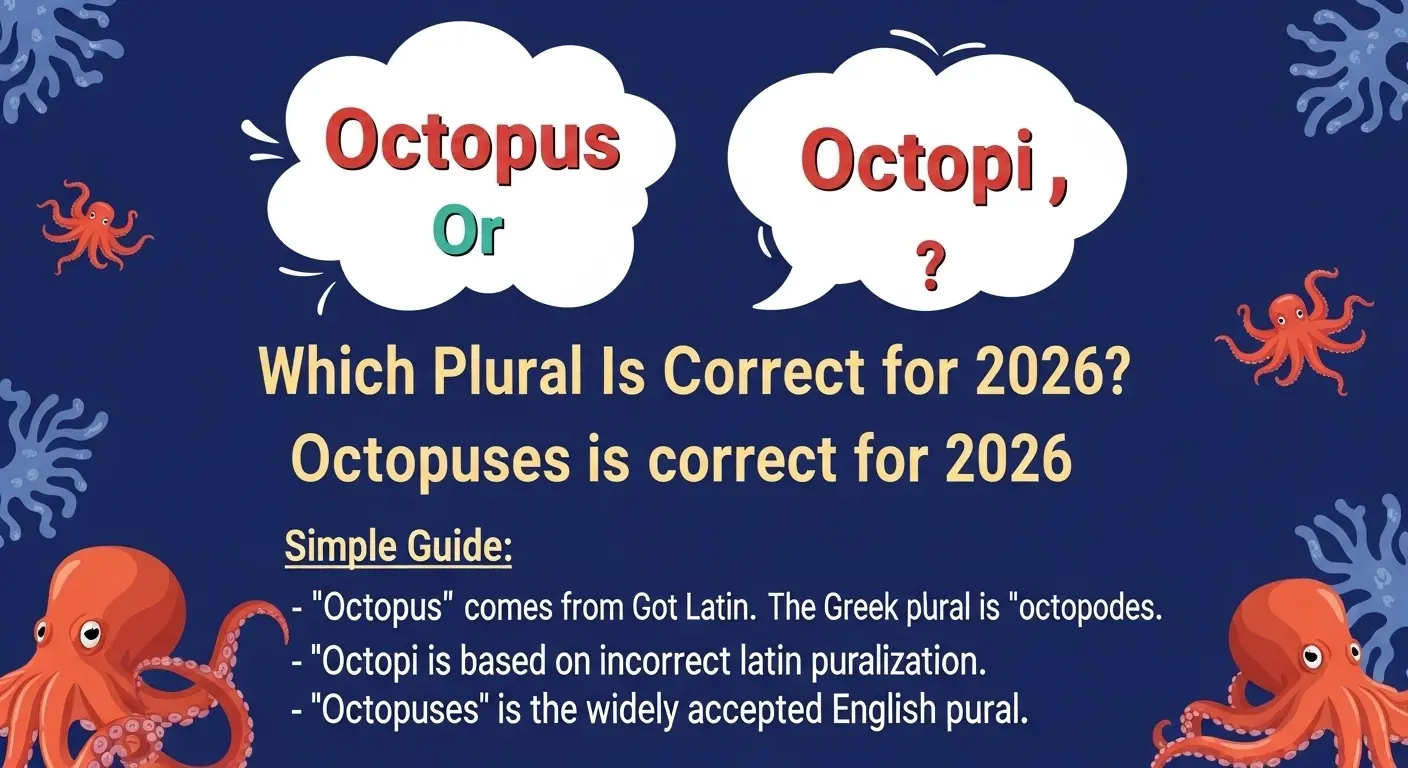
Have you ever paused while writing and wondered: is it octopus or octopi? You’re not alone. This is one of the most searched grammar questions online. Many people feel unsure because both words appear in books, blogs, and even classrooms.
The confusion comes from language history. English borrows words from many languages. Sometimes we keep the original plural form, and sometimes we don’t. With octopus, things get tricky because people assume it follows Latin rules but it actually doesn’t.
This article clears up that confusion. You will learn the correct plural form, why the mistake happens, and how to use the word properly in real life. If you’re a student, writer, or content creator, this guide will help you choose the right word with confidence.
Let’s make it simple and clear.
Octopus or Octopi – Quick Answer
Correct plural: octopuses
Also accepted (less common): octopodes
Incorrect (but widely used): octopi
Examples:
- ✅ I saw three octopuses at the aquarium.
- ❌ I saw three octopi at the aquarium.
Why?
Octopus comes from Greek, not Latin. So it should not follow Latin plural rules.
The Origin of Octopus or Octopi
The word octopus comes from the Greek word “oktōpous”, meaning “eight-footed.”
- oktō = eight
- pous = foot
In Greek, the correct plural would be octopodes (pronounced ok-TOP-uh-deez). This form is correct but rarely used in modern English.
So where did octopi come from?
People assumed octopus was a Latin word. In Latin, words ending in -us often change to -i in plural form (like cactus → cacti). But this rule does not apply here because octopus is not Latin.
That’s why octopi is technically incorrect, even though many people still use it.
British English vs American English Spelling
Unlike many words, octopus does not change between British and American English.
Both use:
- octopus (singular)
- octopuses (plural)
Comparison Table
| Form | British English | American English | Correct? |
| Octopus | ✔️ | ✔️ | Yes |
| Octopuses | ✔️ | ✔️ | Yes |
| Octopi | ⚠️ Used informally | ⚠️ Used informally | No (technically) |
| Octopodes | Rare | Rare | Yes (formal/Greek) |
Key Point:
There is no regional difference. The confusion is about grammar, not geography.
Which Spelling Should You Use?
For American English users:
Use octopuses. It is standard and widely accepted.
For British / Commonwealth users:
Also use octopuses. It is the safest and most correct choice.
For global or online writing:
Always choose octopuses. It avoids confusion and looks professional.
When to use “octopodes”:
- Academic writing
- Linguistic discussions
- Rare or formal contexts
Avoid using “octopi” if:
- You are writing professionally
- You want to be grammatically correct
Common Mistakes with Octopus or Octopi
Here are the most frequent errors:
1. Using “octopi” as the correct plural
❌ Incorrect: Many octopi live in this tank.
✅ Correct: Many octopuses live in this tank.
2. Assuming all “-us” words become “-i”
Not true.
Examples:
- Cactus → Cacti (Latin)
- Octopus → Octopuses (Greek origin)
3. Mixing forms in one sentence
❌ I saw octopi and octopuses.
✅ I saw octopuses.
4. Overusing “octopodes”
It’s correct but sounds too formal in daily writing.
Octopus or Octopi in Everyday Examples
In Emails:
- “We added two new octopuses to the aquarium exhibit.”
In News:
- “Scientists discovered rare octopuses in deep-sea waters.”
On Social Media:
- “Look at these cute baby octopuses!”
In Formal Writing:
- “The study observed multiple octopuses in controlled environments.”
In Casual Speech:
People may say octopi, but it’s better to use octopuses.
Octopus or Octopi – Google Trends & Usage Data
Search trends show interesting patterns:
- “Octopuses” is the most used and accepted form worldwide.
- “Octopi” is still popular, especially in casual searches.
- “Octopodes” is very rare and mostly used in academic contexts.
By Region:
- USA & UK: Prefer octopuses
- Global internet users: Often search for octopi due to confusion
Context Use:
- Education & science → octopuses
- Casual blogs & memes → octopi
Key Insight:
People search “octopus or octopi” because they want clarity. The correct answer is simple: use octopuses.
Comparison Table: Octopus vs Octopi
| Feature | Octopus | Octopuses | Octopi | Octopodes |
| Type | Singular | Plural | Plural | Plural |
| Origin | Greek | English form | Misapplied Latin | Greek |
| Correctness | ✔️ | ✔️ | ❌ (technically) | ✔️ |
| Usage Level | Common | Very common | Informal | Rare |
FAQs:
1. Is “octopi” ever correct?
No. It is widely used but grammatically incorrect.
2. What is the correct plural of octopus?
The correct plural is octopuses.
3. Why do people say octopi?
They think octopus is a Latin word and apply Latin rules.
4. Is “octopodes” better than “octopuses”?
It is correct but too rare for everyday use.
5. Which form should I use in writing?
Use octopuses in all professional and academic writing.
6. Do dictionaries accept “octopi”?
Some list it as “common usage,” but not as the correct form.
7. Is there a difference between UK and US usage?
No. Both prefer octopuses.
8. Can I use octopi in casual speech?
Yes, but it’s better to use octopuses for accuracy.
9. Why is English so confusing here?
Because it borrows words from different languages with different rules.
Conclusion:
The debate between octopus and octopi is a classic example of language confusion. At first glance, octopi seems correct because many English words follow Latin plural rules. But the truth is simple: octopus comes from Greek, not Latin. That means the correct plural form is octopuses.
While octopi is widely used in casual speech and online content, it is not technically correct. If you want to write clearly and professionally, always choose octopuses. It is accepted in both British and American English and works in every context from emails to academic writing.
The form octopodes is also correct, but it is rare and sounds too formal for daily use. So, for most situations, you don’t need to worry about it.
In short, if you remember one rule, let it be this:
Use “octopuses” and you’ll always be right.

I hold a degree in English Literature and Linguistics and have worked extensively on educational blogs, comparison websites, and digital learning platforms. My writing focuses on simplifying complex language rules, highlighting British vs American English differences, and providing practical examples for everyday usage.