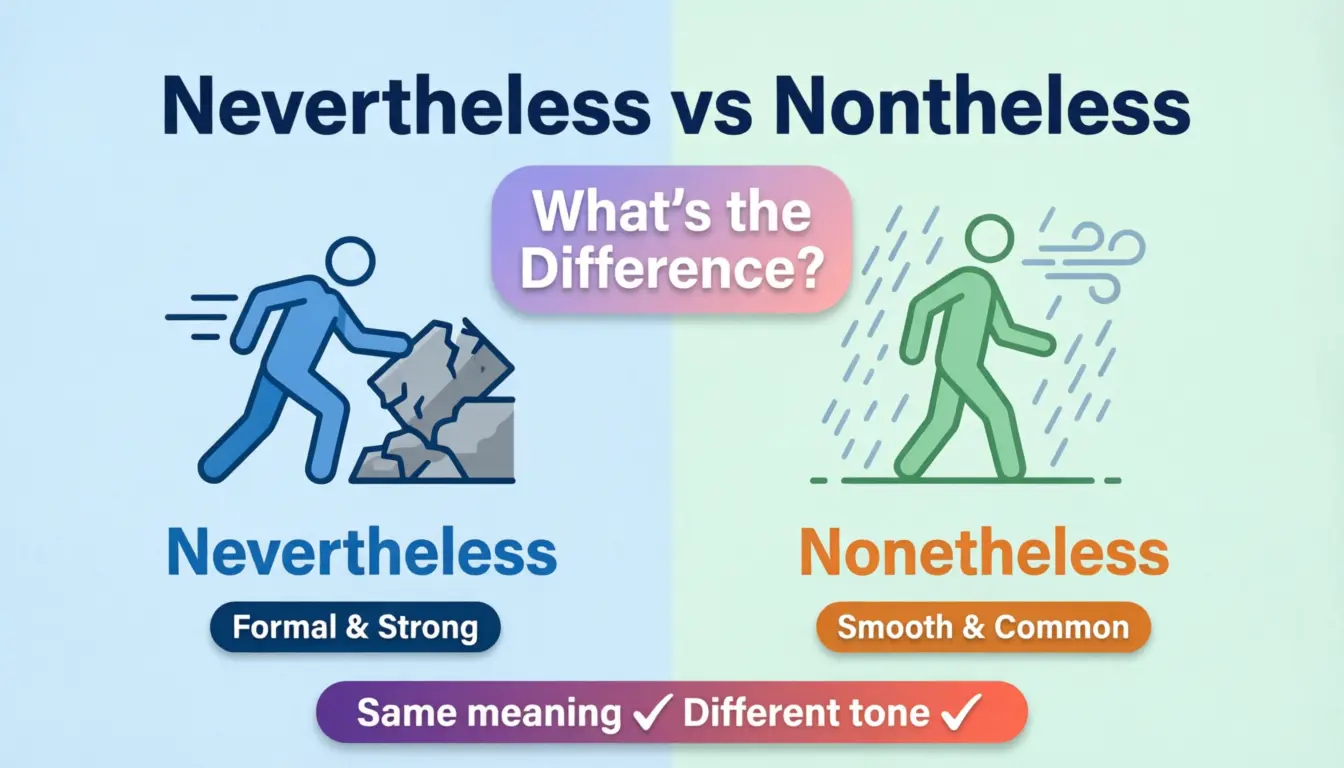
“Nevertheless” is used to show contrast or despite something that was said before, while “nonetheless” means the same but is often used in a slightly more formal or concise way.
“Nevertheless” and “nonetheless” look almost the same. They sound similar too. That is why many writers stop and ask: which one is correct?
The short answer is simple: both are correct.
People often search for “nevertheless or nonetheless” because they want to know if one word is better, more formal, or more correct. Some think one is British and the other is American. Others wonder if they can use them in essays, emails, or business writing.
This confusion happens because both words have the same meaning. They both connect two ideas and show contrast. For example, you may talk about a problem, but then show that something still happened.
Example:
- The weather was bad; nevertheless, we went outside.
- The weather was bad; nonetheless, we went outside.
Both sentences are correct.
In this guide, you will learn the difference between nevertheless and nonetheless, where they came from, how they are used, common mistakes, and which one fits your writing best.
Nevertheless or Nonetheless – Quick Answer
Nevertheless and nonetheless mean the same thing.
They both mean:
In spite of that
Even so
Still
They are used to show contrast.
Examples:
- The test was hard. Nevertheless, she passed.
- The test was hard. Nonetheless, she passed.
Both work the same way.
Quick comparison:
| Word | Meaning | Formality | Common Use |
| Nevertheless | Despite that | Formal | Academic, business |
| Nonetheless | Despite that | Formal to neutral | General writing |
Simple rule:
Use nevertheless if you want a slightly more formal tone.
Use nonetheless if you want smoother, modern flow.
The Origin of Nevertheless or Nonetheless
Both words are very old.
Nevertheless comes from three words:
- never
- the
- less
Over time, they joined into one word.
Its meaning became: not less true because of that.
Example idea:
It was risky. Nevertheless, they tried.
This word has been used in English since the 14th century.
Nonetheless also comes from three words:
- none
- the
- less
Its meaning is very close: not weaker or smaller because of that.
It became common later than “nevertheless.”
Why do both exist?
English often keeps similar words from history. Both survived because both are useful.
That is why today they still mean almost the same thing.
British English vs American English Spelling
This is where many people get confused.
Unlike words like “color” and “colour,” nevertheless and nonetheless do not change spelling in British or American English.
The spelling stays the same.
That means:
- British English uses nevertheless
- American English uses nevertheless
- British English uses nonetheless
- American English uses nonetheless
No spelling change.
The real difference is style, not spelling.
British writing often uses nevertheless more in formal writing.
American writing uses both, but nonetheless sounds a little more natural in modern speech.
Comparison Table
| Type | British English | American English |
| Formal writing | Nevertheless (common) | Nevertheless (common) |
| Casual writing | Nonetheless | Nonetheless |
| Spelling change? | No | No |
So, this is not a spelling issue. It is a style choice.
Which Spelling Should You Use?
Choose based on your audience.
If your audience is in the US
Use either word.
But nonetheless may sound more natural in blogs and online writing.
Example:
The plan was expensive. Nonetheless, it worked.
If your audience is in the UK
Use either word.
But nevertheless often feels stronger and more formal.
Example:
The road was closed. Nevertheless, traffic continued.
If your audience is global
Pick one and stay consistent.
Good rule:
- Formal document → Nevertheless
- Blog or simple content → Nonetheless
Professional advice:
If you are writing academic work, legal content, or business reports, choose nevertheless.
If you are writing social content or modern articles, choose nonetheless.
Common Mistakes with Nevertheless or Nonetheless
Here are common mistakes.
1. Using both together
Wrong:
The project failed, nevertheless nonetheless we learned.
Correct:
The project failed. Nevertheless, we learned.
2. Wrong punctuation
Wrong:
It was raining nevertheless we left.
Correct:
It was raining; nevertheless, we left.
Correct:
It was raining. Nonetheless, we left.
3. Using them with no contrast
Wrong:
I like pizza. Nevertheless, it tastes good.
No contrast here.
Correct:
I was full. Nevertheless, I ate pizza.
4. Thinking one is incorrect
Wrong idea:
“Nonetheless” is not real English.
Truth:
Both are correct.
5. Overusing them
Bad:
It was cold. Nevertheless, windy. Nevertheless, dark.
Better:
It was cold, windy, and dark. Still, we walked.
Nevertheless or Nonetheless in Everyday Examples
Here is how people use them in real life.
In Emails
The budget is tight. Nevertheless, we can finish the project.
The schedule changed. Nonetheless, the meeting will happen.
In News Writing
The company faced losses. Nevertheless, it grew this year.
The storm was strong. Nonetheless, flights continued.
On Social Media
I was tired. Nonetheless, gym time.
The movie was long. Nevertheless, I loved it.
In Formal Writing
The study had limits. Nevertheless, the results were useful.
The data was small. Nonetheless, it showed clear patterns.
In Daily Speech
It’s late. Nevertheless, let’s go.
I’m busy. Nonetheless, I can help.
Nevertheless or Nonetheless – Google Trends & Usage Data
Search interest for “nevertheless or nonetheless” is steady because writers often compare them.
Usage patterns show:
- Nevertheless is more common in academic writing.
- Nonetheless is common in journalism and online content.
Country trends:
| Country | More Common Word |
| USA | Nonetheless |
| UK | Nevertheless |
| Canada | Both |
| Australia | Nevertheless |
| India | Both |
Context trends:
| Context | Preferred Word |
| Academic writing | Nevertheless |
| News writing | Nonetheless |
| Business writing | Nevertheless |
| Blogs | Nonetheless |
| Social media | Nonetheless |
This shows both are alive and useful.
Comparison Table: Nevertheless vs Nonetheless
| Feature | Nevertheless | Nonetheless |
| Meaning | Despite that | Despite that |
| Correct word? | Yes | Yes |
| Formality | More formal | Slightly less formal |
| Academic use | High | Medium |
| Casual use | Medium | High |
| US use | Common | Very common |
| UK use | Very common | Common |
FAQs
Is it nevertheless or nonetheless correct?
Both are correct.
Do nevertheless and nonetheless mean the same thing?
Yes. Their meaning is almost identical.
Is nevertheless more formal?
Yes. It often sounds more formal.
Is nonetheless more modern?
Yes. Many modern writers prefer it.
Can I use them in essays?
Yes. Both are good for essays.
Is there a grammar difference?
No. They work the same way.
Can I start a sentence with nevertheless?
Yes.
Example:
Nevertheless, we moved forward.
Can I start a sentence with nonetheless?
Yes.
Example:
Nonetheless, the work continued.
Which is better for business writing?
“Nevertheless” is often the safer choice.
Conclusion
The debate over nevertheless or nonetheless is not about right or wrong. Both words are correct, clear, and useful. The main difference is style.
If you want a formal and classic tone, nevertheless is often the better choice. It fits well in academic papers, reports, and business writing. It sounds strong and polished.
If you want a lighter and more modern tone, nonetheless is a smart option. It works well in blogs, articles, and everyday writing. It feels smooth and natural.
The good news is that readers understand both words the same way. They both show contrast and help connect ideas clearly.
Your best choice depends on your audience. Writing for the US? “Nonetheless” may feel more natural. Writing for the UK or formal readers? “Nevertheless” may fit better.
In the end, the key is simple: pick the word that matches your tone, use it correctly, and stay consistent in your writing.

I hold a degree in English Literature and Linguistics and have worked extensively on educational blogs, comparison websites, and digital learning platforms. My writing focuses on simplifying complex language rules, highlighting British vs American English differences, and providing practical examples for everyday usage.