English has many small words that can confuse learners. One common question is “mis or miss.” Both words sound similar, but they have very different meanings. People search for mis or miss to avoid mistakes in writing, emails, social media, and professional documents.
The confusion usually appears when people want to talk about failure, absence, or titles. For example: Did you mis the train or did you miss it? One is correct, the other is wrong but which one?
This article explains mis and miss in very simple English. You will get a quick answer, word origin, British vs American usage, common mistakes, real-life examples, Google trends, comparison tables, FAQs, and professional advice.
By the end, you will confidently know when to use mis and when to use miss.
Mis or Miss – Quick Answer
- Mis → prefix, means wrongly or badly
- Miss → verb or title, means fail to catch or address a woman
Examples
- I misunderstood the instructions.
- I missed the bus.
- Miss Smith is our teacher.
👉 Mis = prefix
👉 Miss = word / title / verb
What Does “Mis” Mean? (Simple Explanation)
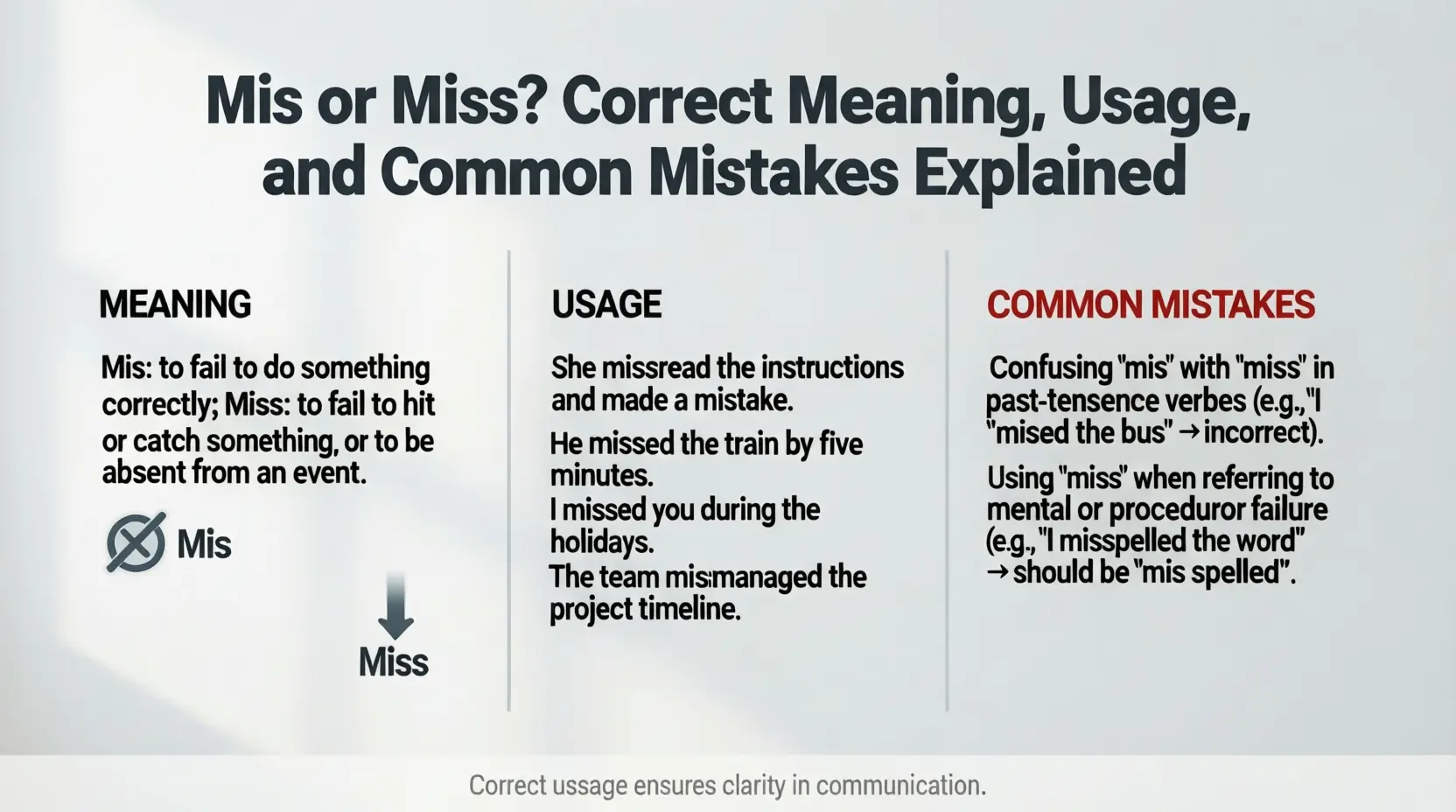
Mis is not a full word. It is a prefix added to verbs to show something went wrong or was done badly.
Examples
- Misspell → spell wrongly
- Misunderstand → understand wrongly
- Misplace → place in the wrong location
👉 Mis changes the meaning of the base word.
What Does “Miss” Mean? (Simple Explanation)
Miss is a full word. It can be:
- Verb: fail to catch, reach, or attend
- I missed the train.
- He missed the goal.
- I missed the train.
- Title: polite address for a woman
- Miss Johnson is here.
- Miss Johnson is here.
- Feeling: feel the absence of someone
- I miss my family.
- I miss my family.
Mis vs Miss – Part of Speech Difference
| Word | Part of Speech | Meaning |
| Mis | Prefix | Wrongly / Badly |
| Miss | Verb / Title / Noun | Fail, absence, or polite address |
The Origin of Mis or Miss
Origin of “Mis”
- Comes from Old English mis-
- Meaning: wrongly, badly
- Used as a prefix for centuries
Origin of “Miss”
- Comes from Middle English misse
- Meaning: fail or loss
- Title “Miss” came from “Mistress”
👉 Different origins explain the different uses.
British English vs American English Usage
There is no spelling difference between British and American English for mis or miss. Both are standard.
Comparison Table
| Feature | British English | American English |
| Mis | Same | Same |
| Miss | Same | Same |
| Meaning | Same | Same |
| Verb / Prefix | Same | Same |
Examples:
- UK: I misread the instructions.
- US: I misread the instructions.
- UK: I missed the bus.
- US: I missed the bus.
Which One Should You Use?
- Use Mis → when adding to a verb to show wrong action
- miscalculate, misplace, misunderstand
- miscalculate, misplace, misunderstand
- Use Miss → when talking about failing to catch, absence, or addressing a woman
- I missed the meeting
- Miss Parker is my teacher
- I missed the meeting
Quick Rule
Ask yourself: Am I talking about something wrong, or failing/absence/title?
Common Mistakes with Mis or Miss
Mistake 1
❌ I mised the train.
✅ I missed the train.
Mistake 2
❌ I missunderstood.
✅ I misunderstood.
Mistake 3
❌ Mis Johnson is here.
✅ Miss Johnson is here.
Mis or Miss in Everyday Life
Emails
- I misread your message.
- I missed the meeting yesterday.
School
- I misspelled the word.
- I missed the class.
Social Media
- I mistagged the photo 😅
- I miss my friends 💕
News
- The team missed the target.
- He miscalculated the score.
Mis or Miss in Professional Writing
- Use mis for technical errors or reports
- The analyst miscalculated the numbers.
- The analyst miscalculated the numbers.
- Use miss for attendance, deadlines, or formal address
- She missed the deadline.
- Miss Thompson will join the call.
- She missed the deadline.
Mis or Miss / Google Trends & Popularity
Search data shows:
- Miss is searched more often because it is a common verb and title.
- Mis searches usually relate to grammar questions.
High Search Countries
- United States
- United Kingdom
- India
- Canada
This confirms worldwide confusion among English learners.
Mis vs Miss – Side-by-Side Comparison Table
| Feature | Mis | Miss |
| Meaning | Wrongly / Badly | Fail, absence, or title |
| Part of speech | Prefix | Verb / Title / Noun |
| Example 1 | misread | missed |
| Example 2 | misplace | miss |
| Usage | Grammar / verbs | Daily life, address, verbs |
Easy Trick to Remember the Difference
👉 Mis → part of a word, shows wrong action
👉 Miss → full word, shows absence, failure, or title
Think:
- Mis = mistake
- Miss = missing someone or something
Practice Sentences (Try Yourself)
Fill in the blanks:
- I ___ the bus this morning.
- She ___understood the instructions.
- ___ Parker is here.
Answers
- missed
- mis
- Miss
FAQs:
1. Is “mis” a full word?
No, it is a prefix.
2. Is “miss” only for women?
No, it is a verb too.
3. Can “mis” be used alone?
No. It is always attached to a verb.
4. Are both spellings correct?
Yes, both are correct but used differently.
5. Which is more common in daily English?
Miss is more common.
6. Can I mix mis and miss in one document?
No. Only mix if meaning is correct.
7. Does “miss” always show absence?
Mostly, yes, or it can be a title.
Conclusion:
The confusion between mis or miss is simple to solve. Mis is a prefix added to verbs to show something is done wrongly. Miss is a full word used as a verb for failure or absence, and as a title for women. There is no British vs American spelling difference; both are correct in all English forms.
To avoid mistakes, check your sentence carefully:
- Wrong action → mis
- Fail, absence, or title → miss
Understanding this small difference makes your writing clearer, professional, and error-free. Once you master mis vs miss, you can confidently write in emails, social media, reports, and exams without mistakes.
Read More Article:
Whelp or Welp – What’s the Correct Spelling and Usage?

I hold a degree in English Literature and Linguistics and have worked extensively on educational blogs, comparison websites, and digital learning platforms. My writing focuses on simplifying complex language rules, highlighting British vs American English differences, and providing practical examples for everyday usage.